By GREGORY ZELLER //
That was great, the whole Artemis II thing.
 Impressive technology, fantastic distance records, peak human ingenuity, above-and-beyond bravery, all clicking without a hitch – stubborn space toilets notwithstanding – straight through the made-for-TV Prime Time splashdown in the eastern Pacific.
The mission was an historic success and an early chapter in a longer play, so I do not disparage the cast and crew of Artemis II in any way. But it’s fair to say the neatly wrapped miniseries event, while innovative in form and function, dropped 50 years too late – and that it’s a brilliant example of the dumbing down of American culture.
The science was certainly not dumb. The 8.8 million-pound thrust of the mighty Space Launch System, the pinpoint functionality of the Orion capsule, the high-definition visuals, even the sleek style of Mission Control – less Gene Kranz’s Apollo 13 sweatshop than a futuristic Starship Enterprise bridge. All have come a long and likeable way.

Gregory Zeller: Give me some space.
And the human spirit remains undefeated. En route to setting the spaceflight-distance record (known record, discounting secret Mars missions and potential ET abductions), the unprecedentedly diverse crew displayed nonstop fortitude and plenty of joy, while a new generation of talented mission controllers kept everything five-by-five.
But there’s no escaping this gravity: It should’ve happened a half-century ago.
You can cheer it, because everything I said there about the advanced science and remarkable chutzpah is true. But understand exactly what we’re cheering: Artemis II went where many have gone before.
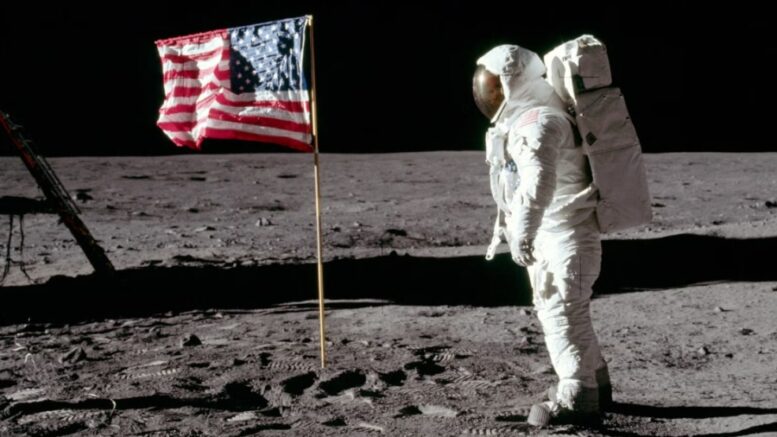
Including this intrepid crew, 28 astronauts have now orbited the Moon – 24 between 1968 and 1972, as part of NASA’s bold Apollo program. Twelve of those voyagers walked, drove and/or golfed on the dusty satellite.
Orbiting the Moon, therefore, is the equivalent of flying all the way to Disneyland and driving around the parking lot. A cosmic example of been there, done that, 50 years later.
The China National Space Administration’s Yutu-2 probe has been rolling around the Moon’s dark side since 2019, mapping topography and such (now history’s longest-operating lunar rover, for the record). Fully engaged in the race to return humans to the Moon, China is preparing to launch another lunar lander this Summer, to search for water ice hiding in craters.
Not boots on the ground (2030, China predicts), but certainly more wheels on the ground. Artemis II was great theater, sure, but Americans aren’t walking on the Moon again until 2028 at the earliest – so, yeah, the race is on.
When President Kennedy dared the nation’s best and brightest to put a man on the Moon by the end of the 1960s, it wasn’t because Earthmen had to go. It was an all-time-historic rallying cry, supercharging audacious ambition and supreme science and national pride at a moment when the nation sorely needed it.
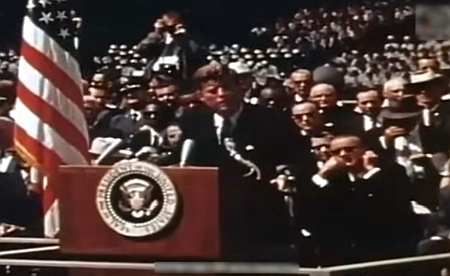
What your country can do for you: Kennedy didn’t just send men to the Moon — he sent the United States into the future.
In a country marked by civil unrest and economic disparity, in a world of international tensions and unpopular wars, it was something to believe in.
And it became an enormous practical benefit, too: integrated circuits, memory foam, air purifiers, cordless power tools, enriched infant formulas … all this and more spun out of the halcyon days of America’s ambitious space program. The Space Race’s effects on Long Island socioeconomics is certainly well-documented.
We went to the Moon. It was all-around awesome.
But we stopped right there – and that swelling national focus evaporated.
We kept going to space, of course. But instead of pressing onward and outward, “space exploration” became local. Territorial. Financial.
Boring.
Space Shuttles were cool for a while, until it was another mission to drop a satellite into orbit or fix a telescope in orbit or grow fungus in orbit or maybe just to orbit, before landing in California with all the excitement of the 6:29 p.m. pulling into Ronkonkoma.
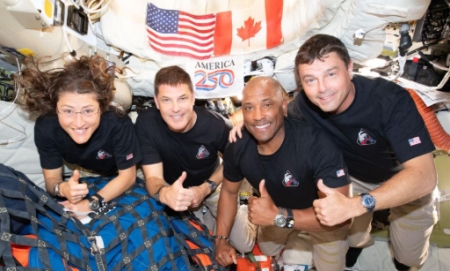
Away team: There’s no doubting the bravery of (from left) Mission Specialists Christina Koch and Jeremy Hansen, Pilot Victor Glover and Commander Reid Wiseman.
The International Space Station? Also amusing for a time, drumming up visions of Death Stars or maybe that highly functional ringed waystation from “2001: A Space Odyssey,” with a Hilton and everything – until it was evident that it wasn’t any of those things, just some modules and antennas spinning in, you know, orbit. And apparently, it smells like farts.
Now the shuttle fleet is unceremoniously retired and the ISS will follow in 2030, and other countries and private companies are sending up the newest (yawn) orbiters.
Commercial space travel has some exciting elements, including the intrigue of space tourism and spectacular visual effects (they sure do blow up a lot of drone ships). But even if you could afford a space ticket, almost six full decades from Neil Armstrong, the only place you’re going is … orbit.
Besides a few Mars rovers and (admittedly awesome) intergalactic telescopes, “space exploration” has become tethered since Apollo 17 crewmates Eugene Cernan and Harrison Schmitt lifted off from the Sea of Serenity: 15,000-plus low-orbit satellites, the occasional celebrity stunt.
As our space focus turned inward, so did our national focus – and not in any unifying way. And now here we are, 54 years later: Civil unrest. Economic disparity. International tensions. Unpopular wars.
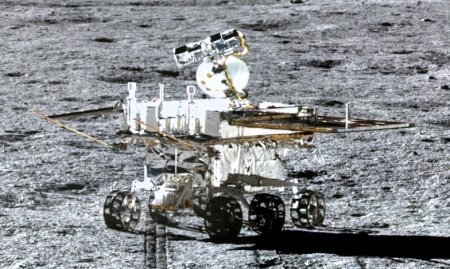
Eat my dust: China’s Yutu-2 rover has been conducting a surface-level exploration of the Moon’s dark side for nearly seven years.
And we’re trying to get to the Moon.
The Artemis II launch and landing drew millions of live viewers; millions more followed the 10-day mission via NASA’s highly innovative livestreaming channel. (Note to mainstream news media: Get with it or give up.)
It’s just too bad the fuss wasn’t over the first boots on Mars. That would seem an achievable, worthy plateau 50-odd years after Apollo – but human space exploration took that half-century off.
And somewhere in there, we were conditioned to accept less, much less, as “greatness.” Now, entire swaths of our gullible population gratefully slurp down whatever they’re given and believe whatever they’re told, science and ambition and common sense be damned.
This makes Artemis II a sensational triumph – not because it lengthens our grasp, but because it’s been so long since we reached.
There are many mind-blowing adventures ahead – including Artemis IV, which aims to put Americans back on the Moon (doing science mapped out by Stony Brook University scientist Timothy Glotch, which is awesome) within the next two years.
As early chapters go, Artemis II was a winner: exciting, emotional, visually spectacular. A worthy reboot, like a Hollywood movie made 20 years after the TV show was canceled.
Hopefully, it reinvigorates the fandom. Gets us thinking again. We surely do need it.
Gregory Zeller is the editor, publisher and COO of Innovate News Service.