By GREGORY ZELLER //
“Normal” is back, at least for now – but COVID-19 is far from finished.
 Variants are thriving, millions remain unvaccinated (and are getting sick, or worse) and COVID is getting smarter. Science has made spectacular progress over the last 18 months, but the work isn’t done yet.
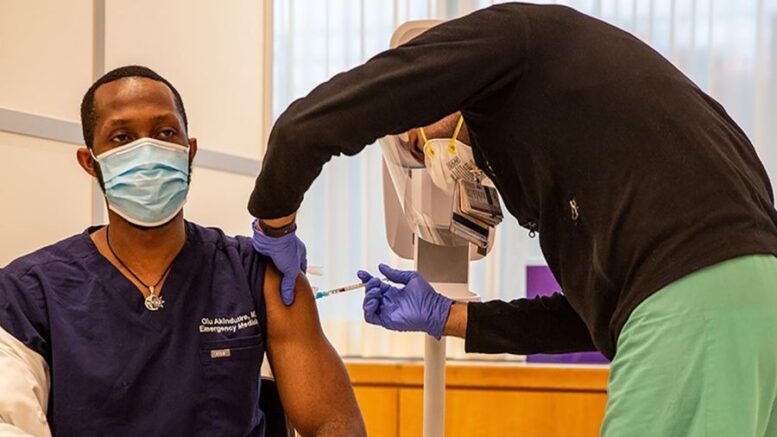
To that end, NYU Langone Hospital-Long Island, the Island base of NYU Langone Health, has initiated two critical COVID-19 vaccine studies – one to determine if the vaccinated can be re-infected, the other assessing the health risks of following one vaccine brand with a booster produced by another company.
The Mineola-based hospital is one of more than 40 nationwide sites participating in the Prevent COVID U Study, which in addition to assessing re-infection risks also aims to determine whether vaccinated people can still transmit the disease (the early word is yes, they can, particularly the nasty new Delta variant).
The Prevent COVID U Study is a function of the COVID-19 Prevention Network, focusing on the Moderna vaccine. NYU Langone-Long Island is currently enrolling volunteers between the ages of 18 and 29 for its contribution to the project, with a particular emphasis on university students, including those who haven’t been vaccinated.

Steven Carsons: Lots of work left to do.
“We know people who are vaccinated have a high degree of protection from the clinical disease,” noted Steven Carsons, director of the NYU Langone Hospital-Long Island Vaccine Center. “What we don’t know is if a vaccinated person might have low levels of the virus that can be transmitted to an unvaccinated person.”
Focusing the study on university students and others in the 18-29 age group makes the most sense, Carsons added, “since that is a socially mobile population.”
In the so-called “Mix and Match” study, the hospital will assess the safety of mixing one type of COVID-19 vaccine with a subsequent booster of a different type – chasing a Johnson & Johnson vaccination with a Moderna booster shot, for instance.
With Delta and other COVID variants emerging around the globe, the likelihood that vaccinated populations will at some point require a booster vaccine dose is increasing fast. And with current global supply lines shaky at best, and new COVID vaccines still moving through the pipeline, determining potential effects mixed vaccines may have on the immune system is suddenly paramount.
The “Mix and Match” study is funded by the National Institute of Allergy and Infectious Diseases. In this case, NYU Langone Hospital-Long Island is signing up previously unvaccinated participants ages 18 and up, with compensation of “approximately $700” per participant, the hospital said.
Like the Prevent COVID U Study, “Mix and Match” has dual purposes – and according to Carsons, NYU Langone-Long Island’s chief of rheumatology and a Department of Medicine professor at the NYU Long Island School of Medicine, determining the effects of mixing vaccines is actually secondary.
“The first goal of this study is to see if a booster vaccination is safe and (assess) its level of efficacy, so we know whether to potentially add a booster to the vaccination protocol,” Carsons told Innovate LI. “A second goal is to see if the same efficacy applies if the booster shot is a different make than the original vaccination.”