By GREGORY ZELLER //
Three new sustainable homes – and, potentially, an exciting new vertical market for the Long Island construction industry – are taking shape on Shinnecock Nation land.
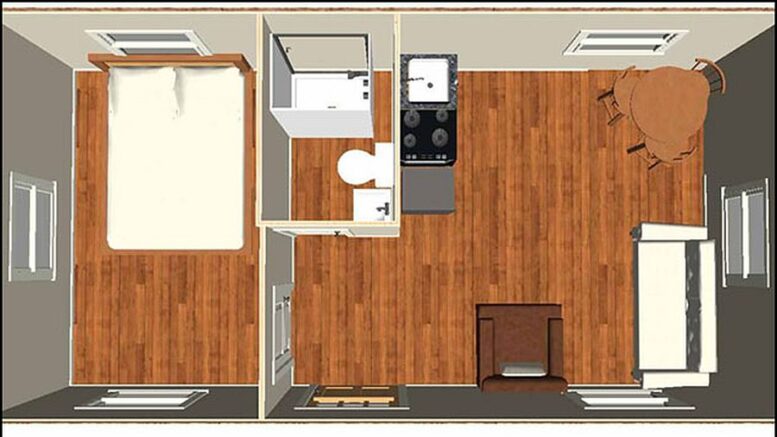
 Beginning Sept. 28, Selden-based business-development ace Dynamic Supplier Alignment will assemble three one-bedroom Emergency Housing Systems, designed and built by Riverhead-based Hunter Shelters, on Southampton land owned by the Native American nation.
The construction effort, part of the Shinnecock “Homeless Transitional Housing Development” effort, brings to fruition a purchase order the Native American nation placed in 2020, when it ordered two Hunter Systems units. “A bit more federal funding” has bumped that order up to three units, according to DSA founder and President Ron Tabbitas, and that’s just for starters.
While the three units will directly address a Shinnecock housing shortage, the nation, Hunter Shelters and Tabbitas all see the construction effort as a first step toward bigger things. Ultimately, as many as eight Hunter Shelters units may rise on Shinnecock land, Tabbitas said – and the construction likely won’t stop there.
“This is really the flagship,” the DSA president told Innovate Long Island. “Once we get this community up and running, it will become the model community – not just a housing program, but a complete jobs-creating, problem-solving program that starts by helping the Shinnecock deal with their housing scenario.”

Ron Tabbitas: Construction connection.
Such ambitions embody the big-picture idea conceived when DSA and Hunter Shelters first aligned their “tiny house” strategy with Eastern Suffolk BOCES in 2018.
The sturdy, energy-efficient lodges arrived on the heels of 2012’s Superstorm Sandy, with Hunter Shelters envisioning quick-build, long-term emergency housing units for displaced disaster-zone residents. When the manufacturer and DSA, its promoter and installation partner, saw the forest for the trees – an across-the-board, affordable solution for nationwide homelessness – they forged an alliance with BOCES to begin training future installers.
“The idea of the business model was to insert technology into education,” Tabbitas noted. “We wanted to show people in the construction trades these new technologies coming around the corner.
“One of the (BOCES) students happened to be a Shinnecock tribal member, and as we anticipated with this model, once he learned about the technology, he loved it,” the innovator added. “He saw the benefits and reported them to the nation.”
Shinnecock tribal leaders, in turn, “saw the utility and benefits,” according to Tabbitas, and quickly decided to incorporate the Hunter Shelters constructs into the nation’s Homeless Transitional Housing Development program. That led to the Summer 2020 purchase order and, eventually, next week’s supersized installation.
The three units set to rise on Shinnecock land have already been built, to a point: They’re “in pieces,” Tabbitas said, waiting at Hunter Shelters’ Riverhead manufacturing plant for delivery to the Southampton reservation. They mark a “2.0 version of the unit at BOCES,” according to the DSA founder, a “next generation that improves upon the original and incorporates new components.”
 Many of the changes are aesthetic. The original version, including the one on display at Eastern Suffolk BOCES’ Gary D. Bixhorn Technical Center, had a “utilitarian look,” Tabbitas noted, while the new versions “look more like a cabin.”
They also feature a new rubber roofing material with a 30-year lifespan and polyurethane structural panels by the U.S. affiliate of German manufacturer BASF; the panels can be tinted, creating colors “with a more residential nature,” Tabbitas added.
“The originals were emergency shelters designed in the aftermath of Superstorm Sandy,” he said. “The real push here was to make them more aesthetically pleasing.”
Aesthetics aside, the real real push is to position Hunter Shelters and DSA at the forefront of an entirely new regional and national construction industry. Hauppauge-based Carpenters Local 290, the worker union representing regional carpenters and other construction professionals, will be on-site during next week’s house-raising, documenting the proceedings with “start-to-finish video footage” that will soon make its way to other Native American nations with similar housing crunches, according to Tabbitas.
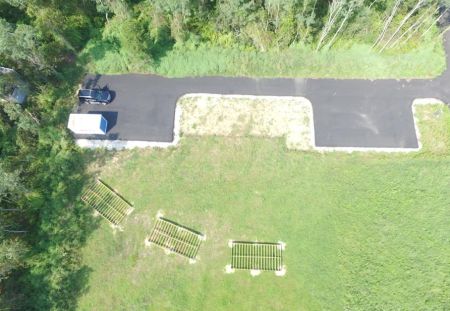
Coming soon: Three Hunter Shelters “tiny houses” will soon rise on this Shinnecock site.
“The union’s interest is to be able to collaborate with the Shinnecock Nation and have Shinnecock tribal members become union members, and ultimately be trained and certified to build Hunter Shelters as we scale it up to production,” he said. “The training would be in collaboration with BOCES, which has already introduced a first-level (Hunter Shelters) training program.”
The three sustainability-centered units – and possibly as many as eight, in one-, two- and three-bedroom configurations – will become a showroom, of sorts, highlighting their potential as an economic driver with positive implications for coast-to-coast housing and employment.
“The community will be shared with other (Native American) nations, giving them the opportunity to train people in how to build them,” Tabbitas said. “We’re creating a new breed of worker and we’re getting excitement back into the construction industry, which has been losing people – another reason the unions are showing interest.
“It starts with the Shinnecock,” he added. “But we’re really creating a new industry for Long Island.”