By GREGORY ZELLER //
Stony Brook University scientists have completed a comprehensive, months-long assessment of Long Island coastal waters. Unfortunately, the good news stops there.
 The Island’s bays and estuaries are rife with toxic algae blooms and oxygen-starved dead zones, the unavoidable ramifications of excessive nitrogen levels delivered by wastewater, which has flowed freely throughout a season of tropical storms and other heavy-rain events.
The Summer of 2021 nearly doubled Long Island’s average rainfall, according to SBU’s Gobler Laboratory, which combined internal data with information generated by the Long Island Sound Study – funded by the U.S. Environmental Protection Agency and the New York State Department of Environmental Conservation – to map the dramatic spread of bad water through the season.
Mahogany tides caused by Prorocentrum, rust tides caused by Cochlodinium, brown tides caused by Aureococcus, a red tide caused by Dinophysis and toxic blue-green algae blooms – commonly caused by Microcystis – set the tone. The map also depicts the emergence of several low-oxygen zones dangerous to marine life.
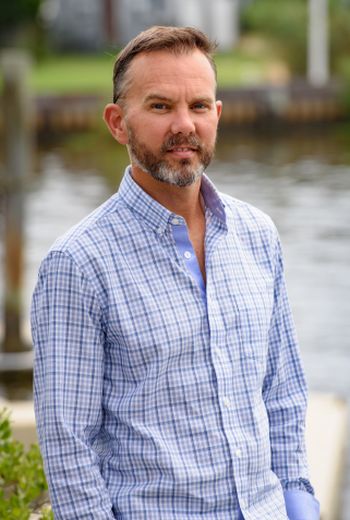
Christopher Gobler: A scary new normal.
As climate change continues to unfold, this could be the new normal – further bad news for Long Island, where mahogany tides and brown tides in June became “a harmful rust tide that continues today across Eastern Long Island,” according to Christopher Gobler, endowed chairman of coastal ecology and conservation at SBU’s School of Marine and Atmospheric Sciences.
“In between, a record-setting two dozen low-oxygen dead zones were identified from Great Neck to East Hampton, over 20 lakes and ponds were affiliated with toxic blue-green algae blooms, and fish kills (were reported) across another half-dozen sites,” Gobler said. “This has become the new normal as Long Island deals with a dual assault of climate change and excessive nitrogen loading.”
That rainwater-fueled “nitrogen loading,” carrying the chemical element from land to sea, sparks the harmful algae blooms and creates the dead zones. As a result, seagrass suffocates and regional scallop and clam fisheries go under – and the effects are felt worst in Suffolk, which has had more lakes with blue-green algal blooms than any other New York county.
One prime example of the crisis-level problem is a “mild rust tide” – caused by a bloom of the organism Cochlodinium polykrikoides – that generated dead zones around the East End and into the Long Island Sound following tropical storms Henri and Ida, neither of which was a direct hit on Long Island.
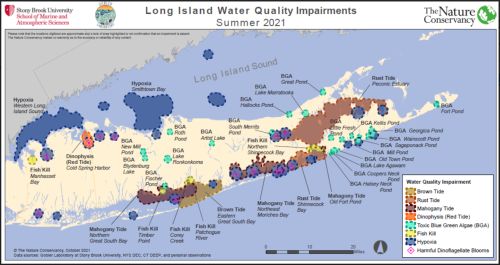
Off the charts: Mapping Long Island’s water-quality crisis.
Within the last two years, Nassau and Suffolk counties both completed “subwatershed studies” identifying residential wastewater as the Island’s largest source of nitrogen contamination. To that end, the Gobler Laboratory – which received project support from the Rauch Foundation and the Chicago Community Trust – recommends new government policies to mitigate nitrogen loading, including better onsite septic systems.
That can’t happen fast enough, according to Nature Conservancy New York Ocean Programs Director Carl LoBue, who said the extent of the problem and the need for new septic solutions are both abundantly clear.
“It has gotten to the point that we have to watch News 12 each week to see where it is safe to swim or fish,” LoBue said “The research findings are conclusive.
“We know how to fix this and it’s time to act,” the senior marine scientist added. “The longer we wait to fix our water quality problems, the longer it will take and the more expensive it will be.”