

By RICHARD MURDOCCO //
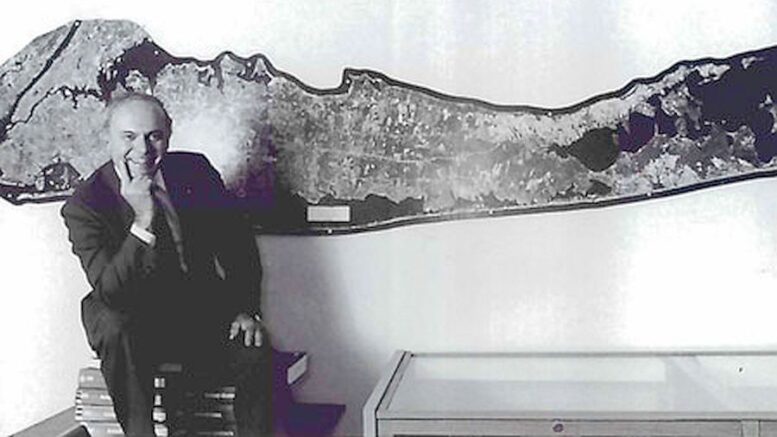
Lee E. Koppelman, the urban planner whose policies and plans shaped Long Island throughout the second half of the 20th Century, died on March 21. He was 94.
 Together with H. Lee Dennison, the first executive to be elected to lead a newly minted Suffolk County government, the planner worked to build the framework of the county from the ground up. Koppelman, who was then a landscape architect and civic leader in Hauppauge, was handpicked by Dennison to shape the then-blossoming locality’s administrative infrastructure from a shared desk that was housed within a dusty trailer.
From the preservation of the sweeping scenic farmland vistas that would eventually be seen by millions of visitors on the East End to ensuring that there would be clean drinking water each time parents turned on the tap faucet for their children, Koppelman’s lengthy and distinguished career touched every community across Long Island.
Koppelman was the director of the Suffolk County Planning Department from 1960 to 1988, a 28-year run across Republican and Democratic administrations that remains unmatched in today’s era of partisan appointments.
From 1965 to 2006, Koppelman served as the executive director of the Long Island Regional Planning Board. During that time, he authored two intricate, comprehensive plans that grappled with everything from the explosive suburban growth of the post-war era to the rumblings of a brewing environmental crisis due to Suffolk County’s lack of sewers.

Richard Murdocco: You can’t overstate Koppelman’s contributions to Long Island.
The studies captured the imagination of both the public and media, with his team’s findings often gracing the covers of Newsday.
Koppelman played a leading role in the preservation of Long Island’s open spaces and was an early supporter for the preservation of open space and protecting farmland in Suffolk County. Thanks to his efforts, Suffolk County became the first local government in the nation to establish a formal program to preserve farmland through the purchase of development rights, an innovative new concept at the time that other suburban localities later emulated.
His research highlighted the interrelationships between developmental policy and the fragility of the Long Island region’s sole source aquifer, which provides potable water to 3 million or so residents.
The footprint of his work was enshrined in “The Power Broker,” the 1974 Pulitzer Prize-winning biography of Robert Moses, where author Robert Caro noted the merits of the “young Lee Koppelman, a brilliant planner from Long Island.”
To Caro, Koppelman served as an informative source who spoke on the nuances of Long Island’s development, standing in stark contrast to Moses’ “build first, ask questions later” mentality.
For years, Koppelman’s personal copy of “The Power Broker” held a prominent spot on the planner’s bookshelf.
A third plan was later authored by Koppelman. While political squabbles at the time prevented its formal adoption, copies can still be found on the bookshelves of Suffolk County bureaucrats and policy wonks alike.
Parallel to his lengthy tenure in public service, Koppelman is also known for his work at Stony Brook University, where he served as executive director of the Center for Regional Policy Studies and taught into his final months as a leading professor and professor emeritus in the Department of Political Science.
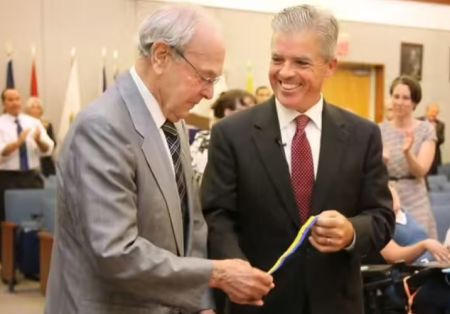
You earned it: Suffolk County Executive Steve Bellone presents Koppelman with the Suffolk Medal for Distinguished Service in 2015.
Prior students of his include a who’s-who list of policy wonks, bureaucrats and elected officials, including Kevin Law, whom Gov. Kathy Hochul recently selected to chair Empire State Development, and former Suffolk County Executive Steve Levy.
He authored a series of books, including widely cited textbooks on the topics of urban planning and coastal zone science that are still read by students in university classrooms across the country.
As suburban sprawl gobbled up farmland early in his career, Koppelman’s calls to policymakers for increasing open space preservation and further diversity of housing types has since rang prescient.
In the sunset of Koppelman’s career, there was a growing recognition of the historic significance of the planner’s work from elected officials. In July 2015, Suffolk County Executive Steve Bellone awarded the planner the Suffolk Medal for Distinguished Service, the county’s highest honor. And in 2018, Brookhaven Town Supervisor Ed Romaine and Councilwoman Valerie M. Cartright announced the dedication of a 46-acre wooded parcel in Setauket as the Dr. Lee Koppelman Nature Preserve.
Koppelman was born on May 19, 1927, in Harlem. He grew up in Astoria and later lived in Hauppauge, Smithtown and Setauket. He earned a degree in electrical engineering in 1950 from the City College of New York and followed his father’s trade to and became a successful landscape architect.
Once established, he got married and moved out to Suffolk County. There, he became active in the hamlet’s local civic group, where his work eventually caught Dennison’s eye.
Koppelman eventually received a master’s degree in planning from the Pratt Institute in the early 1960s, and quickly followed up with a doctorate in public administration from New York University.
He is survived by Connie, his wife of nearly 75 years, as well as his children Lesli, Claudia, Laurel and Keith, and his grandchildren Ezra, Ora and Dara.
This article originally appeared on The Foggiest Idea; reprinted with permission. Richard Murdocco is an adjunct professor in Stony Brook University‘s public policy graduate program and the founder of The Foggiest Idea, an award-winning real estate-development resource.





Lee Koppelman was, as they say in my culture, a “mensch,” which means “a person of integrity and honor.” Lee was always accessible, gracious, and insightful. He was the same age as my father, but he never treated me as “a kid.” When lobbying for Long Island-based development projects, no leadership “listening tour” was complete without a visit to Dr. Lee. They just don’t make ’em like Lee Koppelman any more — he will be missed.