By GREGORY ZELLER //
Add another Nobel Prize laureate to Stony Brook University’s impressive roster.
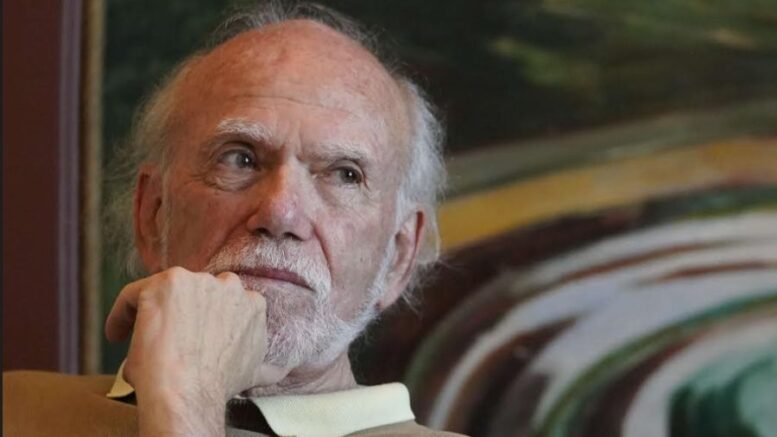
 The co-flagship institution of the State University of New York system has recruited world-renowned experimental physicist Barry Barish, who as principal investigator (and later director) of the famous Laser Interferometer Gravitational Wave Observatory helped prove correct a 100-year-old Albert Einstein prediction about gravitational waves – basically, ripples in the fabric of spacetime.
The effort earned Barish – the Ronald and Maxine Linde Professor of Physics, Emeritus, at the California Institute of Technology – a share of the 2017 Nobel Prize in Physics.
Starting with the Fall 2023 semester, the renowned scientist will become SBU’s inaugural President’s Distinguished Endowed Chair in Physics. It’s more than just a lofty title: In addition to bolstering Stony Brook’s gravitational-astronomy research, Barish expects to be back in the classroom, instructing graduate students in Chairman Chang Kee Jung’s Department of Physics and Astronomy.
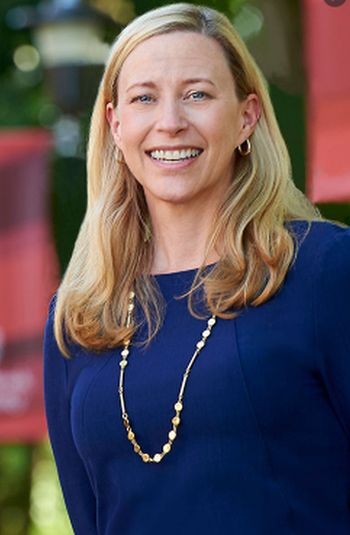
Maurie McInnis: Awed and inspired.
“Stony Brook has long been a very special place for physics,” noted Barish, who plans to continue his affiliations with Caltech and the University of California, Riverside, where he is a Distinguished Professor of physics and astronomy. “I am looking forward to joining the (SBU) physics faculty in 2023, where I will continue to pursue the forefront issues in physics.”
For Barish, the physics forefront is a busy place. The fellow of the American Academy of Arts and Sciences, the National Academy of Sciences, the National Science Board, the American Physical Society (where he served a term as president) and the American Association for the Advancement of Science has collected a galaxy of awards and honors, starting with the 2017 Nobel Prize he shared with Massachusetts Institute of Technology Professor Emeritus Rainer Weiss and longtime Stephen Hawking/Carl Sagan collaborator Kip Thorne.
That ultimate honor stemmed from his leadership of the LIGO, an ongoing mission – managed by Caltech and MIT and supported by the National Science Foundation – to detect gravitational waves, which emanate at the speed of light from accelerated masses (pulsars and black holes, for instance) and distort spacetime’s smooth curvature.
Other awards lining Barish’s trophy case include a 2016 Enrico Fermi Prize from the Italian Physical Society, a 2017 Henry Draper Medal from the NAS and a 2017 Cocconi Prize from the European Physical Society, along with a slew of honorary doctorates and other prestigious scientific prizes.
He earned an actual doctorate (in physics) from the University of California, Berkely in 1962, and followed that with research fellowships at Berkely and Caltech. Focusing on high-energy physics, Barish conducted hands-on experiments at the Stanford Linear Accelerator Center (now the SLAC National Accelerator Laboratory) and the Fermi National Accelerator Laboratory in Illinois, among other cutting-edge facilities, and played a role in many of the biggest breakthroughs – and most ambitious plans – of late 20th Century physics.
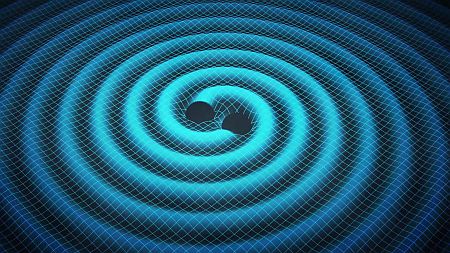
Red alert: Detecting distortions in the spacetime continuum is not as easy as it sounds.
It’s the résumé of an “exceptional physicist,” according to Jung, a Distinguished Professor of physics and astronomy who has collaborated with Barish for the better part of three decades already.
“What he has accomplished with the LIGO experiment is phenomenal,” Jung added. “His work resulted in not only the discovery of gravitational waves that were predicted by Einstein’s theory of general relativity, but also the observation of two black holes merging in real time, which opened a new field of observational astronomy based on gravitational waves.”
That brand of next-level science fits right in at SBU, which boasts “a profound legacy of … research and innovations that expand our world, shift public perspective and help us to better understand the cosmos,” according to Stony Brook University President Maurie McInnis.
“In his awe-inspiring career, Professor Barry Barish has done all three,” McInnis added. “His position as the President’s Distinguished Endowed Chair in Physics is a testament to Stony Brook’s proven excellence in physics and astronomy, as well as to this university’s commitment to remain on the cutting edge of knowledge.”