By GREGORY ZELLER //
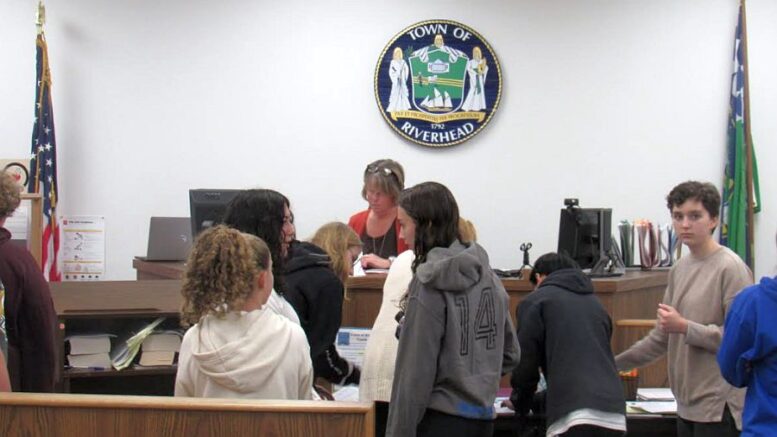
They’ve come to order in the Town of Riverhead, where the innovative Youth Court is back in session.
 Now in its 26th year, the Riverhead Youth Court – a Suffolk County first when it launched way back in 1996 – is a voluntary alternative to the traditional juvenile justice system for underage offenders.
Depending on the severity of charged offenses, defendants ages 17 and under – juveniles, according to current legal guidelines – can choose the Youth Court route, which dismisses criminal charges in lieu of a speedy “trial,” wherein prosecutors prosecute, defense attorneys defend and a jury of peers decides the defendant’s fate.
Sounds fairly typical – except in these cases the judge, prosecuting and defense attorneys and even the court bailiff are high school students, and jury members may age as young as middle school.
Riverhead Youth Court members hail from Riverhead High School, Riverhead Middle School, Shoreham-Wading River High School and multiple private schools in and around the Town of Riverhead. The 2022-23 session, which kicked off in October, welcomes roughly 70 volunteers to weekly Tuesday night sessions – an attendance record for the 26-year-old program.
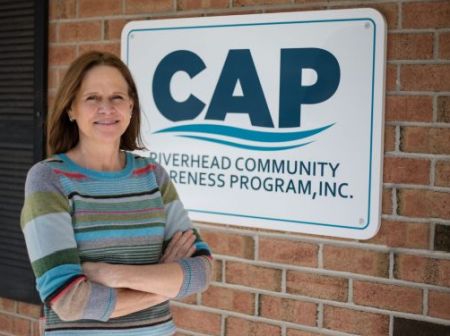
Youth ministering: Youth Court Coordinator Beth Maccagli is deeply involved in Riverhead youth and community programming.
The judge and jury might very well have parent-mandated bedtimes, but this is no moot court. The defendants have (allegedly) committed actual crimes in Riverhead and points east (nothing too heinous or violent); the court members must take an Oath of Confidentiality, preventing them from discussing the facts of any particular case; the cases are tried inside the actual Riverhead Town Court; and the decisions of the Youth Court are binding, including criminal penalties (often involving mandatory community service).
While the stakes are real, the benefits – for good kids who go astray and for potential career delinquents – easily outpace the typical takeaways of the traditional juvenile-justice system, according to Youth Court Coordinator Beth Maccagli.
The Youth Court process leaves a lasting impression on everyone involved, noted the coordinator, who serves as a youth counselor for both the Town of Riverhead Police Department and the Riverhead Central School District.
“You’ve committed a crime,” she said. “You need to pay back the community for the crime you’ve committed.
“With Youth Court, you take more personal stock … instead of just being punished for something,” Maccagli added. “Community service is restorative justice.”
Also benefitting are the middle- and high-schoolers who volunteer for the program, including attorney Lane Bubka, a Riverhead High School and Touro Law Center graduate who not only serves as a Youth Court legal advisor, but was among the program’s first graduates way back in the late 20th Century.
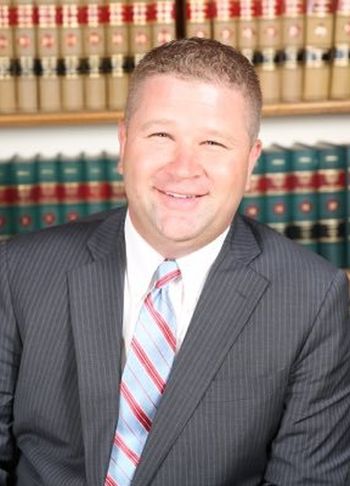
Lane Bubka: Full circle.
“I loved it,” Bubka told Innovate Long Island. “It was one of the primary springboards for me to seek out law as a career.”
Now in his seventh year as legal advisor, Bubka – a former Suffolk County assistant district attorney currently in private practice in Riverhead – fondly recalled Youth Court Legal Advisor Daniel Rodgers, who was a Suffolk County prosecutor when he mentored that first volunteer cohort. The two remained friends throughout Bubka’s education and career, and when Rodgers retired from the DA’s office, he tapped his former protégé to take on the Youth Court.
“It was just kind of full circle that I would do it,” Bubka added. “It’s just been great ever since.”
The attorney and his co-advisor – Suffolk County Assistant District Attorney Kimberly Shalvey, who is also Bubka’s wife – are the latest legal eagles to mentor the young volunteers, following in the footsteps of Rodgers and Riverhead-based attorney Mary Hartill, an ex-Suffolk ADA, former Riverhead deputy town attorney and veteran criminal-defense ace.
While the Bubkas do sometimes find themselves on opposite sides of the Youth Court aisle, they’re not there as lead attorneys or competitors – only guides.
“Sometimes she’ll stick to the prosecution and I’ll do the defense,” Bubka said. “But for the most part, we just try to help [the students] as best we can.”
The husband-and-wife team earn a small stipend from the Town of Riverhead for the effort, which they steer into the Judge Allen Smith Memorial Scholarship, named for a popular Riverhead Town justice and “very vocal supporter” of the Youth Court program who passed away in 2020. More importantly, according to Bubka, they contribute to a legacy community program that’s had a measurable effect on regional socioeconomics.
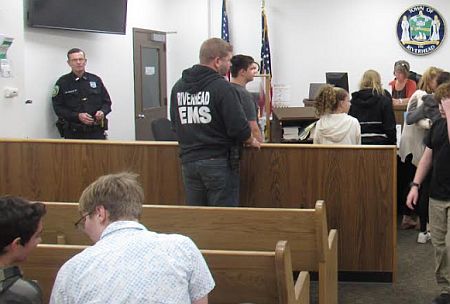
In their court: Bubka (center) oversees the action at this week’s Youth Court session.
Not only do defendants regularly return to Youth Court to participate as court members (both as part of their criminal sentence and voluntarily), but the program boasts a zero recidivism rate – according to both Maccagli and Bubka, in its quarter-century-plus history, the Riverhead Youth Court has never tried a repeat offender.
“We haven’t followed them through their adult lives,” Bubka said. “But we’ve never had a youth defendant who was re-arrested for any type of crime.
“And a lot of defendants have come back to be members of the Youth Court,” he added. “Or they’ve been hired somewhere to provide community service, so the experience has put them on a whole different trajectory.”
These are busy days at the Riverhead Youth Court, now one of multiple Long Island youth courts but the farthest East, after COVID shut down programs throughout Suffolk. “Riverhead is hearing pretty much most of the cases from Brookhaven to East Hampton,” Maccagli noted.
Fortunately, those record volunteers – a “crazy turnout” Bubka attributes to the program’s unique nature, and to college applicants eager to check off “community service” boxes – affords the Youth Court plenty of fresh talent.
And those volunteers, not all of whom want to be lawyers, gain critical skills, according to their legal advisor.
“Yes, they learn all about the law and the legal system,” Bubka said. “But they predominantly learn public speaking.
“A lot of these kids are fearful about raising their hand, and everybody is used to just texting now,” he added. “Getting up in front of people and speaking is somewhat of a lost art, and here they get to master that art.
“They get some confidence back … that seems to be the No. 1 skill that comes out of the program.”