By GREGORY ZELLER //
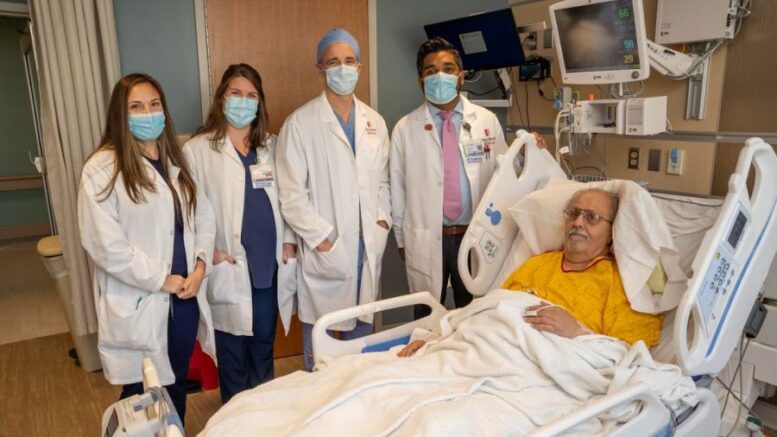
An 80-year-old U.S. Army veteran is alive, well and feeling “lucky” after quick thinking – and a bevy of innovative technologies – saved his life on Veterans Day.
 Kings Park octogenarian Joseph Annunziata was driving on the morning of Nov. 11 when he suddenly found himself struggling to speak and extremely fatigued in his right upper extremities. He was already aware of a narrowing of his left carotid artery – a primary channel delivering blood to the brain, face and neck – but this was a worst-case emergency: The carotid plaque had ruptured and completely blocked the artery.
Annunziata went immediately to the Northport VA Medical Center, where doctors assessed his condition and quickly transferred him to the Stony Brook Cerebrovascular and Comprehensive Stroke Center.
There, computed-tomography and computed-tomography angiogram scans rapidly detected the blockage and the limited blood flowing to Annunziata’s brain. A devastating stroke was imminent – but it was no simple matter of clearing the blockage.
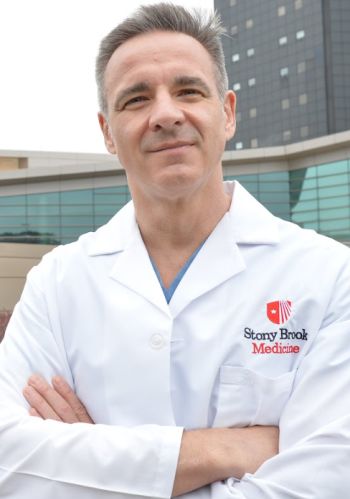
David Fiorella: Life-or-death decision.
David Fiorella, co-director of the Stony Brook Cerebrovascular and Comprehensive Stroke Center, lamented “one of the most difficult clinical dilemmas we face,” a real-life red wire or blue wire moment where the cure might be worse than the cause.
“If we left the carotid [blocked], it is likely that his stroke would continue to progress … leaving him permanently disabled and possibly dead,” Fiorella noted. “Moreover, if we didn’t [unblock] the carotid immediately, it would not be possible to fix it in the future.
“At the same time, opening up a completely [blocked] carotid is also a very high-risk procedure,” the ace neurointerventionalist added, describing a nightmare scenario in which the reopened carotid essentially washes the clot into the brain, “causing an even larger stroke and making things much worse.”
The Stony Brook Medicine team expeditiously decided that fixing Annunziata’s carotid was the only way to go – and called into action a cutting-edge “occlusion balloon technique” pioneered at Stony Brook Medicine.
“We have been very successful using this innovative new technique to open these acute carotid occlusions safely,” Fiorella noted.
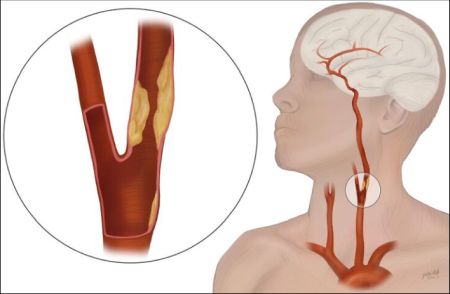
Block tackle: Clearing a carotid clot is a lot harder than it sounds.
The technique scored again. Annunziata was “completely neurologically intact immediately after the procedure” and was discharged Nov. 15, with Fiorella crediting the patient’s home-for-Thanksgiving recovery to his quick decision to seek help – in cases of acute stroke, time is brain – and his good fortune of landing at “one of a select few hospitals in the country equipped with the resources to handle these kinds of complex cases.”
Annunziata, a young soldier stationed in Greenland in the 1960s, credits another Thanksgiving with his family to excellent healthcare and a bit of serendipity.
“I’m lucky,” the veteran said. “Through the grace of God, I thank … the doctors and nurses, and how they are treating me.
“They are wonderful,” Annunziata added, from his recovery bed. “I thank them from my heart and soul for what they do for me and for the veterans.
“Without them, we’d be lost.”