By GREGORY ZELLER //
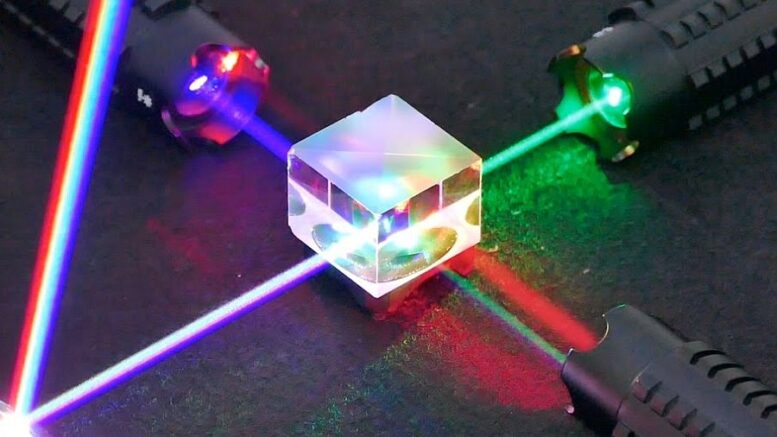
A musical mathematician is studying theories about the ways light behaves – an effort marked by highest-level calculations, immense scientific potential and frickin’ lasers.
 Minus the Dr. Evil affectation, that effectively sums up New York Institute of Technology Assistant Professor Andrew Hofstrand, a nonlinear-optics specialist whose mathematics mastery – and lifelong love of the stars – has put him on the U.S. Air Force’s radar.
Particularly piquing the USAF’s interest: Hofstrand’s studies of “nonreciprocal wave propagation in tailored nonlinear photonic platforms and energy localization in systems with nontrivial topological properties,” according to the scientist himself.
This not only makes Hofstrand a hit at parties – it’s made him one of 58 national winners (one of three in New York State, and the only one on Long Island) of the 2022 Air Force Research Laboratory/Air Force Office of Scientific Research Young Investigator’s Program Awards, announced in December.
Crowned in the Electromagnetics category (one of 36 research areas recognized by the competitive grant program, along with Aerospace Composites, Quantum Information, Condensed Matter Physics and others), the New York Tech teacher will use his three-year, $200,000 award to study how laser beams behave inside different, specially designed materials.
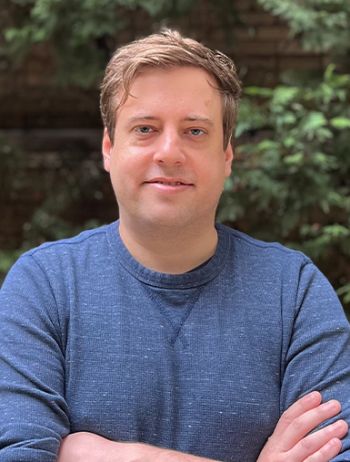
Andrew Hofstrand: Full STEAM.
These complex light-matter interactions are key to future supercomputing, among other potential uses, and could someday have profound effects on how air and space forces do their things, according to the Virginia-based Air Force Research Laboratory.
But it will take sophisticated computer modeling to get there – hence the award for Hofstrand, one of few non-engineers in the 2022 YIP class.
“Most of the awardees are from engineering departments,” the scientist noted. “I am honored to be among these recipients and to be chosen as an applied mathematician.”
Hofstrand may also be the only classical pianist among the bunch: He pursued graduate studies in classical piano performance at the Manhattan School of Music before he went full math, earning a PhD in applied mathematics from the University of Arizona.
The embodiment of innovative STEAM education traces his affinities for music, math and science to his youthful love of outer space, giving his support from the Air Force Office of Scientific Research – the AFRL branch dedicated to basic lab work – a full-circle feel.
“My interest in mathematics grew out of my passion for astronomy in middle school,” Hofstrand said. “I later majored both in astronomy and mathematics in college.
“Actually, some of my current research has connections to astronomy,” the researcher added. “There is currently a great deal of interest among optical scientists and engineers in finding novel ways to control and manipulate light in the hopes of generating faster and more efficient technologies, particularly in computing.”
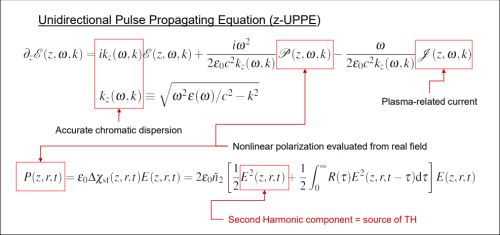
It all adds up: The Spectral Scalar UPPE Propagator made simple (note: universal propagator at all wavelengths, no envelope approximations used).
His current research also has unmistakable potential for the future of atmospheric aeronautics and space exploration, according to YIP Program Manager Ellen Robinson, who lauded the 2022 winners – representing 44 research institutions and private businesses in 22 states – as the future of the Department of the Air Force.
“Through the YIP, the Department of the Air Force fosters creative basic research in science and engineering, enhances early career development of outstanding young investigators and increases opportunities for the young investigators to engage in forwarding the DAF mission and related challenges in science and engineering,” Robinson said in a statement.
While exploring the final frontiers of his particular science, Hofstrand – an Iowa native working primarily at Old Westbury-based New York Tech’s Manhattan campus – is also keeping on eye on the lower rungs. This Spring 2023 semester, he introduced a new mathematics course, Computational Analysis, which the assistant professor designed to familiarize undergraduates with important numerical algorithms.
“I strongly believe in New York Tech’s mission of building strong math and science programs,” Hofstrand noted. “The students I’ve encountered … are hardworking and motivated.
“I am eager to help them acquire a solid mathematic proficiency, underlying numerous career choices and further academic pursuits.”
As for his AFRL/AFOSR-supported research, it will be some time until his comprehensive computer simulations create unique supercomputing algorithms that kick a range of sciences into hyperdrive – but you can see all that from here, according to the scientist.
“The research I’m involved with is at a fundamental theoretical level,” Hofstrand added. “Of course, having a better understanding of the mathematics behind such phenomena is highly beneficial when designing applications.”