By GREGORY ZELLER //
A popular videogame that helps non-programmers dabble in advanced digital modeling has inspired a sophisticated biomedical software platform – and a huge philanthropic gift to build it out.
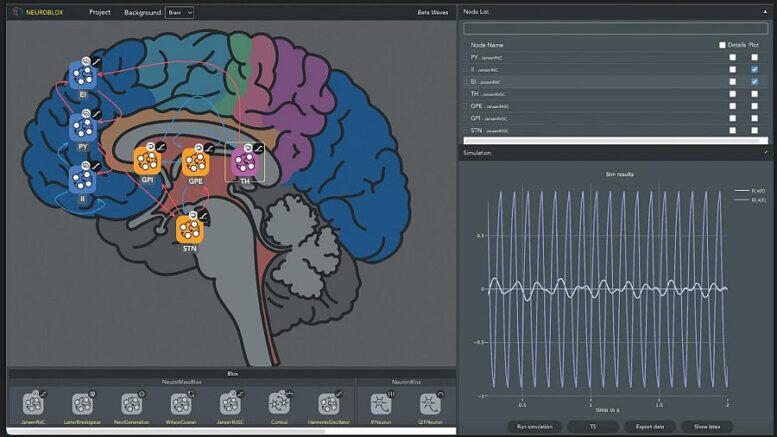
 Meet Neuroblox, a self-described “user-friendly, commercial-grade modular software platform for computational psychiatry” designed by Renaissance School of Medicine neuroscientist Lilianne Mujica-Parodi.
Neuroblox models brain circuits – more specifically, the software allows neuroscientists with no computational-sciences training to explore the complexities of wicked brain-based disorders (including dementia and schizophrenia) through detailed computer models designed by themselves and their fellows.
Mujica-Parodi was motivated by Roblox, the immensely popular interactive platform and immersive virtual world featuring designs, structures and experiences often created by users with no programming experience.

Lilianne Mujica-Parodi: Out-of-the-blox thinking.
Such plug-and-play digitization could give biomedical researchers unprecedented perspectives of the brain and its myriad disorders, helping to overcome “a disconnect between the aims of clinical research and the computational tools we have to exploit that research,” according to Mujica-Parodi, a professor in Stony Brook University’s Department of Biomedical Engineering.
“Neuroblox is doing something fundamentally different,” the researcher noted. “It’s trying to bridge that gap.”
The modeling may be the art of simplicity, but the scientific theory is knee-deep in complex diseases and brain functionality.
In a nutshell: Neurometabolic mechanisms (bipolar disorder, for instance) operate at the cellular level, standard imaging technologies don’t go that far and widescale adoption of computational brain modeling is stymied by a hard-to-find combination of multidisciplinary technical expertise (neuroscience, computer science, stochastic coupled differential equations and so on).
Such roadblocks are common to neuroscientists like Mujica-Parodi, who was studying the role of ketosis on brain functioning when she caught the attention of Roblox founder and Chief Executive Officer David Baszucki and his wife, Baszucki Group President Jan Ellison Baszucki.
 A ketogenic diet had put the Baszuckis’ son’s bipolar disorder into remission, and “here was a neuroscientist unveiling the mechanism by which ketones work to stabilize brain networks,” according to Ellison Baszucki.
Inspired, the philanthropists donated $6.2 million to Mujica-Parodi’s cause: $3.2 million to help build out and launch the Neuroblox brain-modeling system, and $3 million to create the Stony Brook University Baszucki Endowed Chair for Metabolic Neuroscience.
“Lily is building a software platform where neuroscience researchers worldwide can refine, test and share models to help us understand how the brain regulates energy – a critical driver of mental health,” David Baszucki said in a statement. “Our family believes Neuroblox’s impact on understanding and treating brain-based disorders, including mental illness, will be transformative.”

Their kind of wonderful: Roblox founder David Baszucki and bestselling author Jan Ellison Baszucki liked what they saw in Mujica-Parodi.
The hefty Baszucki family donation – and Mujica-Parodi’s ambitious team of neuroscientists, programmers and biomedical engineers – will be burnished by a $550,000 bump from SBU’s Presidential Innovation and Excellence Fund, a philanthropy-supported $75 million war chest dedicated to commercializing the university’s most ambitious and socially progressive research.
Stony Brook University President Maurie McInnis labeled mental health and wellbeing “one of our most pressing societal issues” – and called Mujica-Parodi’s gamified modeling solution “inspiring.”
“It underscores our commitment as an institution to advance knowledge that will have a long-term, significant impact on the world,” McInnis added. “We could not be prouder of these efforts, and we are thrilled that the Baszuckis have chosen to invest in Lily’s trailblazing work in a way that will undoubtedly change lives.”