By MICHAEL H. SAHN //
The results of this November’s congressional elections might not be based on the candidates, the issues, campaign funds raised or even the number of votes cast.
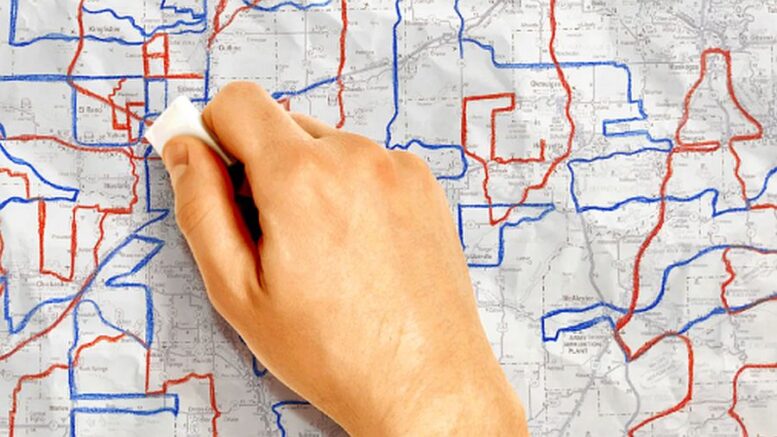
 Winning and losing may hinge on the maps used to determine Congressional districts. No wonder Democrats and Republicans nationwide – and especially in New York – are litigating the drawing of these maps so fervently.
In New York, Democrats want to vote on a new map drawn by the state’s Independent Redistricting Commission, arguing the IRC is compelled to draw a constitutionally compliant map – unlike the current map, which was created not by the commission, but by much legal wrangling.
Republicans argue the map used in 2022 – a catalyst for New York’s “red wave,” which saw four Congressional districts flip Republican – should stay in place for the rest of the decade, obviously including the 2024 election.
There are legal precedents in play. According to the U.S. Supreme Court, the 14th Amendment requires Congressional districts within each state to be drawn to encompass approximately equal population sizes, to satisfy the “one-person, one-vote” principle.

Michael Sahn: Mapping it out.
While the Constitution doesn’t specifically prohibit political gerrymandering, the Supreme Court has also determined that racial gerrymandering violates the Voting Rights Act of 1965 – and New York enacted a state law prohibiting the practice in 2014.
A partisan, gerrymandered congressional district map would therefore violate state law – but might be out of reach for the federal court system.
New York has a process for changing its maps, established in 2014 under Gov. Andrew Cuomo. The IRC must redraw the state’s congressional districts every 10 years, based on the U.S. Census; if the state legislature rejects the map, the IRC must draw a second map for a legislature vote. If that map is also rejected, the legislature can draw the map itself.
The most recent census was completed in 2020. However, the IRC deadlocked along party lines and failed to produce a second map option after the first option was rejected. As such, the legislature – which has a Democratic majority – took over drawing the map.
The 2022 map that the state legislature drew faced claims of partisan gerrymandering favoring Democrats. The state’s highest court agreed, holding that the map drawn violated the State Constitution’s ban on partisan gerrymandering – and that the legislature did not have authority to redraw the lines.
A lower court appointed an “expert” to draw the congressional lines ultimately used in the 2022 election. The result: 11 of the state’s 26 Congressional districts went Republican, helping the GOP win a majority in the U.S. House of Representatives.
On Long Island, all four Congressional districts elected Republicans to the House for the first time in decades, including the election of George Santos in a newly drawn Nassau County district.
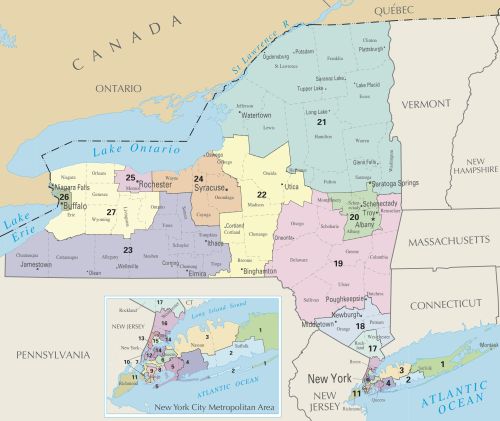
The eyes of a nation: How New York’s Congressional districts are drawn up is of keen interest to the rest of the country.
In July 2023, the Appellate Court found the 2022 map was only a temporary solution and ordered the IRC to “commence their duties forthwith” in drawing a new map. Republicans, naturally, have appealed this decision (oral arguments this November) – and the Court of Appeals has decided the IRC cannot take any official redistricting actions until it rules on the merits of the case.
If the court determines that new district lines must be drawn for the 2024 election, the legislature would need to have the maps in place by February 2024 to avoid disrupting the election calendar. The clock is ticking.
This partisan fight is not unique to New York’s Congressional districts. In July, Democrats sued to block new Nassau County Legislature maps that allegedly favor Republican candidates. Republicans, meanwhile, are battling redistricting in the Democrat-controlled Town of North Hempstead.
Similar issues are playing out in numerous states, and speculation abounds about what the IRC will propose this time around, if the Court of Appeals sides with Democrats and orders another new New York Congressional map. Whatever the court decides, there is no doubt it will be integral to deciding the fate of the U.S. House of Representatives next year.
Michael H. Sahn, Esq., is the managing member of Uniondale law firm Sahn Ward Braff Koblenz PLLC, where he concentrates on zoning and land-use planning, real estate law and transactions, and corporate, municipal and environmental law. He also represents the firm’s clients in civil litigation and appeals.