By GREGORY ZELLER //
The National Science Foundation is backing several ambitious Hofstra University professors on computer-science missions with wide-ranging implications.
 The foundation has awarded the university three grants totaling more than $3.3 million, targeting projects focused on operating-system development, computer-infrastructure enhancement and advanced computer-education training.
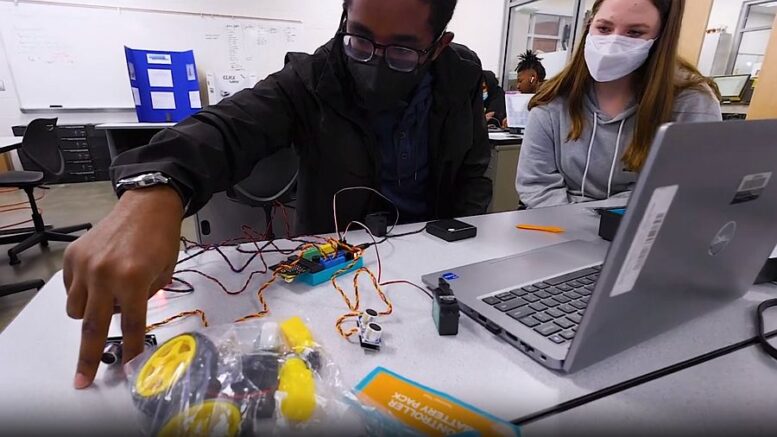
The largest of the three grants (just $8 short of $2 million) is earmarked for a Hofstra Center for STEM Research effort to turn high school science teachers into high school computer-science teachers.
The initiative leverages Exploring Computation Integrated into Technology and Engineering, a professional-development program designed by the International Technology and Engineering Educators Association to upload computer-science knowledge into technology and engineering teachers.
The Center for STEM Research is actually utilizing ExCITE II, the program’s second iteration, which builds on an original pilot program that focused on teachers in Maryland and Virginia.

Anthony Gordon: Training the trainers.
Led by principal investigator (and Hofstra visiting scholar) Anthony Gordon, the scale-up effort will look to expand professional-development workshops for technology and engineering teachers in school districts across nine states with majority populations of minority students: Georgia, Idaho, Louisiana, Minnesota, Missouri, New Jersey, North Carolina, North Dakota and Pennsylvania.
Another NSF grant, this totaling $1 million, will bring a new high-performance computing cluster to Hofstra’s Science and Innovation Center, creating a “supercomputing environment” that will support the university’s computational-intensive workloads.
The HPC cluster will create a “hybrid cloud environment” to back up data-intensive projects at neighboring Adelphi University and Nassau Community College, Hofstra said in a statement.
Hofstra Associate Professor of Engineering Edward Currie, the $1 million grant’s lead investigator, called the cluster “the fastest and most sophisticated computer processing available,” precisely what his university needs “to prepare today’s students for tomorrow’s high-tech environment.”
And not just the fast-paced IT sectors, the engineer noted.
Jianchen Shan: Multifaceted approach.
“This isn’t just about computer sciences,” Currie said in a statement. “This HPC cluster is vital for classroom instruction and research in STEM fields including biology, physics, chemistry, computer science and engineering.”
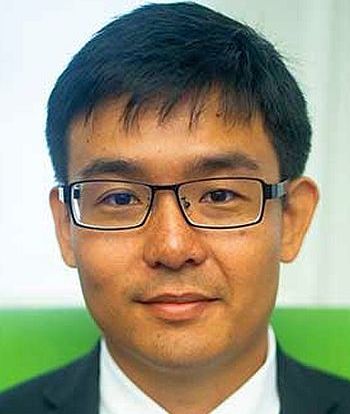
Dynamic clouds and other high-tech environments are also on the mind of Assistant Professor of Computer Science Jianchen Shan, principal investigator of a $327,984 grant covering the development of Octopus OS, a high-performance cloud-based operating system.
Shan, who also earned $50,885 in NSF cloud research credits, called Hofstra’s build-out of the Octopus OS – which manages precise cloud-resource abstractions and creates novel algorithms to optimize virtual environments – a “multifaceted endeavor.”
“The development we are undertaking … involves a series of intricate steps,” Shan said. “With this funding, we can propel the project forward swiftly, yielding substantial benefits for the entire industry.
“Additionally, it will enhance the computer-science curriculum at Hofstra University,” he added. “And it will foster undergraduate research in the field of computer systems.”