By GREGORY ZELLER //
Ten years, 10 towns and one historic effort later, the Suffolk County Industrial Development Agency has finalized a winning downtown-redevelopment strategy – and is sharing the formula with all of Long Island.
 The IDA on Monday released “Planning for Economic Growth,” a 48-page “summary report” of downtown redevelopment across 10 Suffolk municipalities (and several local neighborhoods) over the last decade, as chronicled in 13 previous reports tracking investments, construction, new housing units and other progress toward safer, more pedestrian-friendly downtowns.
The summary – a collaboration of Greater New York’s own Regional Plan Association, New York City-based business advisory James Lima Planning + Development, the Long Island Association’s Economic Development & Infrastructure Committee and other Suffolk County offices – is the second high-profile report in as many months for the IDA and the James Lima team.
They two organizations joined the HIA-LI and the Albany-based Workforce Development Institute to release the employment-focused “Innovating the Talent Pipeline” study in October.
That earlier report focused on job-creation resources inside and around Long Island Innovation Park at Hauppauge; this time, transit-oriented development and housing diversity across Suffolk County get special attention.

Kelly Murphy: Takes more than tax breaks.
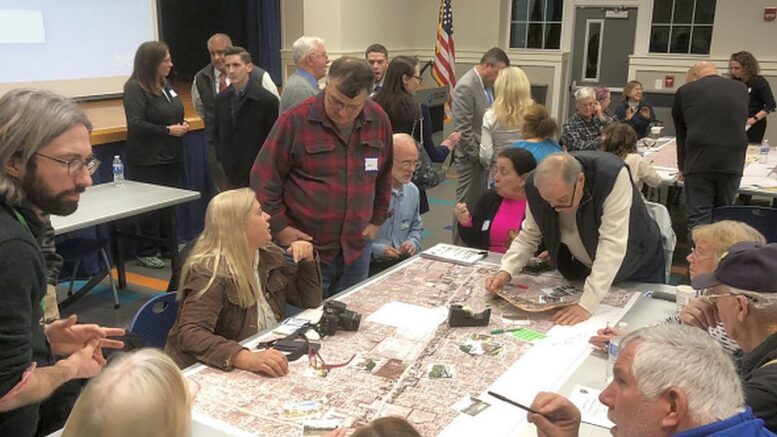
“Planning for Economic Growth” traces its roots to 2014, when the IDA – thinking long-term – partnered with the RPA, James Lima and 10 “self-selecting local municipalities” to identify sustainable downtown-redevelopment opportunities along Long Island “transit corridors” and focus regional economic-development opportunities upon them.
Since then, 13 follow-up studies tracking these collaborative efforts have been completed, according to the IDA, reviewing efforts in Amityville, Lindenhurst, Ronkonkoma, Holbrook, Hauppauge, Greenport and Brentwood, as well as North Bellport, West Babylon and East Patchogue.
Further studies examined progress along the Route 110 Corridor and in the Selden/Centereach and Kings Park/Smithtown regions.
The data is tracking upward: On Monday, the IDA highlighted “significant community investment into infrastructure, land use and planning, as well as real estate development.”
That not only proves the efficacy of the unique collaboration, according to Suffolk County IDA Acting Executive Director Kelly Murphy, it makes the earlier studies a sort of blueprint-in-progress for other Suffolk municipalities to follow.
“Many of Suffolk County’s municipalities have leveraged these roadmaps, which have provided tangible benefits to their overall economic-development goals,” Murphy said. “Meaningful economic development requires a holistic approach, and these comprehensive planning documents are providing our partner municipalities the keys to unlock their true potential.
“The Suffolk County IDA is so much more than providing financial incentives to businesses,” the acting exec added. “This effort is a shining example of that.”

Tom Wright: To your downtown health.
Compiling data from those earlier studies, “Planning for Economic Growth” counts up more than $129.5 million in collective infrastructure grant awards for downtown-redevelopment projects in the participating communities over the last decade. More impressively, it estimates that every $1 in grant funding spurs $13 in “additional real-estate investment.”
The report also tallies 5.9 million square feet in relatable real estate projects in various stages of progress, with 1,600 new residential units – 300 designated “affordable” – either built or on their way.
And it calculates fantastic economic side effects: 15,000 new construction-phase jobs, $1.4 billion-plus in related annual labor income and some $2.7 billion in annual economic output during the regional buildout.
Sustainability, you ask? Post-buildout, “Planning for Economic Growth” projects 11,000 permanent jobs (generating $882 million in annual income) and $1.4 billion in regional annual GDP – a “permanent impact” of $2.5 billion in annual economic output.
Those are some robust numbers, according to Regional Plan Association President and CEO Tom Wright, who noted the RPA is “thrilled to see participating municipalities’ progress to make themselves more sustainable, equitable, prosperous and healthier.”
“We are hopeful that the demonstrable success in these communities will continue to be replicated and scaled up in other places across the region,” Wright said in a statement.
Suffolk County Department of Economic Development and Planning Commissioner Sarah Lansdale agreed the decade-in-the-making summary provides “pivotal resources … to expand and improve our local economic landscape.”
“The economic-development opportunities born by this effort have led to real results for many of our local downtowns,” added Lansdale, who doubles as Suffolk IDA chairwoman. “We sincerely thank all of our partners in this effort that are helping to produce a better and more robust Suffolk County.”