
By JOHN L. PARKER //
The Earth Day celebration started with an event that drew millions together to address environmental issues and has been with us for more than five decades.
 Today, newly enacted laws address climate disclosure and climate trading programs and bring market forces directly into the sustainability equation. Market-focused approaches are controversial with some of America’s largest companies, but paradoxically, America’s CEOs have indicated that sustainability strategies are their top operational priority in the coming years – and they expect significant returns from sustainability investments over the next three to five years.
Climate related risk is factored into the decision-making of many businesses. While disclosure of these risks and company sustainability efforts were initially voluntary, there are now many climate-change narratives regarding business obligations.
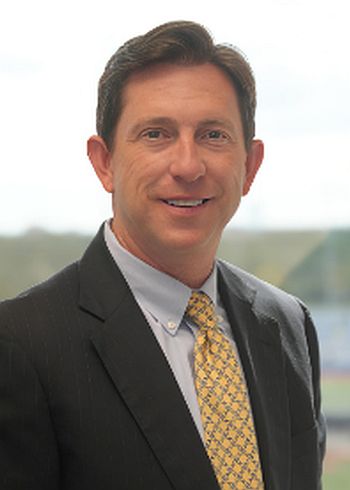
John Parker: Change is gonna come.
However, there is also growing government consensus that larger companies need to transparently address the environmental sustainability of their operations. The new climate disclosure laws will impact tens of thousands of companies and become milestones in the field of climate risk and sustainable investment.
This year, the U.S. Securities and Exchange Commission adopted a climate disclosure rule requiring reporting of climate-related risks deemed to have a material impact on businesses. The climate-related risks include direct emission impacts (Scope 1) and indirect impacts (Scope 2) of energy needed for operations.
In the final rule, SEC did not include indirect emissions (Scope 3) from the supply chain and customers, both upstream and downstream – factors a company does not directly control.
California recently enacted a law requiring that companies review, assess and disclose financially related climate risks annually, plus the steps they are taking to manage these risks. It applies to companies with a $500 million business threshold and addresses Scope 1, 2 and 3 emissions.
The reality is that this threshold – and the fact that so many businesses operate in California – will likely result in almost every large company being required to meet its disclosure requirements. These requirements cover more than 10,000 large companies, and not just those that are publicly traded.
A separate law focuses on annual disclosures of companies with at least $1 billion in revenue.
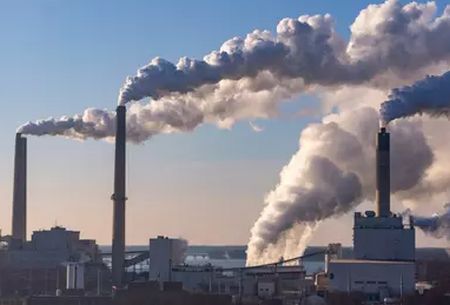
Where there’s smoke: New laws across the land will compel big businesses to clean up their acts.
New York has yet to adopt its own law in this area. There are, however, pending bills to address the climate disclosure and sustainability space – one leading bill takes a similar approach to California’s and includes supply chain Scope 3 emissions – and New York’s landmark Climate Leadership and Community Protection Act continues to drive legal developments in the state.
Among other things, it creates a new Cap and Invest program that will account for all emissions in the state and will set annual caps needed to meet emission reductions of 40 percent by 2030 and at least 85 percent (from 1990 levels) by 2050.
The program relies upon market incentives. Large emitting sources must report emissions and obtain allowances equal to those emissions. The allowance prices will increase over time, providing an incentive to transition to lower emitting sources.
The proposal mandates climate-emissions reductions, addresses disadvantaged community’s concerns, ensures affordability for statewide residents and businesses and seeks to equitably support overall investments in climate mitigation, energy efficiency and clean-transportation projects, among others. And it will fund annual rebates that will mitigate costs to consumers of this climate transition.
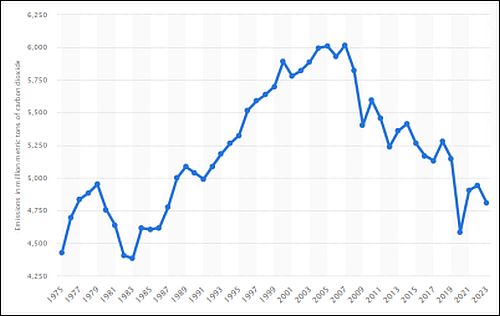
Gas, gas, gas: Blips abound, but U.S. carbon-dioxide emissions have been trending in the right direction over the last two decades. (Source: Statista)
Earth’s climate continues to change, and Earth Day has motivated citizens to impact environmental change. There are a number of positive developments showing what is possible in the climate space – for instance, U.S. energy sector greenhouse gas emissions have decreased more than 3 percent since 1990.
New York is a leader in this category. A wind farm located 35 miles east of Montauk can remarkably now power more than 70,000 homes without any emissions.
But even with many ongoing efforts to reduce emissions, the data raises concerns that the international goal of limiting emissions to a 1.5-degree Celsius temperature increase by 2100 may be unattainable with substantial and unpredictable consequences.
New governmental approaches rely upon direct market forces to address climate risk. The new climate disclosure rules will set reporting requirements for companies’ climate risk and sustainability efforts. The information will help inform sustainable investment strategies and impact risk aversion in the marketplace. In addition, New York’s upcoming Cap and Invest program will create a market to decrease statewide emission levels.
There will undoubtedly be challenges ahead to these new laws and regulations. Each one, however, represents a new and needed approach that will help build a sustainable climate future.
John Parker is a partner at Uniondale-based Sahn Ward Braff Koblenz Coschignano.