
By GREGORY ZELLER //
Scientists have deciphered the genetics of dozens of bacteria known to transmit Lyme disease – a major step toward new treatments for the world’s most prevalent tick-borne illness.
 As detailed in the Aug. 15 issue of mBio, the peer-reviewed journal of the American Society for Microbiology, an international team of scientists has spent years unraveling the genetic makeup of 47 strains of known and potential Lyme disease-causing bacteria – essentially reconstructing the evolutionary history of Lyme-transmitting bacteria through millions of years of development.
Investigators sequenced the complete genomes of 23 known species of Lyme disease bacteria, targeting multiple bacteria strains commonly associated with human infections and strains not previously known to cause the disease in humans.
Among their primary discoveries: “Lyme disease,” named for a small Connecticut town by mid-1970s researchers investigating an unusual pediatric arthritis cluster, is not from Connecticut.

Benjamin Luft: Seminal study.
Actually, that was already known: German physician Alfred Buchwald first detected and described the telltale rash and other symptoms of what became known as Lyme disease in the late 19th Century.
But the international team conducting this study – including Benjamin Luft, the Edmund D. Pellegrino Professor of Medicine at Stony Brook University’s Renaissance School of Medicine – was able to determine that Lyme-transmitting bacteria likely originated before the breakup of ancient supercontinent Pangea, helping to explain the disease’s global reach.
The genetic analysis also revealed how these bacteria exchange genetic material within and between species – a process known as genetic recombination, which allows the bacteria to rapidly evolve and adapt to new environments – and identified “hot spots” within the bacterial genomes where this genetic interchange occurs most frequently.
By decoding these exchanges, “we’re better equipped to predict and respond to changes in [bacterial] behavior, including potential shifts in their ability to cause disease in humans,” noted Hunter College-City University of New York Biology Professor Weigang Qiu, the senior author of 20 listed on the study.
While the team’s conclusions already mark a giant leap in the potential prevention, detection and treatment of Borrelia burgdorferi – the bacterial species identified as the primary cause of Lyme disease in humans via tick bites – the work is only beginning.
The collaborators – including scientists from SBU, CUNY, Rutgers University, the Czech Academy of Sciences Biology Center and more than a dozen other international institutions – have developed a web-based software tool to continue studying Borrelia genomes and identify possible “determinants of human pathogenicity.”
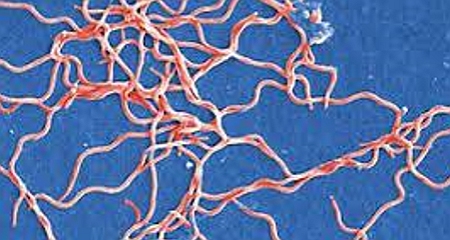
Strain theory: Meet Borrelia burgdorferi, the bacterial species most responsible for transmitting Lyme disease to humans.
The team also plans to expand the genome analysis to include more strains of Lyme-transmitting bacteria – particularly strains from understudied global regions – and to investigate specific functions unique to disease-causing strains, with an eye on new pharmaceutical targets.
But the genetic mapping of 47 bacteria strains associated with the most common tick-borne disease in the United States and Europe is a “seminal” step, according to Luft, an internationally recognized expert in the investigation and treatment of Lyme disease
“[This] is a body of work that provides researchers with data and tools going forward to better tailor treatment against all causes of Lyme disease,” Luft said in a statement. “And (it) provides a framework toward similar approaches against other infectious diseases caused by pathogens.”