By MICHAEL H. SAHN //
Get ready, Long Island, for the impacts of the Supreme Court’s precedent-changing Loper Bright decision.
 The decision abandoned the court’s own Chevron doctrine, which stems from SCOTUS’ 1984 decision in Chevron v. Natural Resources Defense Council – basically stating that if federal legislation is ambiguous, courts must defer to “reasonable” regulatory agency interpretations.
Essentially, the rules, regulations and decisions of administrative agencies – government bodies such as U.S. Department of Labor and the U.S. Environmental Protection Agency, previously authorized to implement legislative directives by developing more precise and technical rules than possible in a legislative setting – are no longer entitled to deferential treatment.
As Associate Justice Neil Gorsuch wrote in his concurring opinion, “Today, the Court places a tombstone on Chevron no one can miss.”
The end of Chevron means that lower courts must examine whether rulings of administrative agencies are consistent with statutory authority – meaning agency actions implementing statutes, many of which are vague or ambiguous, are now fair game for challenges.

Michael Sahn: The Supremes have changed the game.
For context, the SCOTUS decision abandons many longstanding models – rejecting principles of judicial restraint and stare decisis (Latin for “let the decision stand,” meaning essentially that judges should honor precedent) – by citing the need to correct prior mistakes in interpreting the U.S. Constitution and various statutes, as the court did in the Dobbs case on women’s health and abortion rights.
This is a game-changer with significant consequences for Long Island. Across the Island’s vital healthcare field, the end of the Chevron deference doctrine opens the door to challenges of the wide and overreaching administrative rulings of state and federal health departments and other agencies governing how, when and where healthcare is delivered, and how providers charge for their services.
Now courts will be the arbiters of important ambiguities in laws impacting public health, which used to be up to federal agencies such as the U.S. Food and Drug Administration and the Centers for Disease Control and Prevention.
Among other consequences, Long Island employers and employees should expect wide-ranging changes in state and federal labor department rules regarding wages, overtime pay, gender-based discrimination and non-compete agreements. Current laws may no longer apply.
New rulings affecting the National Labor Relations Board and the U.S. Labor Department, on issues such as unionization and wage structures, will also impact Long Island businesses, affecting everyone from unions to private and public employers. For example, Amazon – citing Loper Bright – has brought an action in Texas declaring the NLRB unconstitutional; if successful, the lawsuit could stay the NLRB’s pending action alleging that Amazon failed to fairly negotiate with a union in New York.
The Long Island Federation of Labor, AFL-CIO has 250,000 members. In New York, there are approximately 300,000 Civil Service Employees Association public employees. The stakes are high.
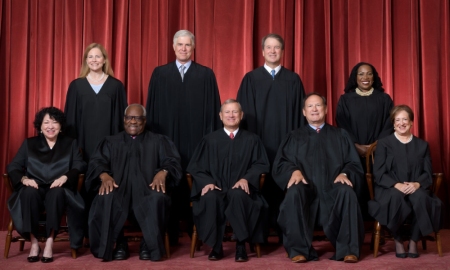
Precedent schmecedent: Over dissenting opinions from Associate Justices Elena Kagan and Sonia Sotomayor, the Conservative-majority SCOTUS has proudly upended decades of legal norms.
From an environmental perspective, EPA and the New York State Department of Environmental Conservation administrative rulings covering critically important Long Island issues – regulating “forever chemicals” like polyfluoroalkyl substances in drinking water, for instance – are now going back to court.
To put this in perspective, Island water providers are currently planning to spend several hundred million dollars to comply with limitations on new classes of “forever chemicals” including 1,4 dioxane. The Suffolk County Water Authority alone is planning to spend $177 million on compliance.
Environmental laws and decisions are complex. Relying on often-updated scientific studies, their public-health goals and directions can be ambiguous. This makes them ripe for court challenges – consider the example of West Virginia v. EPA, in which the courts found that climate goals laid out in federal law were ambiguous and the EPA’s actions addressed “major questions” Congress did not specifically authorize the agency to address.
Similarly, U.S. Securities and Exchange Commission rules on Environmental, Social and Governance investment requirements and disclosures – many of which directly affect Long Island industries and investors – are also in the crosshairs. Challengers argue that some regulations are beyond the SEC’s authority because they advance energy-policy goals and not investor protections.
Not all of this is bad. The end of the Chevron deference doctrine will help rein in an administrative state that has grown into a bureaucratic-compliance web that many times defies explanation. It will rebalance the playing field between government regulators and the regulated.
But only time will tell how it all plays out. What’s certain is that the game is changing fast and stakeholders must stay sharp to remain current and competitive – and be ready to move swiftly to adapt to new regulatory environments.
Michael H. Sahn, Esq., is the managing member of Uniondale law firm Sahn Ward Braff Coschignano PLLC, where he concentrates on zoning and land-use planning, real estate law and transactions, and corporate, municipal and environmental law. He also represents the firm’s clients in civil litigation and appeals.