By GREGORY ZELLER //
From the You Think YOU’RE Having a Bad Day? File comes the Donald and Barbara Zucker School of Medicine at Hofstra/Northwell, which dealt with a terrorist bombing on Sept. 27 – plus a train derailment, a multi-vehicle car crash, a chemical-spill disaster and an active-shooter situation.
 Fortunately, this was only a test.
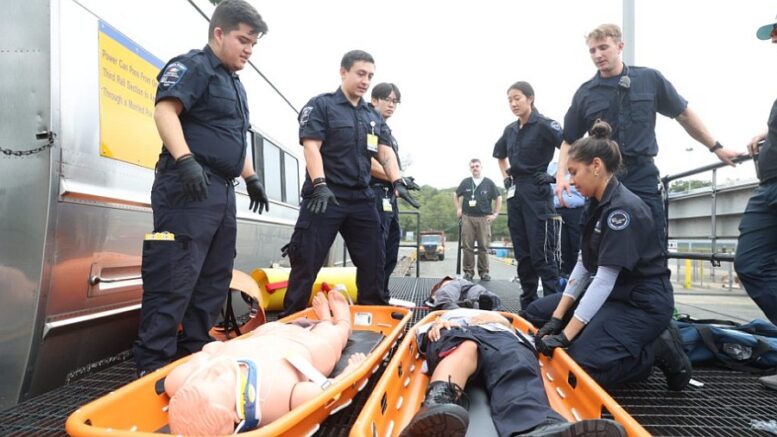
The Zucker School’s very worst day ever came courtesy of the Nassau County Fire Service Academy, which hosted the medical school’s annual Mass Casualty Incident Training Day – a rite of passage for first-year Zucker students, 100 of whom put their nascent emergency skills to the test under the most trying circumstances imaginable.
Guided ably by seasoned professionals from the Nassau County Police Department’s Homeland Security Division, the students put eight weeks of Emergency Medical Technician training – underway since the Class of 2028 convened in early August – to good use.
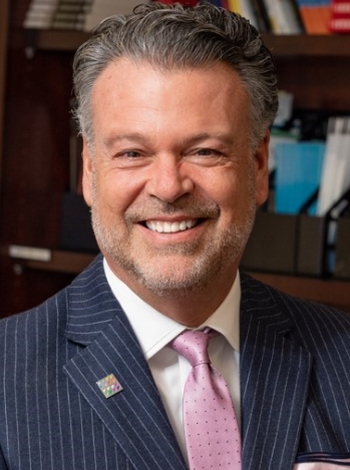
David Battinelli: Disaster declaration.
Employing their freshly minted lifesaving disaster skills, the future doctors rotated through five different stations during the daylong exercise, which also included contributions from Northwell Health’s Emergency Medical Institute.
The scenarios were staged, but the chaos was real: Students battled fire, smoke, darkness, sirens and the blood-curdling screams of “victims” and “first responders” as they triaged the wounded, administered emergency care, navigated hazmat zones and otherwise hustled across the NCFSA’s sprawling campus.
More than just a trial by fire, MCI Training Day is “one of the most meaningful (programs) for our students in their journey as medical professionals,” according to Zucker School of Medicine Dean David Battinelli.
“Disaster training may not seem like it’s in the purview of doctors, but having the knowledge and skills will only benefit our students in their careers,” noted Battinelli, also a Northwell Health vice president and the vast health system’s physician-in-chief. “The experience makes our students more well-rounded and better-prepared medical professionals.”
Training as EMTs – including ride-alongs with actual Northwell Health ambulance crews and hands-on simulations in Northwell’s Center for Learning Innovation – has been a first-year requirement since the Zucker School opened in 2011. The comprehensive Sept. 27 exercise marked the third year the NCFSA hosted the medical school’s Mass Casualty Incident Training Day.
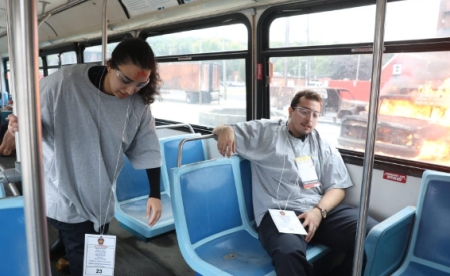
Flame on: Real fires and fake blood added to the chaos of Mass Casualty Incident Training Day.
It’s loud, it’s muddled and it’s messy. Students used to working with mannequins suddenly find themselves treating living, breathing people – some splattered with faux blood – in the center of the storm (including some of their own classmates, who switched from responders to victims as the scenarios changed up).
But while the action-packed event was occasionally intimidating, it was also “surprising and valuable,” according to future doctor Claudia Rodriguez.
“Because of our early clinical experiences, I expected our patients today to be all mannequins,” Rodriguez noted. “However, this was to our benefit, as we got to see what it was like to act like patients and work with ‘real-life’ patients, which was extremely rewarding.
“Working from the perspective of a patient, versus being on the EMS side … will give us a better perspective and allow us to think from the patient’s perspective when providing care,” she added. “Additionally, this day has taught me how to stay calm and how to work through a high-pressure situation.”
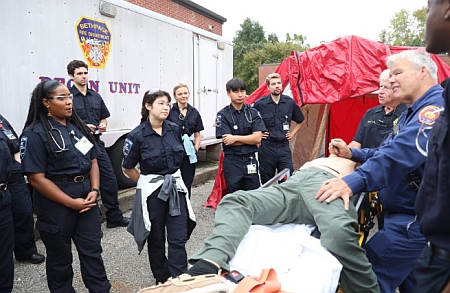
Teaching moment: Experienced emergency-management professionals show first-year medical students how it’s done.
Always exciting and educational for the students, MCI Training Day has also become a favorite of Fire Service Academy personnel, according to NCFSA Chief Instructor Paul Wilders.
“This year’s group of students was very dynamic,” Wilders said. “They came here fired up and ready to go.
“At each station, they went through and cleared the scene, developed a treatment plan and thoroughly triaged all of their patients,” he added. “This is what the day is all about – putting learning into action.
“The more I watch the students learn, the more it’s enjoyable for me.”