By GREGORY ZELLER //
An all-new institute has enlarged the ranks at Northwell Health’s R&D mothership.
 The Manhasset-based Feinstein Institutes for Medical Research as leveraged a $5 million gift to create the Institute of Translational Research – a “bench to bedside” division designed to connect the dots between better understanding basic chronic-disease molecular mechanisms and cranking out innovative clinical therapies.
Joining the institutes of Behavioral Science, Bioelectronic Medicine, Cancer Research, Health System Science and Molecular Medicine, the sixth Feinstein institute is fueled by the latest chunky donation from the Karches family, a philanthropic bunch who’ve supported decades worth of Feinstein Institutes research into chronic lymphocytic leukemia, cancer and bioelectronic medicine.
Susan Karches, a member of the Feinstein Institutes Board of Directors since 2007, said her family is “proud to support this gift,” which has established the Karches Family Laboratory and endowed celebrated researcher Douglas Nixon as the first-ever Karches Family Professor in Translational Research.
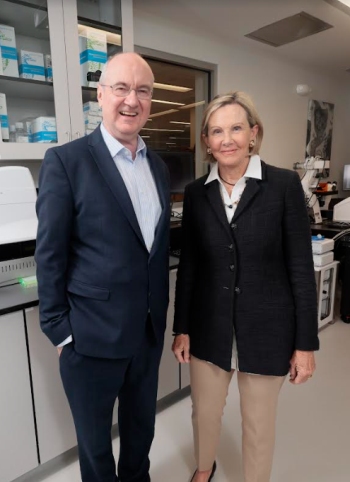
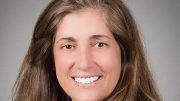
Gift of life: Feinstein Institutes Board of Directors member Susan Karches (right) believes Douglas Nixon and his team will have a transformative effect on modern medicine.
“We hope (the donation) empowers Dr. Nixon and his team to pioneer innovative solutions for chronic illness and disease, ultimately improving health outcomes for patients worldwide,” Karches said Wednesday.
The English-born Nixon, who earned his bachelor’s degree (in immunology) and medical degree from the University of London and his master’s degree and doctorate (also in immunology) from the University of Oxford, transitioned to the Feinstein Institutes in April from New York City’s Weill Cornell Medical College, where he was the Herbert J. and Ann L. Siegel Distinguished Professor of Medicine.
After six months of topnotch researcher recruitment and solid operational-plan development, the newest Feinstein institute debuts as “a world-class hub for translational research,” according to its inaugural director.
“Our institute’s mission is to … bridge bench-to-bedside approaches to find solutions to chronic diseases,” Nixon noted. “Through this endowment and overall support, we are eager to roll up our sleeves and get to work.
“I am confident the collaborative efforts of our scientists and clinicians will have positive impacts on science and medicine.”
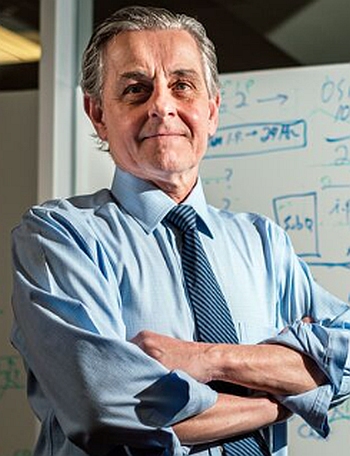
Kevin Tracey: Speeding up progress.
Nixon knows all about impactful medicine. During a long career that’s stretched from Oxford to NYC’s Rockefeller University, from San Francisco’s Gladstone Institute of Virology and Immunology to the University of California-San Francisco, and from D.C.’s George Washington University to Weill Cornell, the scientist has pioneered research on human endogenous retroviruses – sometimes referred to as humanity’s “dark genome” – with multiple advances on neurodevelopmental and neurodegenerative conditions.
At the Institute of Translational Research, the National Institutes of Health Merit Award-winner and his team will look to advance the sciences confronting a wide range of diseases, including cancer, Alzheimer’s disease and other viral infections and mental-health disorders.
It’s a tall order, but Nixon – also an elected fellow of the American Society for Microbiology and the National Academy of Inventors – is the right person for the job, according to Feinstein Institutes for Medical Research President and CEO Kevin Tracey.
“His leadership and pioneering translational research strengthen our mission of ‘producing knowledge to cure disease,’” Tracey, also the Karches Family Distinguished Chair in Medical Research, said in a statement. “His arrival promises an acceleration of work linking the patients in need to the newest discoveries in the lab.”