
By GREGORY ZELLER //
Stony Brook University will attempt to scale fusion power’s difficult “first wall” with a major boost from the U.S. Department of Energy.
 The DOE’s Advanced Research Projects Agency-Energy division has awarded the university $2.5 million in research funding through its Creating Hardened And Durable fusion first Wall Incorporating Centralized Knowledge program. That mouthful (shortened to the tortured acronym CHADWICK) aims to develop advanced materials and manufacturing techniques that enhance the durability of the “first wall” in a fusion power plant – the critical armor surrounding a fusion reactor’s energy-producing core plasma.
In cahoots with scientists at the University of Tennessee-Knoxville, the Massachusetts Institute of Technology and New Mexico-based Sandia National Laboratories, Lance Snead and David Sprouster – both professors in SBU’S Materials Science and Chemical Engineering Department – will leverage the $2.5 million stipend in an effort to increase the thermal conductivity, irradiation resistance and ductility (the ability to permanently stretch or bend in response to stress) of ceramic materials, in hopes of building a better first wall.
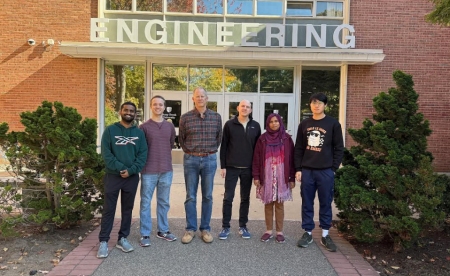
Reaction shot: Professors Snead and Sprouster (center, left to right) and their team in SBU’s Engineered Microstructures and Radiation Effects Laboratory might hold the future of fusion power in their hands.
Dilip Gersappe, chairman of the Materials Science and Engineering Department, applauded the “pioneering work” of the SBU scientists, noting it “could lead to transformative advancements in the durability and efficiency of fusion power plants.”
Fusion reactions – in which two lighter nuclei combine to form a single, heavier nucleus – require fuel and a confined, controlled environment where sufficient temperature, pressure and confinement time to create plasma can occur. Although research began in earnest back in the 1940s, fusion power is still in its relative infancy: Achieving net fusion power is exceptionally difficult and has only happened twice, in fleeting experiments.
A first wall strong enough to confine the fuel during the heating and pressurization process is, ironically, essential to breaking through. Ceramic materials have not been considered a viable first-wall option – they tend to be relatively brittle and to quickly lose thermal conductivity when irradiated – but new ways of thinking are changing that.
 According to Stony Brook, Snead and Sprouster – co-principal investigators of the ARPA-E grant – and their team in the university’s Engineered Microstructures and Radiation Effects Laboratory plan to introduce “second phase additives into low activation, ultra-high-temperature ceramics.”
Their highest hope is a technological breakthrough that propels ceramics to the top of the first wall, unlocking the door to a virtually limitless energy source.
That’s the goal, but simply earning the ARPA-E funding is already a major win for the challenging science of fusion power – and, according to Gersappe, for SBU’s Materials Science and Engineering Department.
“The CHADWICK program represents an extraordinary opportunity for our department and Stony Brook University to contribute to the future of sustainable energy by developing materials that can withstand the extreme conditions of fusion power,” the chairman added.