By GREGORY ZELLER //
Researchers have looked back in time – way back – to produce pictures of our vast universe in its infancy.
 The Atacama Cosmology Telescope, a cosmological millimeter-wave telescope tucked high in the Chilean Andes, has captured images of cosmic microwave background radiation that was visible only 380,000 years after the Big Bang. Researchers equate the images to hours-old baby pictures of a universe that’s now about middle-aged.
The telescope – a joint project of Princeton University, the University of Pennsylvania, the National Science Foundation and the Chilean government – completed its work in 2022 and was subsequently decommissioned. But before it shut down, it made several breakthrough discoveries, including the graphic representation of light that traveled roughly 13 billion years to reach Earth.
An international team of scientists, including Stony Brook University astrophysicist Neelima Sehgal, has spent the last three years poring over the imagery – basically, a snapshot of the afterglow of the Big Bang, the most widely accepted theory on the universe’s origin.

Neelima Sehgal: Light show.
While they are the clearest visualization yet of the baby universe, the images are not sharp-focus photos of black space dotted by young stars. Instead, they present as a sketch of blobs and pixels – like a microscopic view of microbes swimming through a water droplet, or a super-closeup of a blue-orange pizza – with different colors and shapes representing subtle variations in the density and velocity of ancient astronomical gases.
Important point: According to science’s best current guess, the rapidly expanding universe was filled with various gases for hundreds of thousands of years after the Big Bang – a primordial ooze that was so hot and thick that light could not easily pass through it. We envision the universe today as largely open space, but back in the day, it was essentially opaque.
This is what’s captured in the ACT’s universal baby pictures. At first glance, they might not look like much – but to the trained eye, they’re breathtakingly detailed snapshots of the movement of hydrogen, helium and other gasses, en route to the earliest formation of stars and planets.
Atacama Cosmology Telescope Director Suzanne Staggs, the Henry deWolf Smyth Professor of Physics at Princeton University, trumpeted “the first steps toward making the earliest stars and galaxies,” visualized with unprecedented detail.
“We’re not just seeing light and dark,” Staggs noted. “We’re seeing the polarization of light in high resolution.

Suzanne Staggs: Baby steps.
“That is a defining factor distinguishing ACT from [retired European Space Agency space observatory Planck] and other, earlier telescopes.”
The findings, presented this week at the annual meeting of the American Physical Society, reveal answers to longstanding scientific questions about the universe’s origins. Among other things, they refine current theories about the age of the universe.
Cosmologists have disagreed for years about the Hubble Constant, the rate at which space expands. While measurements of cosmic microwave background radiation consistently calculate an expansion rate of about 68 kilometers per second per megaparsec, measurements derived from the movement of nearby galaxies indicate a Hubble Constant as high as 74 km/s/Mpc.
Enter the ACT researchers, including Seghal and her group in SBU’s Department of Physics and Astronomy, who confirm the lower Hubble Constant value – and have even increased its precision.
“With these images, we have achieved a sensitivity over half the sky that surpasses previous ‘baby pictures’ of the universe,” noted Seghal, an associate professor in the Department of Physics and Astronomy who leads an international team proposing a next-generation CMB experiment called CMB-HD – an even deeper exploration of the universe’s fundamental physics.
That project will rely heavily on the Simons Observatory, the ACT successor funded primarily by the Simons Foundation and also located in the Chilean Andes. (Stony Brook University is among an eye-popping international collection of Simons Observatory institutional partners.)
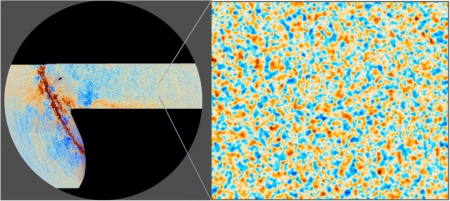
Isn’t it cute: Polarized radiation from 13 billion years ago is on unprecedented display in universal “baby pictures” captured by the Atacama Cosmology Telescope.
But the accomplishments of the ACT – shoring up theories about universal age and expansion rates and offering contemporary science a glimpse at the way things worked 13 billion years ago – cannot be overstated, according to Seghal.
“The sensitivity is particularly outstanding on small scales and in measurements of the polarization of CMB light,” the astrophysicist said. “With this work we have tested the [Standard Model of Cosmology] in different ways and find no evidence of any cracks.”