By GREGORY ZELLER //
Just when you think it’s safe to go back in the water, you might want to wait a little longer.
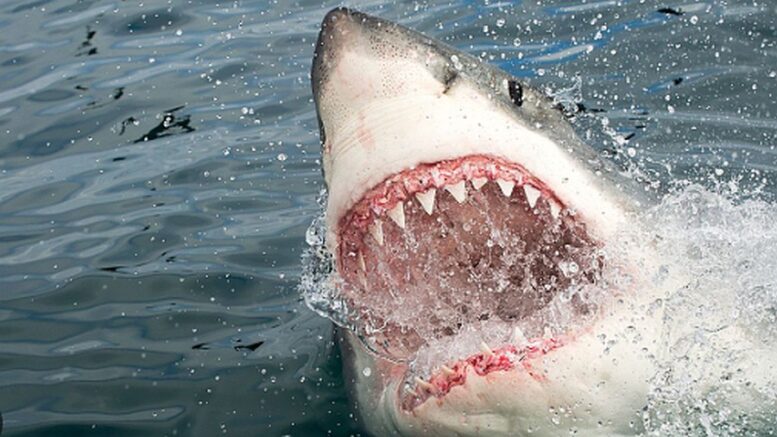
 That’s the word from researchers at Stony Brook University’s School of Marine and Atmospheric Sciences, who led a five-year study showing that certain migratory shark species are swimming – and feeding – in Atlantic Ocean waters off the Northeast coast longer into the Fall season than ever before.
The study – published last month in Conservation Biology, the peer-reviewed scientific journal of the Society for Conservation Biology – followed six shark species over five years via tagging and acoustic tracking.
According to their findings, ocean warming – a well-documented side effect of climate change – delayed five shark species’ southern migrations anywhere from one day to as much as 29 days. Statistically speaking, that’s a signification alteration in traditional migratory patterns with substantial ripple effects on everything from conservation strategies to delicately balanced Atlantic Ocean ecosystems.

Maria Manz: Swimming with sharks.
Led by lead author and SoMAS PhD candidate Maria Manz – whose field of study focuses on shark ecology in the Northeast Atlantic and the New York Bight, a large swath of Atlantic Ocean waters triangulated off the New York and New Jersey coasts – the researchers determined several environmental factors influencing sharks’ southerly migrations, starting with water temperatures.
And as ocean waters continue to warm, according to the SoMAS scientists, it’s likely that annual migratory patterns will be delayed even further.
The study – which ran from 2018 to 2022 – was supported in part by the New York State Department of Environmental Conservation and conducted under research permits granted by the DEC, the National Oceanographic and Atmospheric Administration and the New Jersey Department of Environmental Protection.
It tracked 155 individual sharks of six different species: blacktip, dusky, sand tiger, sandbar, thresher and white sharks. All six species are “highly migratory,” according to the SoMAS, with annual September-October migrations leading them from northern portions of the west Atlantic (from the Canadian coast to the lower Northeast coast) to coastal waters between the Carolinas and Florida.
Leveraging acoustic-tagging technology – a passive form of tracking the involves tags with unique identification frequencies and acoustic receivers positioned on the sea floor – Manz and friends developed mathematical models to predict the movement of each species and identify environmental variables driving their southern migrations.
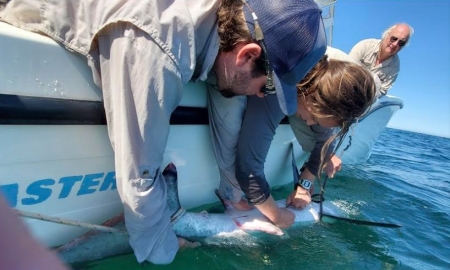
You’re it: Manz (center) tags a thresher shark for study.
With a nod to collaborating scientists along the East Coast, Manz’s team – including SoMAS professors Michael Frisk and Robert Cerrato and Assistant Professor Oliver Shipley – showed how projected sea-surface temperatures across decades may delay southern Autumnal migrations of coastal sharks, “with many species remaining in northern habitats for longer durations,” according to their published paper.
It’s likely that both water temperature and “photoperiod” (the among of time sunlight directly hits the water each day) both “cumulatively influence migratory patterns,” according to Manz – with different effects from species to species, she noted, but all resulting in the same bottom line: More sharks in northern waters for longer amounts of time.
“We also found both regional and species variation in the predicted delay in shark migratory timing,” Manz said. “Our model predictions of migratory timing under future ocean temperatures suggest that species will delay the initiation of their southern migratory timing.”