By GREGORY ZELLER //
An intergalactic survey led by a Stony Brook University astronomer has shed new light on the formation of stars.
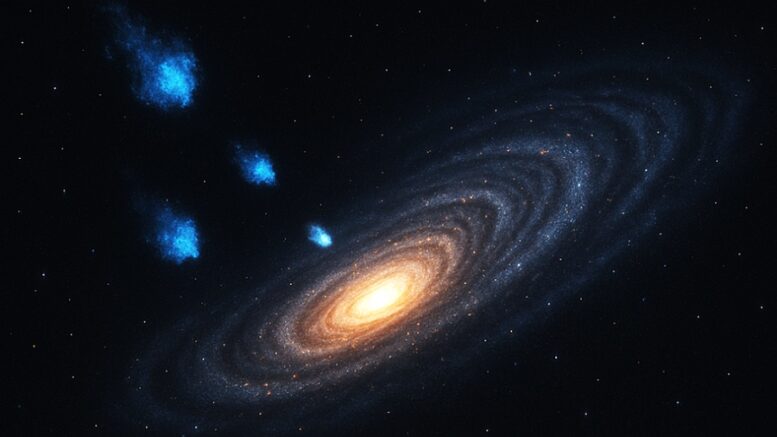
 As told by Jin Koda, a long time ago, 10 high-velocity clouds composed of molecular gases invaded a galaxy far, far away – an incursion Koda, a professor in the Department of Physics and Astronomy in SBU’s College of Arts and Sciences, detected using the Atacama Large Millimeter/submillimeter Array Telescope.
The astronomical interferometer of 66 radio telescopes, located in Northern Chile’s Atacama Desert and known professionally as ALMA, was able to spot the long-ago invasion of the cosmic clouds by determining that the large gaseous bodies were zipping along at ludicrous velocities when they slide into Southern Pinwheel Galaxy M83 – speeds entirely alien to the galaxy itself.
Southern Pinwheel Galaxy 83, known best by the stage name Messier 83, is a spiral galaxy in the constellation Hydra, located about 15 million light-years from Earth. Discovered by 18th Century French astronomer Nicolas Louis de Lacaille, it’s comprised of hundreds of thousands of individual stars and hundreds of supernova remnants, making it one of the brightest galaxies in Earth’s night sky – easily visible with a good pair of binoculars, if you know where to look.

Jin Koda: Star man.
Koda – who collaborated on the survey with a team of international astrophysicists, primarily University of Tokyo scientists Maki Nagata and Fumi Egusa – packed more than a good pair of binoculars on his intergalactic mission.
The team used ALMA to peer back in time and calculate a significant speed differential between those 10 molecular clouds and Messier 83’s rotational constant – a strong indication that the clouds came from beyond Messier 83, perhaps from a galaxy even farther, farther away.
Wherever they originated, the molecule-rich clouds played a major role in the formation of stars in the brilliant pinwheel galaxy.
Galaxies are primarily composed of stars and gas, with various vapors fueling the formation of new suns – an evolutionary process that takes millions of years to unfold. Conventional science estimates that without the arrival of intergalactic gas sources like the clouds Koda and friends detected, a particular galaxy’s gas supply would be exhausted within a billion years or so, bringing new-star formation to a grinding halt.
Egusa, an associate professor in the University of Tokyo’s Institute of Astronomy, suggests only two possibilities explaining the existence of the speedy gas clouds in Messier 83: They’re either molecular fogs created by supernova explosions within the pinwheel galaxy, or they’re from outside the galaxy.
According to Koda, you can scratch Scenario No. 1: “Most of these clouds do not correspond to any known supernova remnants in M83,” he noted, and “their kinetic energies are too high to be explained by a single event,” such as a supernova explosion within the galaxy itself.
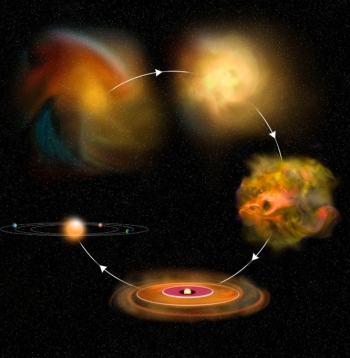
A star is born: Interstellar clouds of gas and dust contract and flatten as they spin, with a new star finally forming at the center — and possibly planets, too, if there’s enough extra material. (Source: ESO Supernova Planetarium and Visitor Center)
Those clues “strongly suggest” that the clouds “must be flowing into M83 from external sources,” added Nagata, a University of Tokyo graduate student.
Supported by two National Science Foundation grants, this first-ever study of high-velocity molecular clouds moving through neighboring galaxies – detailed in a paper published in June by The Astrophysical Journal, a peer-reviewed, 130-year old scientific periodical dedicated to significant discoveries in astronomy and astrophysics – reconfirms longstanding theories about galactic-level star formation requiring billions of years of intergalactic interactivity.
It also uncovers intriguing clues about star formation in Earth’s tiny corner of the universe, according to the survey’s lead scientist.
“[Messier M83] resembles our own Milky Way,” Koda noted. “Therefore, findings there may also provide clues into star formation and galaxy evolution in the Milky Way.”