By GREGORY ZELLER //
State University of New York royalty visited Long Island this week to celebrate a significant expansion of two successful student-retention/college-completion initiatives.
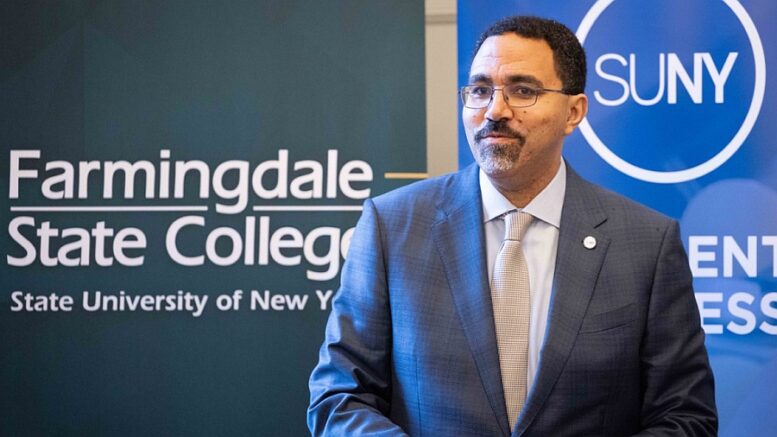
 During a Wednesday tour of Farmingdale State College, SUNY Chancellor John King Jr. trumpeted the proliferation of the SUNY ASAP|ACE programs (for “Advancing Success in Associate Pathways,” which supports students pursuing associate’s degrees, and “Advancing Completion through Engagement,” which supports students studying for bachelor’s degrees).
The joint program – built to offer financial, instructional and programmatic support to financially challenged and other at-risk SUNY students – launched during the Spring 2024 semester, with an initial cohort of 4,270 students across 25 SUNY campuses (including Nassau Community College, Suffolk County Community College and Farmingdale State).
In June 2025, SUNY announced the expansion of ASAP|ACE to nine additional state university campuses – including SUNY Old Westbury – starting with the current Fall 2025 semester. The expansion, which pushed the number of ASAP|ACE-enrolled students past 7,000, leveraged $12 million in allocated funding from New York State’s Fiscal Year 2025-26 budget.
The growing initiatives – which aim to maintain academic momentum and help disadvantaged students graduate on time – is proof-positive that SUNY “is committed to supporting student success,” King said Wednesday.
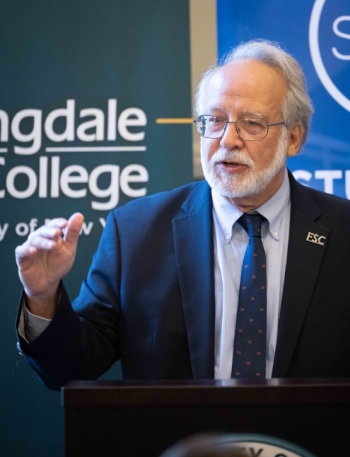
Robert Prezant: Inclusive initiative.
“The continued expansion of our ASAP|ACE programs ensures SUNY students can get important support and services to help them complete their degree on time,” the chancellor added. “ASAP|ACE is a proven, evidence-based strategy to improve student retention and completion.”
By combining the state funding with a $1.5 million grant provided by New York City-based education-support organization Robin Hood – specifically targeting New York City-based students enrolled at participating campuses – SUNY is on course to expand ASAP|ACE to 10,000 students by the Fall 2026 semester. In 2015, Robin Hood also funded the City University of New York pilot program that spurred SUNY’S ASAP|ACE effort.
During the Farmingdale State visit, King and a cadre of elected officials met with faculty, staff and students to discuss the growth and impact of the college’s ACE program. Farmingdale State, which does not currently have an ASAP program, increased participation in its ACE program from 215 students in year one to 230 this year, with the college aiming to boost 250 at-risk bachelor’s-degree candidates by the Spring 2026 semester.
Farmingdale State College President Robert Prezant said FSC was proud to count ACE among its “robust portfolio of academic-support programs.”
“The ACE Program at Farmingdale homes in on three key indicators of success: retention, persistence and graduation rates,” Prezant noted. “Our ACE students become a part of a welcoming and inclusive community, where they meet success through the support of our talented and dedicated staff.”
Both ASAP and ACE offers students access to a wide array of barrier-busting resources, including funding to cover textbooks, groceries, transportation and other academic costs. Comprehensive, personalized guidance and career-development services are also in play.
 According to SUNY, it’s working. Students participating in the ASAP program are earning up to two more credits in their first semester and have posted a 17 percent increase in retention from their first to second terms, plus a 15 percent increase in one-year retention rates.
ACE students, meanwhile, also boast impressive year-to-year retention rates and degree-completion rates as high as 90 percent, SUNY reports.
Those numbers more than justify plans to expand ASAP/ACE, according to King, who credited “Gov. (Kathy) Hochul’s leadership” for the dual programs’ successes.
“I am thrilled to see this model expand across the SUNY system,” the chancellor added. “We will continue our efforts to support more SUNY campuses to implement ASAP|ACE to take full advantage of [these programs].”