
By GREGORY ZELLER //
Stony Brook University’s most ambitious pro-environmentalism platform is taking its climate-health message on the road – more specifically, to the airwaves.
 Known colloquially as “C4E,” SBU’s Collaborative for the Earth – a wide-ranging alliance of multidisciplinary educators, learners and industry experts cultivating ongoing conversations about climate, energy and the environment – is expanding its reach with a special radio broadcast ticketed for nationwide airtime.
Through large-scale summits, local lectures and numerous roundtable discussions, C4E has positioned itself as a networking hub for climate scholarship and environmental stewardship.
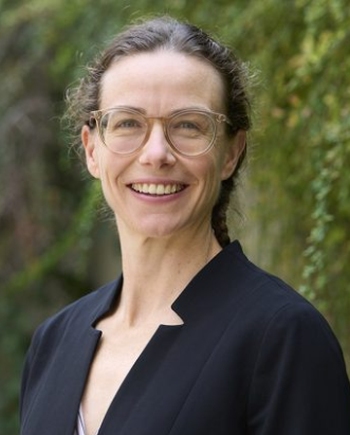
Heather Lynch: Can we talk about this?
Now, the hub is on the air: Its self-titled radio special, to be circulated by Minnesota-based producer/distributor American Public Media, focuses exclusively on nuclear energy’s contentious role in America’s current and future energy mix, as climate change threatens and national energy demands surge, fueled by proliferating data centers and other factors.
Heather Lynch, the C4E director and endowed chair for ecology and evolution in SBU’s Institute for Advanced Computational Science, hosts the one-off production, which dives deep into the history of U.S. nuclear power, current safety and waste concerns and the geopolitical implications of falling behind global stakeholders intent on safer, more efficient nuclear technologies.
The topic is right in C4E’s sweet spot, according to Lynch, who noted the consortium exists “to foster dialogue on the environmental challenges that matter most.”
“Sharing our work with APM brings these conversations to a national audience, extending our mission beyond the lecture hall and into car radios and smart devices across America,” the associate professor added.
 That’s APM’s sweet spot. The Minnesota media house produces and distributes numerous award-winning public-radio programs and podcasts, including National Public Radio’s daily “Marketplace” magazine show, the BBC World Service and the popular New York Times podcast “The Daily,” among others.
Drawing largely on facts and figures from C4E’s second-annual, nuclear energy-focused Stony Brook Global Environmental Forum – which united experts from the New York Climate Exchange, New York University, the Georgia Institute of Technology and across the energy sector for an April 2025 confab on Governors Island – the radio special applies C4E’s trademark multidisciplinary dialogue as it seeks straightforward answers to complex questions about safety, environmental effects and other critical topics.

J.D. Allen: Journalism’s job.
Among the contributors: J.D. Allen, a lecturer in Stony Brook’s Department of Journalism and climate communication specialist in the university’s Office of Marketing and Communications; Lance Snead, the dean’s chair for research in SBU’s College of Engineering and Applied Sciences; Nicholas Fisher, a distinguished professor in SBU’s School of Marine and Atmospheric Sciences; and a cross-section of experts representing Georgia Tech, Stanford University, the U.S. Nuclear Regulatory Commission and other schools and authorities well-versed in U.S. nuclear policy.
“We’re really digging deep to tackle the issues that unite us, but even more importantly, the ones that divide us,” Lynch said. “We want to foster conversation and debate the tough questions surrounding climate solutions.”
The participation of journalists in the C4E radio special – which will be available to participating APM stations through April, with digital-distribution details coming soon – is especially important, according to Allen.
“Journalists have such an important role to play in helping individuals and communities to engage with challenges facing them and find possible solutions,” the climate-communications specialist said. “Serious issues like climate change are going to take people with diverse perspectives, creative ideas and wide-ranging expertise to solve.
“Journalists can bring those people together and help them understand each other.”