
By GREGORY ZELLER //
Serious concerns about governmental leadership are weighing on socioeconomic stakeholders – and optimism about the state of the Long Island economy has lost some ground.
 That’s the primary takeaway from the HIA-LI’s 2026 Long Island Economic Survey, a comprehensive breakdown of fortunes and factors affecting the Nassau and Suffolk business environments, as seen by regional entrepreneurs and executives.
Conducted for the HIA-LI by Adelphi University and New York City-based professional-services titan Citrin Cooperman, the survey queried representatives of roughly 120 Long Island-based organizations – from staffers to the C-suite – on a range of business-sensitive topics, in an effort to capture the region’s socioeconomic mood.
While the report’s executive summary notes “growing optimism regarding the economy on Long Island,” the numbers tell a slightly different story, when compared to HIA-LI’s 2025 Long Island Economic Survey.

Terri Alessi-Miceli: Cautious optimism.
In last year’s report, 52 percent of respondents said they believed the Long Island economy was “Growing Modestly,” with an additional 2 percent saying it was “Growing Rapidly” and a solid 32 percent estimating it was holding steady.
This year, that rosy glow is harder to spot: Roughly 30 percent of 2026 respondents see the Long Island economy as “Declining Somewhat,” with another 8 percent saying it’s “Declining Significantly.” Only 17 percent rate the regional economy as “Improving Somewhat,” with a paltry 3 percent saying it’s “Improving Significantly.”
Also less than stellar are updated revenue predictions. In the 2025 survey, 45 percent of respondents said they met their 2024 revenue projections, while 25 percent said they exceeded those projections and 30 percent said they fell short.
In the 2026 survey, only 14 percent of respondents expect their annual revenues to increase (by 10 percent or more), while 59 percent expect stagnant income and 27 percent expect revenues to decline.
Roughly 26 percent of this year’s respondents project a decrease in their 2026 net profits.
Among the issues currently worrying Long Island business owners the most are inflation (53 percent of 2026 respondents said they expect inflation to increase this year), cybersecurity (82 percent linger between “Somewhat” and “Very” concerned) and increased payroll costs (41 percent identified “Compensation and Benefits” as their top human resources concern).
 Business-development support provided by local, state and federal governments also leaves something to be desired, according to respondents, with 55 percent rating the state/local government performances as “Poor” or “Terrible” and 42 percent giving the federal government the same low marks.
Only 9 percent of respondents rated state/local business support as “Excellent” or “Good,” with partisan policymaking and wild swings on national immigration cited as business owners’ biggest concerns.
Despite this persistent unease, the survey – unveiled Thursday by the HIA-LI in a special program featuring an A-list panel discussion moderated by Citrin Cooperman Partner John Fitzgerald – was not all doom and gloom.
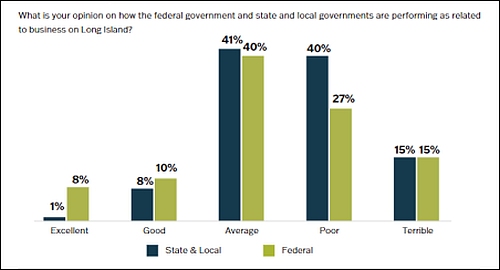
Room for improvement: Survey respondents are not happy with the business-development support provided by the local and federal governments.
A lion’s share of respondents (59 percent) said they believe artificial intelligence will positively affect their business, while a healthy 58 percent indicated plans to expand in 2026 – and an even more impressive 67 percent said they planned to grow their business within the next five years.
Another 14 percent said that despite those compensation concerns, higher wages were in play as a 2026 employee-retention tool, along with work-from-home flexibility (20 percent) and improved worker benefits (9 percent).
Bottom line: As in previous years, the HIA-LI 2026 Long Island Economic Survey is a “cautiously optimistic” snapshot of the regional business climate, according to HIA-LI President and CEO Terri Alessi-Miceli.
 “While concerns around inflation, labor availability and operating costs remain real, a majority of Long Island businesses report plans to expand in 2026, with more than two-thirds anticipating growth over the next five years,” Alessi-Miceli added. “The takeaway is that businesses are responding strategically and making thoughtful decisions to stay competitive in a changing economy, regardless of the challenges.”