By GREGORY ZELLER //
An ambitious fellowship program leveraging key “green economy” technological advancements has wrapped up its first six-month cohort.
 The New York Climate Exchange’s inaugural Climate Tech Fellowship program held its virtual closing ceremonies Feb. 26, with researchers from several institutions – including Stony Brook University, the NYCE’s anchor institution – discussing their work and progress before a widespread audience.
Among the high-profile Climate Tech Fellow Showcase presenters was SBU materials-science and chemical-engineering adjunct professor Stephanie Taboada, who shared promising updates on next-generation hydrogen-storage technologies.
Taboada, also an assistant professor of engineering at Suffolk County Community College, is the founder of HySep, a 2025 startup developing safe and scalable hydrogen-storage systems.

Stephanie Taboada: Vision quest.
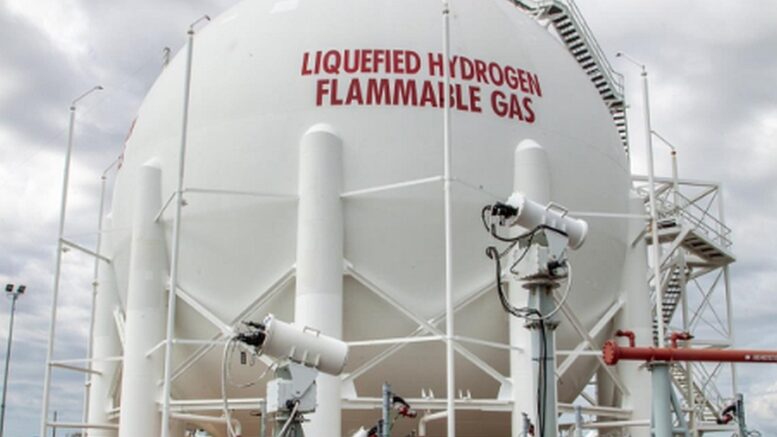
Hydrogen offers the highest energy-per-mass of any established or potential fuel, and with a host of applications preparing to capitalize on that immense promise – from portable fuel cells to hydrogen-powered vehicles to city-scale power plants – hydrogen storage is universally hailed by energy insiders as a critical clean-energy plateau.
In her presentation, Taboada discussed HySep’s quest for solutions that incorporate current energy infrastructure – including natural-gas pipelines and existing industrial-processing facilities – without requiring new buildout.
HySep’s science is a thick blend of chemistry and physics. In a nutshell, Taboada’s enterprise aims to separate hydrogen gas from hydrogen-natural gas blends, store it in a stable solid material (a metal lattice, for instance) and release it on demand.
It’s heady stuff for sure. But “if we can make hydrogen storage practical and safe at scale,” Taboada noted, “we can support decarbonization across transportation, industry and power generation.
“That is the bigger vision,” she added.
Enter the Climate Tech Fellowship, which aims to centralize university-level innovations and give cutting-edge researchers like Taboada the resources they need to avoid the “valley of death” that stalls so many promising ideas. Billed as the NYCE’s debut “signature incubation program,” the first-edition fellowship involved 11 university partners – including SBU, the NYCE anchor institution.
 “There’s no question that climate is impacting our ability to sustain our cities, including flooding, grid failures, rising tides and damaged coastal environments,” Stony Brook University President Andrea Goldsmith, who chairs the NYCE board, said during the October launch of the Climate Tech Fellowship. “This is our opportunity to bring together the brilliant research by Stony Brook and our other partners, the corporate world and government officials to help us understand the policies and mechanisms to bring these solutions to bear.”
The first fellowship cohort was limited to innovators affiliated with the NYCE’s university partners, including professors, PhD researchers, students, visiting scholars and executives-in-residence.
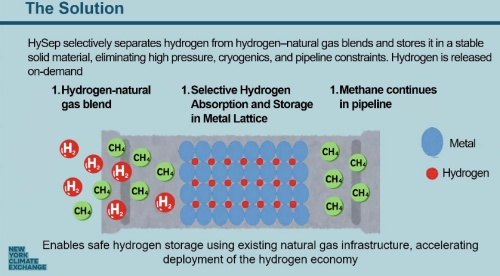
Separation anxiety: HySep’s science is as complicated as it is important. (Source: New York Climate Exchange)
Joining Taboada were representatives of New York University, the City University of New York, the Pratt Institute in New York City, North Carolina’s Duke University and the Georgia Institute of Technology. Their ambitious projects ranged from real-time flood-monitoring systems to construction-site air-filtration technologies to AI-powered analytics platforms for energy providers and large-scale consumers.
Uniting these big thinkers and their advanced ideas in a centralized hub with access to financial support and bench-level scientific talent is a brilliant concept, according to Taboada – and an enormous forward step for projects that can literally save the world.
“This is about building technologies that do not stay in the lab,” the scientist said. “It is about creating beneficial communal solutions.
“As researchers, we are trained to think about discovery and validation,” Taboada added. “The fellowship pushed me to think about potential customers, regulatory pathways and what real-world deployment actually requires.”