By JACI CLEMENT //
Artificial intelligence entering the workforce feels like déjà vu all over again.
 Remember when computers were supposed to revolutionize the world? Free humankind to spend less time working and more time living? The first part happened – although we can debate whether that revolution worked in our favor.
But the second part? Nope.
How naïve we were to trust so readily.
Our current situation finds us drowning in the aftermath of the Information Age. Therapy bills for algorithm gaslighting and bot relationships are racking up. And now artificial intelligence is being touted as the next great transformation – even as many communities are still trying to recover from the last one.

Jaci Clement: Something familiar about all this.
The switchover from analog to digital has been traumatic for everyone involved: news and media, certainly, but also businesses, nonprofits and communities trying to find their footing in a landscape that keeps shifting under their feet.
The truth is, we have a lot to learn from each other. The irony is that trust – the one thing needed to navigate all this – has never been harder to achieve.
The Digital Age has swallowed us whole, making people and places invisible. First, it happened to local news. Then journalism itself began to fade from view. Now entire sectors, industries and even geographies are disappearing from the public conversation.
Important information sits behind paywalls. Junk news and AI slop are freely available. Everyone talks about affordability and maintaining quality of life, but there’s no guidebook explaining how to do that when life as we know it is being rewritten.
Some communities feel the shift far more than others. Long Island, for example, is something of a casualty of the Digital Age. It has always been geographically remote, but technological change has pulled it even further off the map. Long Island news and information largely live inside their own silo. That’s a problem.
Geographies and organizations still functioning in analog mode are only now waking up to the fact that the digital ecosystem made them invisible – and it happened so quietly they may not realize they’ve been operating in crisis mode since 2000.
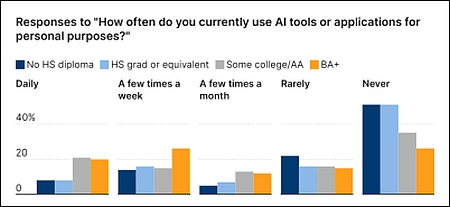
Use it, or…: Personal use of AI tools hasn’t really caught on yet … or so survey respondents say. (Source: AmeriSpeak Omnibus Survey)
Just as communities are beginning to understand that shift, along comes AI, pushing everyone into the next phase of technology before we’ve fully figured out the last one.
Right now, AI’s introduction and its promise are light-years apart. For most of the public, it’s being used like an upgraded version of Google – a faster way to find answers, draft emails or settle an argument. Surveys show searching for information remains the most common use of AI among Americans.
In the workplace, the transformation is even less dramatic than the headlines suggest. The Pew Research Center finds only about 1 in 5 U.S. workers say AI plays any role in their job today, while most say they rarely or never use it at work. At the same time, more than half of workers say they are worried about AI’s impact on the workplace, and very few believe it will create more opportunities.
Does that gap between promise and reality sound familiar?

Job No. 1: Artificial intelligence won’t eliminate the human workforce — but it’s likely to change the nature of human work.
It should. In the early days of the tech revolution, we were promised that computers would usher in an era of efficiency and leisure. Instead, the Digital Age created a new economy built on attention, speed and constant connectivity.
Now it’s happening again.
Out on the West Coast, AI is often framed as a replacement for human capital – a tool designed to eliminate jobs and maximize efficiency. Here on the East Coast, the focus tends to be on innovation that creates better jobs, not less work. (For the record, Long Island is exceedingly good at innovating for humanity, not against it.)
The real question isn’t whether AI will change the nature of work. It’s what kind of future we want it to create.
If the last few decades have taught us anything, it’s that technology alone doesn’t determine the outcome. Culture does. Leadership does. Trust – fragile as it is right now – does.
The biggest threat to humanity may not be artificial intelligence at all, but the absence of human leadership.
Because once a place – or an industry – disappears from the information ecosystem, it doesn’t just lose attention.
It loses influence.
And in the Digital Age, influence is power.
Lose that, and no amount of technology will bring it back.
Jaci Clement is the CEO and executive director of the Fair Media Council. This article was originally published by the Fair Media Council and republished with permission.