By FRANK PICCININNI //
Wastewater infrastructure represents one of the largest public investments many communities will ever make.
 Treatment plants, collection systems, pump stations, force mains and decentralized wastewater systems collectively account for billions of dollars in public assets. Protecting those assets is a matter of both fiscal responsibility and environmental stewardship.
Most people think of wastewater infrastructure as pipes, pumps, tanks and treatment plants. They picture concrete. Steel. Engineering.
They are not wrong.
But they are only describing the structure that contains the process. The actual treatment process is biological.
Regardless of whether treatment occurs in an activated sludge basin, an anaerobic digester, a septic drain field or a constructed wetland, the underlying mechanism is fundamentally the same. Living organisms transform organic matter and nutrients. The engineering determines where and under what conditions those transformations occur.

Frank Piccininni: Living wastewater’s best life.
This distinction may seem obvious. However, it is often overlooked.
Wastewater treatment is frequently discussed as though it were something that happens inside a collection of tanks and pipes. In reality, those structures exist largely to support biological communities capable of transforming organic matter and nutrients.
Remove the engineering and the biology becomes difficult to manage. Remove the biology and much of the treatment process disappears. The two are inseparable.
This observation has practical implications. If biological processes perform much of the treatment, then protecting wastewater infrastructure requires more than maintaining physical assets. It also requires maintaining the biological processes those assets were designed to support.
Roads are maintained before they fail. Bridges are inspected before they collapse. Pumps are serviced before they break. We recognize that infrastructure requires stewardship. Preventative maintenance is often less expensive than emergency repairs because it addresses conditions before they become failures.
Wastewater systems are different in only one respect: A substantial portion of the infrastructure is alive.
Collection systems are often viewed as conveyance infrastructure. Their purpose is assumed to be moving wastewater from one location to another. Septic systems are often viewed as storage and disposal systems. Yet biological processing occurs throughout both.
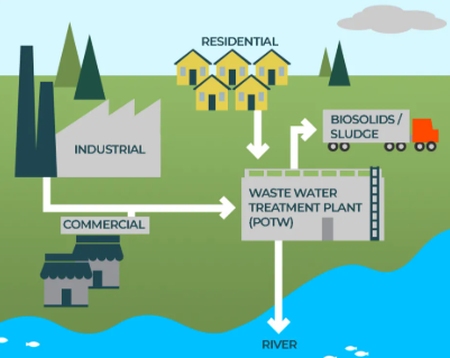
Life cycle: The infrastructure is simple, but the process is complex (and biological). (Source: University of Michigan Center for Sustainable Systems.
Wastewater does not suddenly arrive at a treatment plant and begin changing. Processing begins immediately. Organic matter is transformed. Nutrients cycle. Biological communities respond continuously to loading, residence time, temperature, oxygen availability and countless other environmental conditions. These processes occur throughout the system.
In many respects, treatment begins long before wastewater reaches a treatment facility. This perspective challenges how we think about infrastructure itself.
Roads function because asphalt and concrete remain intact. Bridges function because steel and concrete remain intact. Wastewater infrastructure depends upon the integrity of physical assets as well – but it also depends upon the continued function of biological processes occurring within them.
The infrastructure is not a black box into which wastewater enters and treated water emerges. It is a living system supported by engineered structures.
For more than a century, engineers have become extraordinarily effective at designing the physical structures necessary to support wastewater treatment. That achievement should not be understated.
Yet much of what we call “wastewater infrastructure” exists for a single purpose: to create conditions under which biological processing can occur.
The engineering creates the conditions. The biology performs the transformations.
Recognizing this distinction raises an important question: How should those biological systems be stewarded?
There is no single answer. System design, preventative maintenance, hydraulic management and operational practices all influence biological performance.
Bioaugmentation represents one such approach. By supporting the biological communities responsible for processing organic matter and nutrients, bioaugmentation seeks to strengthen the living infrastructure upon which wastewater treatment ultimately depends.
If much of the treatment process is biological, then protecting public wastewater infrastructure requires more than maintaining concrete and steel. It requires stewardship of the living systems that make treatment possible.
Environmental attorney Frank Piccininni is the co-founder and vice president of the Long Island Conservancy and the cofounder and president of Spadefoot Ecosystems Solutions.