
By MICHAEL H. SAHN //
Reading, writing, arithmetic … and class-action lawsuits?
 As Long Island students return to the classroom, public school districts face numerous legal and policy challenges that threaten their educational and economic viability.
These challenges involve declining enrollment, aging infrastructure, unsteady funding sources and increasing alternatives to public education, such as private and charter schools. Meeting them requires innovative solutions on local and state levels.
There are 125 public school districts in Nassau and Suffolk counties, with a total Island-wide enrollment of 414,059. Simultaneously, about 50,802 students are enrolled in private schools and another 7,000 attend charter schools.
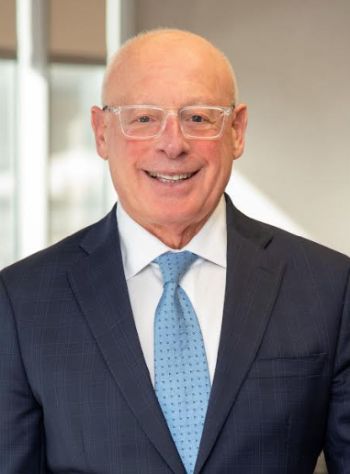
Michael Sahn: Difficult lessons.
There are seven charter schools on Long Island and more are planned. These schools enroll students who would otherwise attend public schools and therefore receive tuition payments from the students’ home districts – siphoning away public-school funding and leading to budget deficits in underperforming or financially challenged districts.
That’s a critical concern for districts like Hempstead, Brentwood and Wyandanch. The loss of funds creates a vicious cycle that puts each district in a hole – a hole that’s even harder to escape in light of significant public-education funding cuts.
Two of the four charter schools operating in Nassau County are located in Hempstead. With another charter school slated to open nearby in 2026, at least half of Hempstead’s students are set to attend a charter school or special-needs site during the 2025-2026 school year.
This equals $107 million in charter-school payments for the Hempstead Union Free School District, creating a $30 million budget deficit and potentially forcing the district to close an elementary school. According to Acting Superintendent Susan Johnson, the district has lost approximately 3,000 students to charter schools in the last two years.
In response, State Sen. Siela Bynoe (D-Garden City) has introduced a bill that would prohibit new charter schools from opening within a five-mile radius of the Hempstead, Uniondale or Roosevelt school districts.
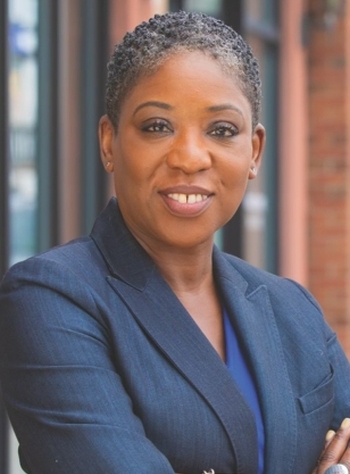
Siela Bynoe: Chartering a different course.
Suffolk County has three charter schools and three more are proposed. Two of those proposed charters – an elementary school and a middle school – are planned in Brentwood and one in Central Islip.
Brentwood has rallied to oppose new charter schools, attracting support from other Long Island districts. At a June meeting convened by the Brentwood Union Free School District, Hempstead Board of Education President Jeffrey Spicer called the establishment of additional charter schools a “cancer” on public school systems due to the increasing drain on district resources.
Residents moving out of New York State and shifting family demographics – including drastic declines in student enrollment from lower birth rates – present further challenges for most school districts.
Statewide student enrollment is at its lowest level since the early 1950s. Island-wide student enrollment dropped 12 percent – from 465,000 to 409,000 – between 2007 and 2022, complicating districts’ long-range plans for staff, teachers and facilities.
Naturally, school aid and other funding concerns also affect public schools.
For the fourth year in a row, the New York State real property tax cap – which is set at 2 percent or the inflation rate, if it’s lower – will be 2 percent, meaning districts must navigate the 2.95 percent inflation rate without a proportionate property tax funding increase. For schools trying to upgrade aging infrastructure, planning for the future based on uncertain, sometimes inadequate tax revenues is an additional burden.
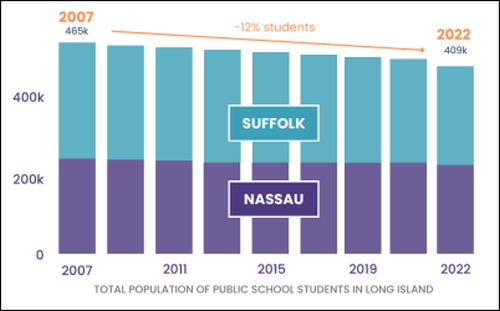
Absence makes the schools grow poorer: Long Island is slowly losing students. (Source: ERASE Racism)
The state has allocated additional money to Long Island districts to help address funding concerns. Overall, Island districts are set to receive an additional $270 million in state aid this school year – a 5.4 percent increase from 2024-2025 aid levels.
But a separate state directive requires districts to provide free breakfast and lunch to all students, regardless of household income; that’s not cheap. And lawmakers are mandating statewide schools to implement a smartphone ban – certain to raise its own logistical, safety and personal-liberty challenges.
To address these concerns, Albany has come up with a Regionalization Initiative that encourages school districts to collaborate with neighboring districts on improving educational opportunities and operational efficiencies. This has met staunch opposition; while sharing resources could help address funding concerns and declining-enrollment issues, some districts – such as Jericho – have voiced concerns about losing local control, funding and resources.
Ultimately, the question for school districts in confronting these challenges is not whether change is coming, but whether lawmakers will come at them with a budget axe to cut costs or a sharpened pencil to formulate a plan that supports the best education for all students.
Michael H. Sahn, Esq., is the managing member of Uniondale law firm Sahn Ward Braff Coschignano PLLC, where he concentrates on zoning and land-use planning, real estate law and transactions, and corporate, municipal and environmental law. He also represents the firm’s clients in civil litigation and appeals.