By MICHAEL H. SAHN //
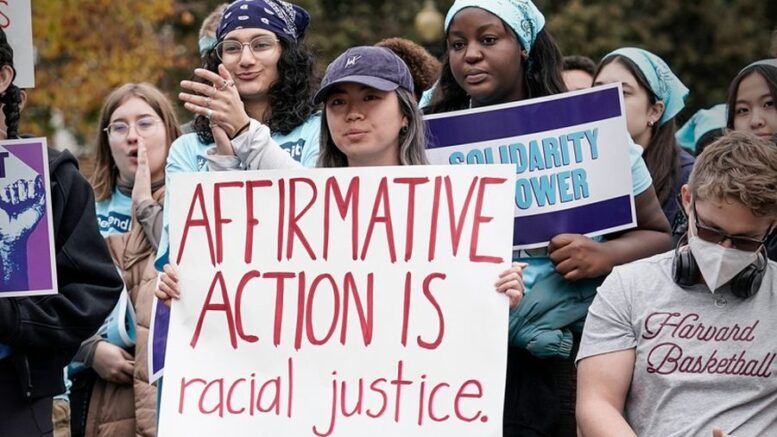
Based on lengthy oral arguments in two recent high-profile cases, the U.S. Supreme Court appears ready to overturn decades-old precedents on Affirmative Action at public and private universities – a potential turning point for colleges on Long Island and everywhere else.
 Petitioners in one case, involving the University of North Carolina, allege that considering race in admissions decisions violates the 14th Amendment’s Equal Protection Clause and Title VI of the Civil Rights Act. All six conservative justices openly questioned whether UNC’s Affirmative Action admissions programs served the “compelling interest” of educational diversity, as opposed to race-neutral distinctions and programs.
The Equal Protection Clause requires that government-imposed racial classifications be narrowly tailored to serve a compelling state interest. Title VI states that no U.S. citizen shall be “excluded from participation in, be denied the benefits of, or be subjected to discrimination under any program or activity receiving Federal financial assistance.”
The Affirmative Action programs the Supreme Court has approved in decisions dating back to 1978 are not numerical quota systems. Instead, they aim to achieve a more diverse student body by giving applicants an admissions advantage – a “plus,” based on race.

Michael Sahn: Action star.
A 1978 decision actually invalidated a minority-quota system at the University of California medical school, while upholding other race-conscious admissions practices. Other SCOTUS decisions – in 2003 regarding the University of Michigan Law School, in 2016 regarding the University of Texas – allowed race as an admissions factor, finding educational diversity to be a compelling interest.
These holdings are now in serious jeopardy.
Ironically, the Court itself is more diverse than ever before, measured by demographic standards. Also ironically, both sides in recent admissions cases have invoked the Court’s landmark 1954 decision in Brown v. Board of Education, which held that “separate but equal” in public education is unconstitutional and mandated the desegregation of public schools.
Petitioners argue this precedent holds that education must be made available to all on equal terms, prohibiting admissions officers from considering a student’s race in an application review – and that Affirmative Action violates this precedent.
The University of North Carolina, Harvard University and others hauled before the Court contend they’re furthering the very goals of inclusive and diverse education that Brown demands.
If SCOTUS reverses Affirmative Action, there will be noticeable impacts on Long Island-based institutions and their students.
Also more diverse than ever is the Island population, with minorities increasing from 31.3 percent of the total population in 2010 to 40.2 percent in 2020, based on U.S. Census data. Long Island’s current high schoolers may face a different application review than their predecessors at elite institutions, where race-conscious admissions practices are more common.

Just getting started: Overturning Roe v. Wade was just the beginning for this SCOTUS.
Long Island is home to 13 higher-education institutions: four 4-year public schools, seven 4-year private schools and two are community colleges. According to CollegeData.com, only the U.S. Merchant Marine Academy and Hofstra University self-report as considering a student’s ethnicity during the application process.
However, all 13 institutions report that they strive for inclusion and diversity on their campuses. Most have Diversity, Equity and Inclusion offices.
The anticipated decision on Affirmative Action is only one of a series of precedent-changing cases this SCOTUS has already considered (overturning Roe V. Wade, for instance) and will be considering. Another with potentially significant impact on Long Island is Merrill v. Milligan, which examines redistricting practices under the Voting Rights Act of 1965 – especially interesting in Nassau County, which is currently redistricting its legislative districts.
Nassau’s Temporary Districting Advisory Commission will carefully watch that Merrill decision. In fact, SCOTUS’s decisions in all these cases matter – a lot – both for our personal rights and the nation’s course.
Commentators pointed to the Roe V. Wade-overturning Dobbs case as a major factor in this week’s midterm elections. No doubt, the Court’s decisions have immediate impacts that will unfold in the months and years ahead.
Michael H. Sahn, Esq., is the managing member of Uniondale law firm Sahn Ward Braff Koblenz PLLC, where he concentrates on zoning and land-use planning, real estate law and transactions, and corporate, municipal and environmental law. He also represents the firm’s clients in civil litigation and appeals.