
By MICHAEL H. SAHN //
Long Island is on the front lines of the battle between the federal government and New York State over Trump 2.0’s aggressive pursuit of government deregulation.
 Deregulation is key to the Trump Administration’s policy agenda and its wide range of economic, social and commercial upheaval – environmental protection, education, transportation, energy, public health and healthcare are all in Trump’s sights.
This battle to undo what is often called the “regulatory state” may not be as scintillating as the fight to disclose the Epstein files or the rocky Trump-Musk bromance. But it has big stakes for Long Island.
“Regulatory state” refers to the government’s reliance on administrative agencies to adopt, implement and enforce regulations that have the force of law. Government by regulations dates to 1887, when the Interstate Commerce Commission was established to regulate railroads.
The approach grew rapidly in the early 20th Century with the New Deal and its delegation of authority to administrative agencies with rule-making powers. Congress essentially gave agencies authority to act and the courts deferred to agency actions, thus giving regulations the force of law.

Michael Sahn: Battle lines.
Despite years of bipartisan criticism and attempts to reign in administrative agencies, government by regulation remains pervasive on the federal, state and local levels. Both Republican and Democratic administrations have used regulatory programs to implement policy decisions.
To do away with regulatory government, Trump’s Justice Department is suing New York and other states that stand in the administration’s way, arguing that the president’s executive orders and mandates preempt conflicting state regulations.
For instance, the administration’s efforts to end New York City’s congestion pricing program are ongoing and remain contested in the courts. The twist here is that Long Island towns and officials also oppose congestion pricing, which some see as an unfair tax on Island commuters.
On the other hand, the administration is rolling back regulations that promote renewable-energy sources such as wind and solar projects and rescind regulations that limit greenhouse-gas emissions in favor of fossil fuel energy sources. As a result, the future of offshore-wind projects – like the Empire Wind farm off Long Island’s South Shore – are in jeopardy.
Empire Wind remains in doubt, even though the administration has lifted its stop-work order halting the project. But even if Empire Wind continues, as Trump attempts to override state regulations and stymie alternative-energy efforts, similar projects are likely to be axed.
Less discussed, but also threatening huge impacts for Long Island, is the reconsideration of rules limiting the amount of “forever chemicals” in drinking water. This comes just as Island water providers are spending millions on GAC systems to comply with Biden-era standards aiming to remove forever chemicals from public water supplies.
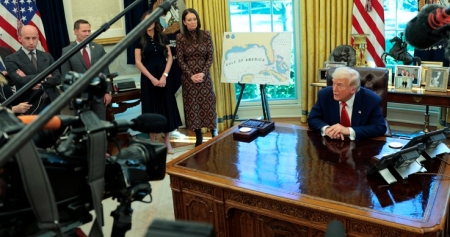
Final say: Trump has issued a memorandum to expedite his deregulatory agenda by eliminating public input.
Changes to the regulations implementing the Affordable Care Act and approving Medicaid benefits, and the U.S. Food and Drug Administration’s regulatory scheme relating to drugs, also impact Long Island providers. The elimination of DEI programs in education has also led to pushback from some Long Island educators.
Notable, too, is the Trump Administration’s fight with the New York State Department of Education over the names of Long Island school mascots and sports teams.
This is but a small sampling of the multitude of issues put in play by the administration’s war on regulatory government. New York and many other states are suing the federal government to block the rescinding of regulations they say are beneficial to the states, such as environmental protections – the “Feds” vs. the “States” in the heavyweight fight of the century.
To be clear, there are merits on both sides of this debate. Regulations that implement policies on important issues protect Long Island, but many Island business and policy groups – such as the Long Island Builders Institute and the Long Island Association – have rightly criticized stifling regulations that restrict businesses from growing, innovating and creating jobs. They advocate strongly for less regulation in important areas like zoning and housing.
The New York State Legislature is now wading in with a proposed law to form a committee to investigate deregulation.
The fact is that the “regulatory state” will not be eliminated, although it will – and should – be curtailed and rethought, with an eye on the best policy outcomes. Balancing the need for appropriate regulations against too few controls is the challenge ahead.
In the meantime, the battle continues in the courts and the legislative chambers – and until a winner emerges, public policy remains in limbo.
Michael H. Sahn, Esq., is the managing member of Uniondale law firm Sahn Ward Braff Coschignano PLLC, where he concentrates on zoning and land-use planning, real estate law and transactions, and corporate, municipal and environmental law. He also represents the firm’s clients in civil litigation and appeals.