By GREGORY ZELLER //
Fifty years later, not much has changed for medical-product consultancy MIDI Product Development – except its ever-evolving technological capabilities, its larger role in the client’s commercialization process and the clients themselves.
 So basically, everything has changed.
Except this: When founder Anthony Montalbano launched Montalbano Innovation and Development Inc. from the basement of his Flushing apartment building in 1971, he envisioned a unique blend of medical science and creative ingenuity – a mantra that still holds true five decades later.
Anthony Montalbano passed away earlier this year. But his next-gen company has long been run by the next generation: sons Gregory and Christopher Montalbano, who took over as principal owners in the 1990s and have led MIDI into a 21st Century filled with increasingly stiff competition, amazing new technologies and endless opportunities to advance global healthcare.
“To me, every project is exciting,” Gregory Montalbano noted. “Whether it’s a small company coming out of Stony Brook University or a Fortune 500 company, we’re working on cutting-edge ideas that make a real difference in the health of individuals.”
Now headquartered in Smithtown and employing a multidisciplined staff of 32 – engineers, industrial designers, ergonomics experts, a prototyping crew – MIDI still has plenty in common with that Queens startup from so long ago, where Anne Montalbano, Anthony’s wife, answered phones and baby Gregory slept in a bassinet under his father’s drafting table.
But “our clients have evolved,” grown-up Gregory told Innovate Long Island, certainly from those earliest days in the 1970s and even from the clientele MIDI serviced when the Montalbano brothers took the reins three decades ago.

Gregory Montalbano: Still thrilled.
“If you dial back even just 30 years, the majority of our clients were medium to very large medical-device manufacturers – General Electric and Medtronic, companies like that,” Montalbano said. “What we’ve seen over the last 10 to 15 years is the growth of startups and other emerging companies.
“That’s become exponential,” he added, “to the point where well over half of our business is working directly with startups.”
This has unavoidably changed MIDI’s own business model. While the drive for the next/the smartest/the best hasn’t changed, the remaking of its client base has forced the master maker to rethink its approach – and, ultimately, expand its services.
“You need to work differently with a startup company than you do with a Fortune 500 company,” Montalbano noted. “You need to help them plan and de-risk more than a Fortune 500 company, which has a full regulatory staff and can de-risk itself.
“As we evolve, we’re not only product consultants,” he added. “We are mentors … ultimately helping the clients get where they need to be, which involves a completely different set of skills.”
To that end, MIDI has expanded its capabilities to become more “vertically integrated,” according to the co-owner, offering clients more of a one-stop shop “with total capability.”
“Now we’ve gotten into full electrical engineering, software and firmware development, AI programming, full engineering, all the way through to commercialization liaison with partnerships with very large contract manufacturers,” Montalbano said. “It’s become full-service, from beginning to end, basically in response to the industry and its particular needs.”

Christopher Montalbano: Family business.
It’s also a bare necessity, in what has always been a competitive field but is now hypercompetitive. Among the differences setting MIDI apart, according to its principal co-owner, are MIDI’s Quality Management System and Design Control documentation, not found at rival consultancies.
“It takes many years of experience to correctly meet FDA Quality System Regulations and ISO 13485 compliance,” Montalbano noted. “This is not something any consultant can readily do.
“We’ve refined our DevelopmentDNA process through the years,” he added. “The methodology of our documentation and safety procedures … is a very unique application for a consultant.”
In addition to its progressive internal policies, MIDI has hung its hat on some major healthcare-related achievements. Among other standout projects, the company was front-and-center when Melville-based Fonar Corp. developed the first commercialized MRI scanner in 1980.
Montalbano remembers that breakthrough well: His father worked closely with Louis Bonnani, Raymond Damadian and other execs at Fonar – just a modest startup at the time – to build and commercialize an entire magnetic-resonance system around Fonar’s proprietary imaging magnet.
“Everything from the design and usability to the structure and electromechanical functionality – the housing, the applications, the controls, all of it,” Montalbano recalled. “Fonar had its own R&D team, but worked with MIDI to create a more multidisciplinary team that really moved the ball.”
Montalbano even remembers a particular Saturday, circa 1979, when he accompanied his father to Fonar’s labs and got a look at the nascent imaging magnet, which looked like “a gigantic steel block.”
“I was 9 years old, so I didn’t know what it was,” he said. “But I remember [Bonnani] saying people would kill to see what I was seeing.
“I saw the first MRI magnetic assembly system ever, before the world got to use it.”
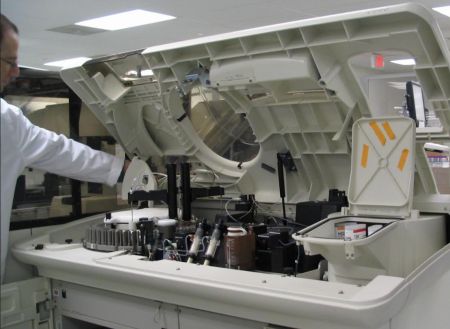
Showing some guts: No technological challenge is too big for MIDI, where engineers and designers always dive deep.
Early experiences like that fueled the Montalbano brothers’ fire for the family business, which hummed along nicely until COVID-19 changed everything – though not so much for MIDI, which was notably well-prepared for the wobbly changes accompanying the pandemic.
“We were always nimble,” Montalbano noted. “Our clients are in California, Hong Kong, Connecticut … we’re used to Zoom meetings and working remotely, so that wasn’t a big jump for us.”
The same couldn’t be said for many of the Smithtown company’s clients. With elective and less-urgent surgeries suddenly paused, several surgical-equipment projects on MIDI’s drawing board were unexpectedly put on hold.
But other programs “ramped up,” according to Montalbano, who noted a dramatic uptick in MIDI’s infection-prevention verticals.
“That was always a sleepy industry – important, but not a major driver,” he said. “But suddenly, we were working on everything from UV disinfection systems to operating room misting systems to unique COVID-detecting diagnostics.”
MIDI also tapped a rich vein in customers who were not used to – and “relatively ineffective” at – working remotely. Suddenly, Montalbano noted, those clients needed to “offload tasks and get MIDI to fill the gaps.”
“Taken together, all that business went beyond the deficit of surgical programs that were put on pause,” he added.
With the pandemic waning and business settling into a more familiar pattern, MIDI and its masters continue to look ahead. Among the company’s recent flagship accomplishments is a portable, cost-effective electronic stroke-detection system conceived by Pennsylvania-based startup Forest Devices; about the size of a lunchbox, the unit can by used by EMTs to detect a stroke in progress, a giant leap past conventional ambulance-based stroke-detection methods, which involve patients squeezing caregivers’ hands and other “analog and subjective” guesswork, according to Montalbano.
“We helped them develop an electronic device that uses AI to analyze brainwaves from both sides of the brain and can definitively detect whether an individual is having a stroke,” he said. “That’s unique and quite disruptive in the industry … if an EMT knows someone is having a stroke, they can bring [the victim] to a particular hospital that specializes in strokes, and that can make the difference between them walking out of the hospital a few days later or being permanently debilitated.”
MIDI worked closely with Forest Devices on the device’s design, firmware, software, electronics, ergonomics, even the disposable cap placed on the patient’s head, and manufactured hundreds of test units for clinical trials now underway in Canada.
Such hands-on contributions to potentially industry-altering advances is what keeps MIDI’s pistons rotating, Montalbano noted, even after 50 years of production.
“I like a lot of things about what we do,” he said. “I like understanding my clients’ needs and their company culture, and I like having unique projects to work on with good people – that’s what really blows my hair back.
“I love the challenges of identifying user and engineering applications, new designs, and pulling all those applications together to generate innovation,” Montalbano added. “When we apply our knowledge and come up with next-step solutions, it’s always rewarding for myself and the team here at MIDI.”