
By GREGORY ZELLER //
Referencing a “once-in-a-generation health crisis” with dramatic implications beyond the physical, the State University of New York system has launched a massive student mental health and wellness campaign.
 Involving all SUNY schools throughout the state – including Stony Brook University, SUNY Old Westbury, Farmingdale State College, Selden-based Suffolk County Community College and Garden City’s Nassau Community College on Long Island – the campaign adds $24 million in system-wide funding to about $35 million in individual-campus investments already made in student-focused mental-health resources.
With the $24 million boost – equaling 5 percent of the roughly $481 million in system-wide SUNY grants – atop the $35 million in campus-based investments, the State University system is pumping nearly $60 million into students’ emotional wellbeing during the 2021-2022 academic year – the “largest single investment in mental health in SUNY history,” according to the system.
Whether you consider it a series of investments or a single buy-in, it’s a necessary expense, noted SUNY Chancellor Jim Malatras, who referenced a COVID health crisis that’s produced alarming rates of depression, anxiety and social isolation among the State University system’s roughly 1.3 million students.
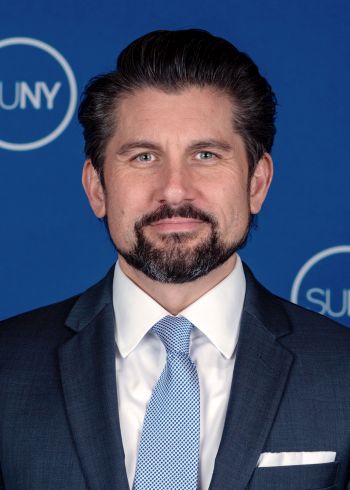
Jim Malatras: Mental breakthrough.
“Our students are dealing with a once-in-a-lifetime health crisis,” Malatras said. “First from the fear of the unknown and being away from family and friends, and now as we readjust to being in-person again.
“Coupled with the normal pressures of college, it is affecting their wellbeing at a higher rate,” the chancellor added. “We can’t expect students to thrive if we can’t be there for them in their time of need.”
Approved by the New York State Division of the Budget, the supersized funding will expand programs and infrastructure meant to directly benefit students facing mental or emotional hardships. On the agenda are additional training for student-facing residential staff – including a better understanding of warning signs – and the creation of “safe spaces” for students in crisis, according to SUNY.
Also planned are expansions of the State University system’s Crisis Text Line, Peer-to-Peer telephone hotlines and campus-based student-counseling networks.
According to Washington-based nonprofit Active Minds, which is dedicated to raising mental-health awareness among college students, 39 percent of all college students experience “significant mental health issues” – and that’s during the best of non-COVID times.
Things have worsened significantly during the pandemic, according to a U.S. Centers for Disease Control and Prevention survey showing the rate of college-age adults (ages 18-24) contemplating suicide jumped dramatically between 2018 – when it was one in 10 college-age adults nationally – and the pandemic’s 2020 “first wave,” when the number spiked to one in four college-age adults.

Charles Schumer: Immeasurable impact.
With the new funding, SUNY – which took significant steps in 2020 and again earlier this year to address students’ emotional wellbeing – is confronting that plague-within-a-plague head on. Citing “two health crises,” U.S. Sen. Charles Schumer (D-NY) trumpeted the SUNY plan to “prioritize the mental health of our students.”
“Many Americans have been faced with … both the physical health concerns of COVID-19 and the mental health crisis that accompanied it,” Schumer said in a statement. “College students in particular have been forced to endure these twin health crises, making it vital that they receive the support they need.
“I know these efforts will make an immeasurable impact on many across the SUNY system,” the senator added.
Malatras – who thanked Schumer, New York’s Congressional delegation and Gov. Andrew Cuomo for helping the State University system obtain the necessary funds for the mental-health push, including funding funneled through the $2.2 trillion CARES Act – framed the $24 million boost as a first step in a larger process.
“Our students are demanding additional services and we hear them,” the chancellor said. “We are providing the help and the tools our students need now to succeed, and we know there is more work to do.
“There is no one cover-all solution,” Malatras added. “We will use this investment to foster a culture where people are trained to come from a place of compassion and armed with the most up-to-date information regarding mental-health issues and healthcare.
“Mental-health needs are very individualized and must be treated on a case-by-case basis.”