By TOM MARINER //
Long Island is recognized as a burgeoning biotech corridor now, though its past biotech efforts “flied under the radar” – despite the region giving birth to important medical-imaging modalities.
 That includes Magnetic Resonance Imaging, the chemistry behind Positron Emission Tomography and even advanced X-ray systems – all created, to some extent, on Long Island.
Twenty-two years ago, a group of talented folks founded Quantum Medical Imaging on Long Island. Quantum Medical Imaging has since become a subsidiary of Rochester-based Carestream Health, but not before it grew to be a “1,000-pound gorilla” in the national and global X-ray imaging fields.
There are important lessons in that growth curve that can be applied to many of our current biotech enterprises and other early-stage ventures.
Quantum Medical Imaging was the brainchild of Scott Matovich, then a vice president at Bennett X-Ray Systems, a veteran Long Island firm that concentrated on mammogram X-rays (now a subsidiary of Summit Industries). Matovich’s leadership skills – ranging from team assembly to product development to marketing to forging relationships with larger companies – quickly drove Quantum Medical Imaging to nine-digit annual revenues.
Tom Mariner: Sharper imaging.
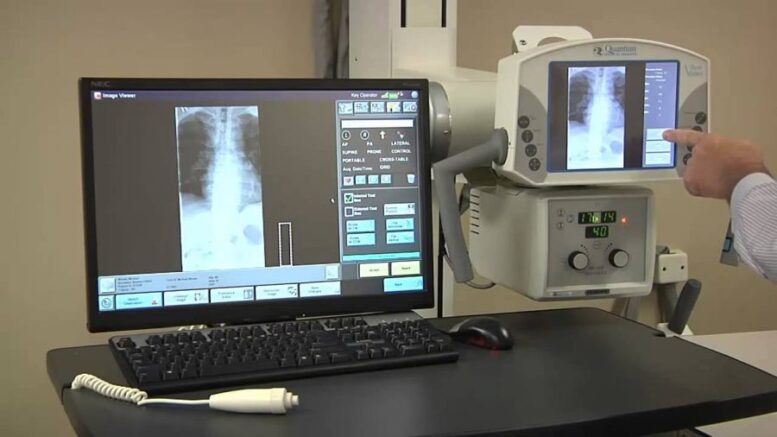
The 1999 startup produced a medical X-ray system consisting of an “X-ray tube” that was fed up to 150,000 volts to emit X-rays that shine through a patient to form an image on a “receptor.” Virtually all of its components were designed, sourced and fabricated on Long Island, then shipped around the world from a Ronkonkoma factory. Many jobs were created.
The basic system includes mechanical structures to hold the tube, the patient and the receptor, surrounded by electronics and software. Sounds pretty basic, as far as X-ray machines go – but the system was not a retread of previous works. As Matovich notes, “We’re probably one of the first new companies in a long time that said we would develop everything brand new – and put some style in it.”
There was definitely some unique style in the system’s operator control panel, used by an X-ray technologist to control the generator that lights up the tube. Competitors at the time used crude electronic displays to convey information; one of Quantum Medical Imaging’s first tasks was to write an operating system that used readable fonts and graphics, making the selected information crystal clear.
Concisely controlling the powerful voltages inside the generator cabinet, and the exacting timing needed for correct exposure, required intelligence with a microcontroller system – just like the one I’d helped develop at General Instrument Microelectronics in Hicksville.
As superb as the systems were, they needed strong marketing. The biggest show for the medical imaging industry was, and is, the annual Radiological Society of North America show in Chicago, where serious players from around the world take a booth to showcase their wares to hospitals and imaging centers.
The normal cash-strapped startup will take a 10-foot-by-10-foot area with curtains. Matovich knew from his marketing successes that it was essential for a company to look viable from Day One, so in 2001, he arranged for 2-story booth and planted it on a 30-foot-by-30-foot spot near the main aisle. Gutsy!
 One of the booth’s highlights was the glowing blue and white computer display in the prototype of the operator control panel, finished minutes before it was shipped from Long Island to Chicago. It was a success – the booth earned a Best New Radiology Vendor of the Year award.
The development crew validated the products shown at RSNA when we shipped a system to a customer a few months later, less than a year from the team’s inception (obeying the “time to market is king” commandment for early-stage firms).
It’s important to note that passion is, and was, essential – everyone on the initial team took a big cut in pay to help establish the company as a major biotech player.
There are many more “lessons” from the tale of Quantum Medical Imaging that apply to Long Island’s up-and-coming biotechnology industry, ranging from innovation to financing to hiring local university students. And, of course, ultimately merging with a larger company never hurts.
Tom Mariner is the chief operating officer of Stony Brook-based SynchroPET and the founder of Bayport-based Kommercialization LLC.