By GREGORY ZELLER //
A major initiative funded by a forward-looking foundation will help the New York Institute of Technology fabricate a brilliant future.
 New York Tech’s School of Architecture and Design this week announced an ambitious computational technologies/digital fabrication strategy, a three-headed plan including the opening of a new robotics laboratory, the recruitment of an internationally renowned educator and the launch of two new master’s degree programs.
The deep dive into 3D modeling, computer-aided design and engineering is funded by a $2 million grant from the New York City-based IDC Foundation, which supports Greater New York educational institutions that train students in fields relating to architectural design and building construction.
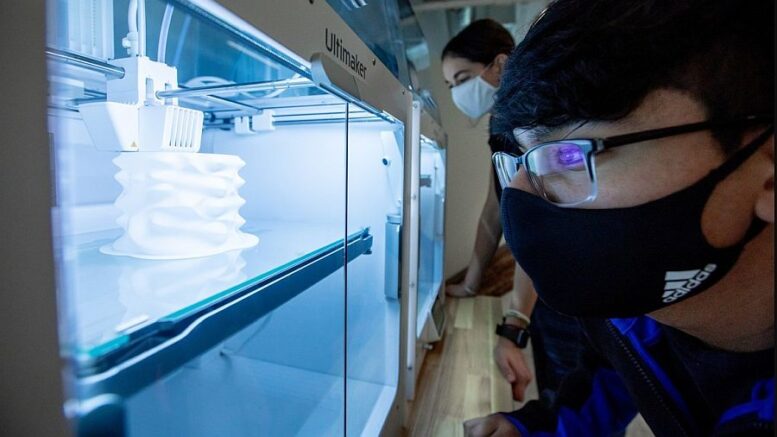
New York Institute of Technology President Hank Foley recently cut the ribbon on the IDC Foundation Digital Fabrication and Robotic Matter Design Labs – a collection of cutting-edge resources that goes by Fab Lab – on the institute’s Old Westbury campus. The Fab Lab unites New York Tech’s Department of Digital Art & Design and the School of Architecture and Design, “tying together the left and the right brain,” according to New York Institute of Technology President Hank Foley.
“When we received the IDC Foundation grant, we realized that it was a real shot in the arm for us, being a school of doers, makers and innovators,” the president said. “We’re really excited to see where [this] will go, especially with the opening of these new labs and the new robotic technology.”

Maria Perbellini: Didn’t even see it coming.
The Fab Lab packs laser cutters, computer numerical control machines, 3D-printing equipment and digital scales for materials of all sizes. It can form a vacuum and boasts various augmented- and virtual-reality simulation tools – everything the budding designer needs to model buildings and advance robotics.
The lab’s mission is to “promote interdisciplinary innovation and facilitate entrepreneurial initiatives,” with students and faculty invited to digitally collaborate at the Old Westbury-based mothership. New York Tech’s Manhattan campus students – along with industry, artists and other “practitioners” – are expected to gravitate, with “new research and grant opportunities” on the horizon, according to the institute.
School of Architecture and Design Dean Maria Perbellini trumpeted an opportunity to “activate new, unforeseen career paths and interests” in students and post-professionals.
“We have developed strategies for the continuous integration of emerging technologies in curricula that impact the profession,” Perbellini said. “Our vision focuses on immersion in an agile learning environment with a variety of fluid degrees, cross-fertilization opportunities and competency-based skills.”
Helping focus that vision will be New York Tech’s first-ever endowed chair: Alessandro Melis, most recently the curator of the Italian National Pavilion at the 17th Architecture Venice Biennale, has been named the School of Architecture and Design’s IDC Foundation Endowed Chair of Digital Technologies.
Melis, a former director of the International Cluster for Sustainable Cities at England’s University of Portsmouth, is “a leader in scholarship, esteemed professional and exquisite educator,” according to Perbellini, who predicted the acclaimed author and frequent international presenter would “chart an innovation-focused approach to research.”
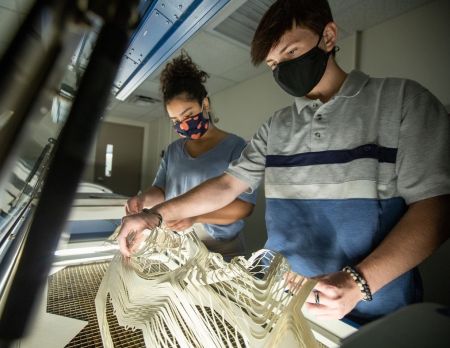
When we was Fab: Students work the cutting-edge laser cutter.
“It is so important, when you have a dream and when you are creating transformative learning experiences, to have people with you who understand where you want to go and what you want to accomplish,” Perbellini added. “We are so fortunate to have those people at New York Tech and the IDC Foundation.”
This is not the first time the IDC Foundation has supported New York Tech’s design designs. The IDC Foundation awarded the School of Architecture and Design a $2 million grant in 2018 and additional funding in 2019, covering scholarships, fellowships and “novel student activities” targeting New York Tech’s maker culture.
Among other things, the institute used those prior stipends to create two new post-professional master’s degree programs, which have both welcomed their first student cohorts. The Architecture, Computational Technologies program focuses on the history of robotics and cybernetics to consider critical relationships between science and culture; the Architecture, Health and Design program aims to design healthier interiors, industrial spaces and products.
That’s precisely the kind of progressive programming the IDC Foundation looks to support, according to foundation President Raymond Savino, who applauded “New York Tech’s growing leadership in this space.”
“The IDC Foundation is pleased to be able to play a key role in the evolution of computational technologies and digital fabrication at New York Tech,” Savino added. “We look forward to seeing what the students and faculty create with these new resources.”