By GREGORY ZELLER //
The future of the national energy industry is now rising off the Long Island coast.
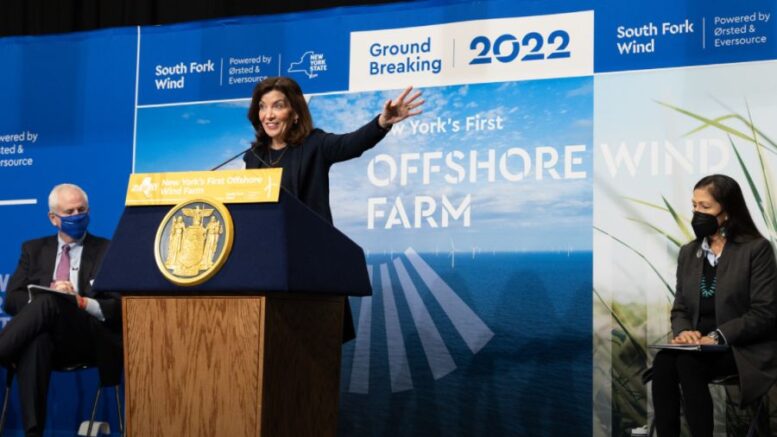
 Construction of the South Fork Wind Farm – officially, New York’s first offshore-wind project and the nation’s second – has officially begun. United States Secretary of the Interior Deb Haaland joined Gov. Kathy Hochul in East Hampton for a ceremonial Feb. 11 groundbreaking marking the start of shoreside construction.
The project – by Ørsted, Denmark’s largest energy company, and Connecticut-based Eversource Energy – aims to produce enough wind-generated electricity to power 70,000 homes by the end of 2023.
That’s right in line with President Joe Biden’s goal of generating 30 gigawatts of wind energy – enough to power 10 million homes – by 2030, according to Haaland.
 “America’s clean-energy transition is not a dream for a distant future,” the interior secretary said at Friday’s ceremony. “It is happening right here and now.”
Haaland joined Hochul and other dignitaries in the Town of East Hampton’s Hamlet of Wainscott, where local residents have waged a court battle against plans for a power-transmission line slated to come ashore on Wainscott Beach, en route to a Long Island Power Authority substation.
The South Fork Wind Farm – a 12-turbine facility located about 15 miles south of Block Island and 35 miles east of Montauk Point – has also drawn fire from regional fisherman, prompting a small demonstration outside Friday’s presser by commercial-fishing supporters.
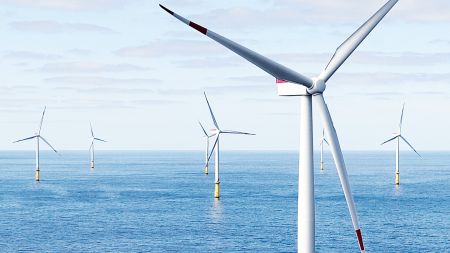
Off and on: Offshore wind could power 70,000 Long Island homes by the end of next year.
But Hochul – like her predecessor, Gov. Andrew Cuomo, who was in charge in 2017 when Ørsted and Eversource Energy approached the LIPA Board of Trustees with their plans – trumpeted the clean-energy benefits of the offshore farm, along with New York’s prominent positioning in the burgeoning offshore-wind industry and the creation of “hundreds of good-paying jobs.”
“The harsh impacts and costly realities of climate change are all too familiar on Long Island,” the governor said Friday. “We are delivering on the promise of a cleaner, greener path forward that will benefit generations to come.
“South Fork Wind will eliminate up to 6 million tons of carbon emissions over the next 25 years, benefiting not only the Empire State, but our nation as a whole,” Hochul added. “This project will also … spur economic growth across the region as we continue to recover from COVID-19.”
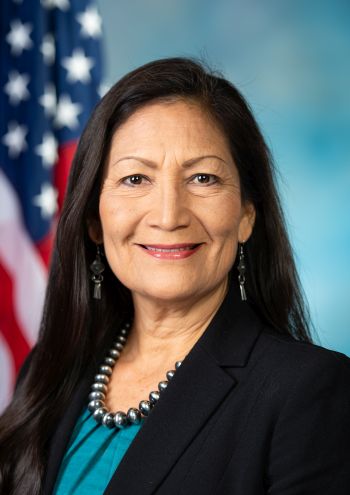
Deb Haaland: No time like the present.
The South Fork Wind project – at least, its ceremonial start – maintains some serious momentum for New York’s offshore-wind ambitions. Already in 2022, the federal Bureau of Ocean Energy Management has announced a highly anticipated “wind auction,” scheduled for next week, that will divvy up 480,000 watery acres off the Long Island coast ripe for wind-power development.
Hochul’s office also announced in January new megawatt power contracts with British multinational BP plc and Norwegian energy company Equinor, officially closing Albany’s second offshore wind competitive solicitation.
Including the state’s $500 million investment in offshore-wind development (a combination of existing deals and new projects lumped into Hochul’s 2022 State of the State address) and the emergence of an Offshore Wind Training Institute administered by the New York State Energy Research and Development Authority, Farmingdale State College and Stony Brook University, Long Island’s offshore goals – after years of stagnation – are suddenly advancing by leaps and bounds.
“New York is setting the example for the nation on tapping into the potential of offshore wind,” New York State Department of Environmental Conservation Commissioner Basil Seggos said in a statement. “South Fork Wind is an exciting and transformative project that will help achieve our state’s ambitious goals to reduce greenhouse gas emissions and ramp up renewable energy sources while safeguarding our natural resources and driving new economic opportunities here on Long Island and across the state.”