By GREGORY ZELLER //
From the Smarter Than You Look File comes an international scientific study questioning decades of presumptions about brain size and intelligence.
 In fact, the study – led by scientists from Stony Brook University and Germany’s Max Planck Institute of Animal Behavior – suggests brain size, in relation to body size, is a fairly lousy IQ indicator.
That’s the premise of “The Evolution of Mammalian Brain Size,” a 22-author research article published this week by the peer-reviewed, open-access journal Science Advances. Relative brain size “has long been a reflection of cognitive capabilities,” note the authors, who also lament “untested assumptions that brain-body allometry is restrained to a stable scaling relationship across species.”
In less cognitive-crunching terms: Bigger ain’t always better for bodies, brains or both.
 The study constructs a timeline of mammalian brain- and body-size evolutions over the last 150 million years. An international team of biologists, anthropologists and evolutionary statisticians measured the brain masses (and fossilized “endocranial volume data”) of 1,400 living and extinct mammals, compared those to each mammal’s body size, then watched as brains and bodies evolved over millions of years.
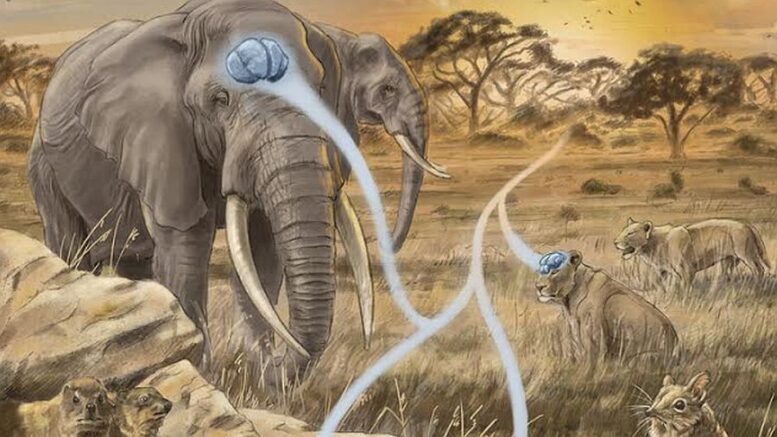
Instead of finding a nice, straight line – bodies grew, brains grew, intelligence grew – the researchers found chaos in the pattern: Intelligent, “big-brained” species like apes, dolphins and elephants, for instance, all attained their current brain-to-body proportions quite differently.
Elephants increased in body size through the megaannums, but their brains grew at an even faster rate; dolphins shrank their bodies while enlarging their brains; great apes generally trended toward parallel increases in body and brain sizes, with corresponding smarts rising.
Meanwhile, ancestral hominins – early us – made like the dolphins, with relative decreases in body size paralleling relative increases in brain size.

Jeroen Smaers: Brains of the operation.
The “big surprise” is not that the evolutions of bodies and brains didn’t follow predictable straight lines, according to evolutionary biologist Jeroen Smaers, lead author of the massive multidisciplinary research article.
The shocker, Smaers said, is that evolutionary leaps seem less connected to physical size than environmental conditions – especially terrible environmental conditions.
“Much of the variation in relative brain size of mammals that live today can be explained by changes that their ancestral lineages underwent following the mass extinction and other cataclysmic events,” noted Smaers, an associate anthropology professor at SBU. “This includes evolution of the biggest mammalian brains … which all evolved their extreme proportions after the climate change event 23 (million) to 33 million years ago.”
Again, the CliffsNotes: Big disasters lead to big brains.
The findings challenge a fundamental life sciences precept, and that’s a tad cheeky. But Smaers has lots of company: Collaborators on “The Evolution of Mammalian Brain Size” represent four SBU departments (or institutes) and the Planck Institute, the renowned German scientific organization committed to understanding and predicting animal behaviors.
Also on board: the New York Institute of Technology’s College of Osteopathic Medicine, the American Museum of Natural History, London’s Natural History Museum, the Smithsonian Institution and an international assortment of prestigious organizations and universities ranging from Maryland’s Johns Hopkins University to the University of Vienna to the Association Vahatra, dedicated to conservation in Madagascar.
The high-caliber multinational mix is confident in its findings, according to the study’s senior author, Kamran Safi, a group leader in the Planck Institute’s Department of Migration.
“We’ve overturned a longstanding dogma that relative brain size can be equivocated with intelligence,” Safi said in a statement. “Sometimes, relatively big brains can be the end result of a gradual decrease in body size to suit a new habitat or way of moving.
“In other words, nothing to do with intelligence at all.”
The study tracks significant brain-size changes around the climate-shifting Oligocene Epoch of about 33 million years ago and the mass extinction of 66 million years ago, when the dinosaurs (literally) bit the dust and mammals took over.
Ultimately, according to Smaers, it suggests that venerable methods comparing brain and body sizes as a measure of a given species’ intelligence must be reconsidered – if not revoked.
“Brain-to-body size is of course not independent of the evolution of intelligence,” the Stony Brook professor said. “But it may actually be more indicative of more general adaptions to large-scale environmental pressures that go beyond intelligence.”