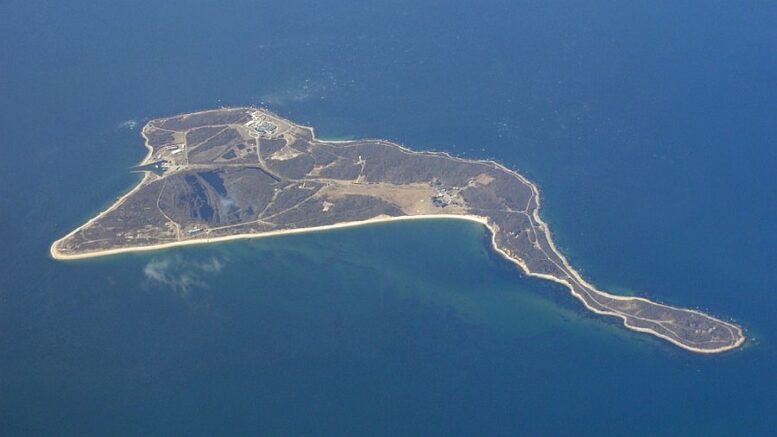
By GREGORY ZELLER //
Regional preservationists have already convinced the federal government not to sell Plum Island to private developers – now, they want the largely undeveloped islet crowned as a national monument.
 So does the Long Island Regional Planning Council, which has announced its support for public/private efforts to establish a Plum Island Preserve – once the Plum Island Animal Disease Center, established in 1954 by the U.S. Department of Agriculture, completely ceases operations.
The Animal Disease Center – which has amassed a fantastic legacy of scientific achievement, nefarious rumor and cultural significance – is expected to complete its relocation to the National Bio and Agro-Defense Facility, a $1.25 billion Biosafety Level 4 laboratory/fortress currently under construction in Kansas, by next year.
When it does, the Preserve Plum Island Coalition – a powerful combo of roughly 120 national and regional conservation groups that pressured the U.S. Congress into calling off a planned Plum Island public auction – wants to ensure that the mostly untouched land remains unspoiled.

John Cameron: Generational opportunity.
After speaking with PPIC representatives at their Feb. 17 meeting, LIRPC members sent a letter to Gov. Kathy Hochul asking her to support ongoing efforts to have Plum Island named a national historic monument, or established as a permanent federal preserve, or both.
Long Island Regional Planning Council Chairman John Cameron called it “a once-in-a-generation opportunity to permanently protect a significant natural and historic resource.”
“Now the challenge remains to find the best way to permanently preserve the Island, which is … unique in its natural resources,” Cameron said Thursday. “As the region’s leading planning body representing Suffolk and Nassau counties, we strongly support the PPIC’s continued efforts.”
History is certainly on the preservationists’ side. The 822-acre island, located in Gardiners Bay about a mile east of Orient Point, is home to significant artifacts and historic buildings, including the circa-1869 Plum Island Lighthouse and the circa-1897 Fort Terry army barracks, both of which are already listed on the National Register of Historic Places.
Records of European settlers on Plum Island date back to 1659, when one settler was said to purchase the pork chop-shaped strip of land – for 100 fishhooks, fresh biscuits and an old coat – from Chief Wyandanch, representing regional Indian tribes that frequented the island.
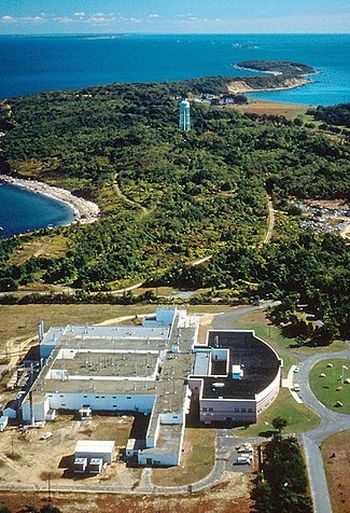
Moving out: The Plum Island Animal Disease Center is relocating to Kansas.
Despite those relics and the 68-year-old Animal Disease Center, roughly 90 percent of Plum Island – part of the U.S. Department of Homeland Security since 2003 – remains undeveloped, creating an ecological treasure chest that includes a 97-acre freshwater wetland and multiple wildlife breeding grounds.
The once-endangered piping plover lives in the pristine island, which is visited annually by some 228 migratory bird species and a large contingency of Atlantic Ocean gray and harbor seals.
Combined with the Animal Disease Center’s long record of protecting the nation’s agricultural assets from transboundary animal diseases like foot-and-mouth disease and African swine fever, Plum Island is already a living monument to American history – and conservationists want to make sure it stays that way, according to Louise Harrison, New York Natural Areas coordinator for Connecticut-based Save the Sound, the PPIC’s parent organization.
“In December 2020, our congressional champions delivered the island from a disastrous fate on the auction block,” Harrison said in a statement. “Now, we rally once more to transfer Plum Island from the Department of Homeland Security to an agency that will carry out the region’s vision.
“We’ve learned there is broad consensus for environmental conservation, historic preservation and discovery and celebration of shared cultural heritage on Plum Island, with sustainable, managed public access,” Harrison added. “We’re calling on our elected leaders to recognize this nationally significant asset off the East End of Long Island.
“Having the LIRPC’s support is essential to our efforts.”