
By GREGORY ZELLER //
Long Island biomedicine is about to be remade, with Stony Brook University leading the way.
 The flagship State University of New York institution has been selected to lead an innovative network of regional biomedical-research facilities pursuing breakthroughs across the healthcare spectrum.
Brookhaven National Laboratory, Cold Spring Harbor Laboratory and the Northport VA Medical Center are in the fold, along with SBU’s Long Island High Tech Incubator and other components of the university’s comprehensive business-incubator system.
Leveraging a $10 million federal stipend, the Long Island Network for Clinical and Translational Science will seek to “accelerate the public-health impact of research,” according to SBU, which will serve as LINCATS headquarters.
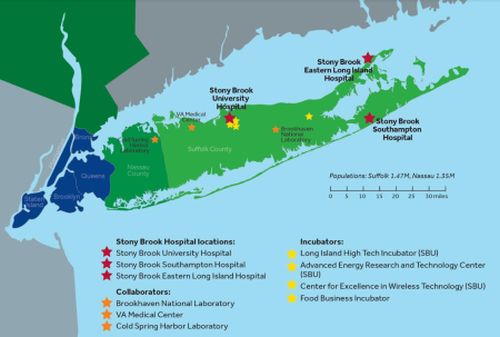
What a lineup: A biomedical Murderer’s Row, with SBU leading off.
The network’s primary mission: Speed all that transformative research to the masses, particularly the members of Long Island’s underserved communities. Everything from basic research to clinical trials will be in play, with LINCATS member institutions incorporating bioinformatics, artificial intelligence, telehealth, genotyping, proteomics and engineering-driven medicine on their biomedical quest.
The $10 million stake is a fraction of the $1.5 trillion Fiscal Year 2022 federal spending package approved this week by the U.S. Congress – but it’s enormous for the LINCATS members and for Long Island, according to Stony Brook University President Maurie McInnis, who credited U.S. Sen. Chuck Schumer (D-NY) with ensuring the innovative network got a running start.
“I am incredibly grateful to Senator Schumer for securing such crucial funding,” McInnis said Wednesday. “Through LINCATS, the entire Long Island community and the greater New York region will have access to a comprehensive health-research network that is capable of a rapid response to emergent healthcare risks, including a future global pandemic.”
The initial funding will be used to scale-up LINCATS operations and create an ecosystem that can fast track new scientific discoveries made at the member institutions, particularly breakthroughs in clinical medical care.

Chuck Schumer: Map maker.
Core personnel and equipment will be budgeted first, with a new inpatient research unit at Stony Brook University Hospital – designed specifically to facilitate clinical biomedical research – in the works.
The National Institutes of Health has been supporting similar research hubs for the last several years, with regionally focused translational science awards heading to the University of Kentucky, Rhode Island’s Brown University and the University of California, Davis, among other institutions.
Richard Reeder, SBU’s vice president for research, framed LINCATS as a direct response to the NIH’s “call to action to create research hubs designed to expand and elevate the bench-to-bedside ecosystem within communities nationwide.”
“We are fully committed to supporting this prominent team of biomedical researchers and practitioners who are set to lead and deliver groundbreaking discoveries,” Reeder added.
The NIH investment could also offer dividends beyond the biomedical: Organizers expect to catalyze hundreds, possibly thousands of new jobs across the regional bioscience sector, particularly as the Long Island network ramps up and tackles specific healthcare challenges within local communities.
Schumer said he included LINCATS in Congress’ budget plan to “bolster continued success and innovation” at BNL, CSHL and SBU, and predicted the investment would result in “a hub for world-class scientific research and groundbreaking discoveries.”
“Not only will LINCATS put Long Island on the map as a center of clinical healthcare research, it will help provide innovative new treatments to benefit more patients throughout the region,” the senator said in a statement.