


By TERRY LYNAM //
For the first time in more than 60 years, gunshot wounds have overtaken motor vehicle accidents as the number-one killer of American children.
 While certainly a testament to progress in vehicular safety, this grim statistic speaks volumes about our nation’s inability to curb gun violence. According to an article published last month in the New England Journal of Medicine, the U.S. Centers for Disease Control and Prevention reported a record 45,222 firearm-related deaths in the United States in 2020 – and about 10 percent of those victims (4,357) were ages 1 to 19.
Coinciding with the start of the COVID-19 pandemic, 2020’s overall firearm deaths were 13.5 percent higher than 2019’s total. But those child/adolescent fatalities jumped nearly 30 percent year-over-year – and while 65 percent of reported gun-related deaths among adults were suicides, the reverse was true for young people: nearly seven-out-of-10 gun-related fatalities in the under-19 population were homicides.
These increasing firearm mortalities represent “a longer-term trend,” according to Jason Goldstick, a research associate professor of emergency medicine at Michigan Medicine.

Terry Lynam: Aiming high.
And they “demonstrate that we continue to fail to protect our youngest population from a preventable cause of death,” says Goldstick, who co-authored a recent letter to the NEJM discussing firearms-related deaths among U.S. children and teens.
While the statistics underscore the severity of the nation’s gun-violence crisis, they don’t explain why so many more young people are becoming victims. More researchers are now looking into the epidemic’s underlying causes, but they have a lot of catching up to do.
Unfortunately, research was stymied for nearly a quarter-century by a Congressional budget provision that effectively prevented the federal government from funding gun-violence studies that “may be used to advocate or promote gun control.” The funding-freeze provision – supported by the National Rifle Association and enacted in 1996 – was finally lifted in late 2019.
In the late 1960s, motor-vehicle accidents on U.S. highways killed more than 55,000 people every year, including about 23,000 people ages 24 and younger. By 2010, the annual number of motor-vehicle fatalities had dropped to about 35,000, including 8,668 young people – and by 2020, while overall U.S. car-crash deaths were slowly creeping up, fatalities among those 24 and under were still dropping (8,237).
These successes can be attributed to a concerted public-safety campaign by the National Highway Traffic Safety Administration and other federal and state agencies, most notably including the adoption of mandatory seatbelts and child-restraint devices. Decades of road improvements, tougher enforcement standards, refined impaired-driving laws and better education of teenaged drivers also helped.
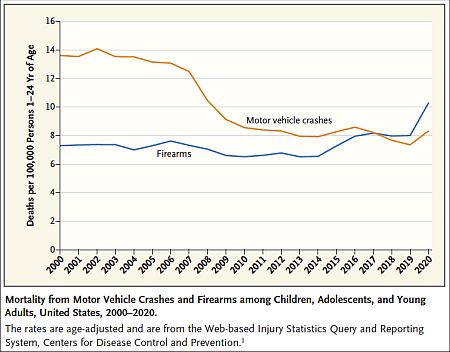
Bad road: Among young Americans, gun deaths have shot past vehicular deaths.
For a variety of reasons – including hollow arguments that stronger gun-safety laws will infringe on Second Amendment rights – the same concerted effort has not been made to reduce firearm deaths. But, recognizing a true public-health crisis, a growing number of health systems and hospitals nationwide have become more active in pursuing strategies to reduce gun violence in the communities they serve.
Northwell Health created a Center for Gun Violence Prevention in 2020. The center has already convened three national forums and last year created Gun Violence Prevention Learning Collaborative for Health Systems and Hospitals, uniting more than 500 healthcare professionals from 35 states; the collaborative holds monthly virtual meetings to share ideas and best practices for mitigating street violence and suicides.
Meanwhile, after the federal freeze on gun-violence research was lifted, Northwell became one of the first recipients of a National Institutes of Health grant funding efforts to screen patients for gun-violence risks.
Since November, clinicians at South Shore University Hospital and Cohen Children’s Medical Center have been posing new questions to thousands of emergency room patients, such as: “Do you have access to a firearm within or outside your household?” and “Have you heard gunshots or has someone pull a gun on you?” Teenagers are also asked if they’ve gotten into serious physical fights, and whether their friends carry knives, razors or guns.
The intent of those screenings is not to take away people’s guns or report them to law enforcement, but to help clinicians determine if patients are at risk – are weapons in the home stored properly and away from kids, for instance? – and suggest positive changes. Based on these discussions, patients may be offered gun-safety locks, information on proper firearm storage, connections to community-based violence-intervention programs and other valuable resources.
The healthcare industry has risen to public health challenges before. It’s driven shifts in public opinion and policy on smoking and other topics that have been historically stigmatized, such as HIV and substance-use disorders.
The hope here is that healthcare professionals can rise above the political gridlock we see in Congress, depolarize gun-safety conversations and use their public-health lens to reduce the bloodshed.
Terry Lynam is a communications consultant and former senior vice president/chief public relations officer for Northwell Health.





If you eliminate suicides, criminals shooting people, and cops shooting criminals, the number of gun shot victims is minuscule. Especially when over 80 million people own more than 400 million guns. And in your research study? Those children are mostly made up of gang bangers 14 and up. Instead, you word your opinion piece in a way to make people think that 7 year olds are dying like flies.
The problem isn’t guns. It’s culturally damaged, inner city folks who think that it’s smart to solve petty disagreements with gunfire. In my Massachusetts, middle-class neighborhood, everyone is armed to the teeth, yet there is no gun violence.
Well stated Bosco! I would add that a physician asking me about my household and my personal possessions is way out of his or her lane.
Two words: “Boundary Violation”
“Eliminating criminals shooting people” is the point. “Gang bangers 14 and up” like that’s ok? Nobody is coming after your guns, Bosco. But as Parkland, Columbine and Sandy Hook have shown it’s not just “culturally damaged inner city folk” doing the killing. Your thinly veiled racism aside, why can’t you just enjoy your super safe middle class life, pray that it never happens there and let the professionals help those who need it? What are you so afraid of?
Unless and until a physician presents me with a graduation certificate from a nationally recognized and honored gun-training school they have no right or authority to offer me or anyone else advice on firearms, firearm laws, and firearm culture. Can you say “malpractice lawsuit” if their advice is followed and proven disastrous.
Okay, Murph… show us how doctors suddenly turned into “firearm professionals.” Give detail. Be specific. And you do realize that trying to fit a non-working solution for the exceptionally rare seven years olds getting shot into a working solution for the vast majority of shootings done by gang-bangers is sorely lacking in your desire for “common sense” gun laws? And please tell us, again with detail and specifics, which laws would have prevented Parkland, Columbine and Sandy Hook. And YOU are the one who is “afraid” of guns. YOU are the one who would, yes, “take them away”. Unless you want to state for the record that you have no problem and agree that people have the full right to buy, build and own AR-15 style rifles, easily concealable handguns, and 30 round magazines.
Ok, Burt… Why do doctors have to be firearm professionals to offer suggestions on how to promote gun safety? And who said anything about laws? My point of bringing up Parkland, Columbine and Sandy Hook was to show this is not just an inner city problem. And even if it was just an inner city problem wouldn’t we still want to do whatever we could to try to save a life?
And there is a lot of real estate between “no guns” and the full right to buy, build and own AR-15 rifles.
Klamath Falls, Oregon Herald and News: Sunday, October 22, 2017/Letters To The Editor
‘Gun violence’ a term that means nothing
With total contempt I read Daniel Hernandez’s Oct. 8 elitist anti-gun “LBJ/KGB” style commentary: “For gun reform, thoughts and prayers don’t work-laws do.”
The distorted term “gun violence” was pontificated six times! Comrade V.I. Lenin and Leon Trotsky would have called this writer a “useful idiot.” With the recent horrific Oct. 1 massacre of 59 innocent bystanders in Las Vegas, by a deranged and depraved sociopath, the anti-gun elite in both house of Congress in Washington, D.C. (mostly deluded Democrats, but including too a remnant of RINOs (Republican In Name Only) have already predictably pontificated the parroted term “gun violence.” They love dancing in the blood of the dead murder victims, and thus are exploiting this horror to advance their “class warfare” political agenda.
There is no such thing as “gun violence.” This is a focus-group-driven buzzword and socialist anti-gun cliché talking point to create an imaginary demonic villain as the main anti-Second Amendment propaganda tool.
While there exist evil, godless, depraved individuals who perpetrate lawless criminal violence with guns, there are numerous others who perpetrate the same without them. And, since the morally and intellectually dishonest parroted term “gun violence” is a catchword/cliché, the title suggests an unattainable goal.
People have been robbing and killing other people, using the weapons of the day, since the dawn of history, which identifies the real issue: controlling criminal impulses in humans, not the otherwise legal instruments they use to commit crimes. Anyone who doesn’t realize and/or acknowledge this isn’t thinking, and are into a denial syndrome. Our liberty cannot depend upon what anybody “feels.”
Without going on further I endorse reading the online commentary: “The Last Civil Rights Struggle? Discrimination and prejudice are still encouraged, gun owners have taken it long enough,” by Alan Korwin.
James A. Farmer, Merrill
Merrill, Oregon (Klamath County) Long Live The State of Jefferson!
Okay, Murph, so you agree that doctors have little to no training as firearm professionals. yet you stated we should listen to the professionals, eh. So which is it? I personally would go with the advice and counsel of those who have trained with firearms and know how to use them, as opposed to doctors who are operating far outside their boundaries and knowledge base.
And ~now~ you don’t want to talk about laws when you are put on the point of showing that you can’t actually name a “law” that is going to be meaningful?
It is, largely, an inner city program. The vast majority of teen deaths by the misuse of firearms are caused by inner city problems. I know that. The Dear Readers know that. And you actually know that also. Again, though, it is something you just cannot admit to. God forbid that you would be considered a “racist” for admitting the truth of the matter.
And, so, you DO want to take guns away from people. You just cannot be honest about it, though, can you.