By MICHAEL H. SAHN //
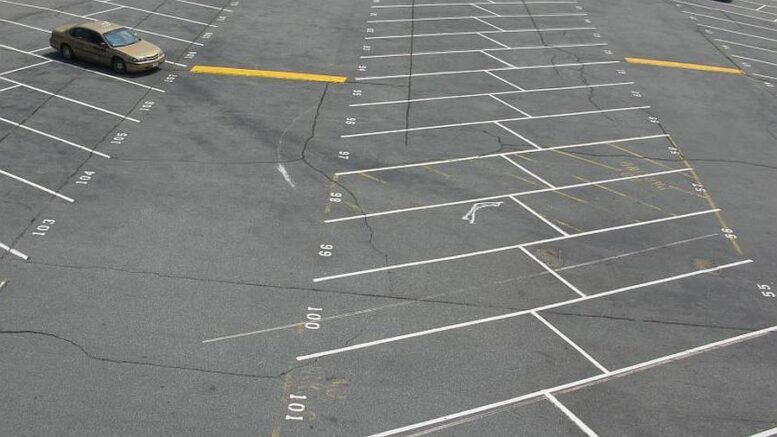
It’s time to take back Long Island’s “seas of asphalt.”
 New planning and zoning concepts and laws that revise and significantly reduce minimum off-street parking requirements will help do that. The idea is to improve quality of life and reduce carbon emissions by limiting “impervious surface” parking areas – either by reducing parking minimums for various developments, or imposing parking maximums, or both.
This creative, new parking-reform movement is catching on. In pockets across the country, it’s increasingly part of efforts to reevaluate land-use regulations and change our car-dependent economy.
Extensive, often unneeded parking facilities dot our Long Island landscape. Large retail stores, malls, office complexes, conference centers, warehouses, industrial facilities, government campuses – all have remote parking areas that most often lie empty, inconvenient to visitors or tenants and simply unneeded in a remote-work economy. Look no further than the massive, completely underutilized Nassau Coliseum property.
Michael Sahn: Lotsa parking.
Almost every municipal zoning and land-use code requires a specific amount of parking per square footage, depending on the property’s particular use. For instance, office and retail uses often require one parking space for every 200 or 300 square feet of building area, and one space for every 600 to 800 square feet of warehouse or industrial space.
The Town of Oyster Bay recently enacted a law requiring one space per employee – and no less than one space for each 500 square feet of gross floor area – for warehouse, distribution and storage uses. Similar zoning codes impose minimum parking requirements on restaurants, hotels, recreational uses and healthcare facilities.
That’s a lot of parking spaces and a lot of hardscape asphalt.
Meanwhile, large last-mile distribution centers are being planned and built all over Long Island – with some estimates counting up more than 11 million square feet of these huge warehouses planned or underway.
According to current zoning laws, this could lead to 15,000 new parking spaces across Long Island – including aisles and driveways, more than 120 acres of land devoted to new parking, on top of Long Island’s hundreds and hundreds of existing asphalt acres.
Forward-thinking planners say deregulating parking requirements and letting owners and developers determine their own parking needs – even legislating parking maximums – will protect valuable land from nonproductive development, encourage more reliance on public transportation and mass-transit shipping options and otherwise discourage suburban sprawl.
The non-profit advocacy group Strong Towns has made reducing or eliminating parking minimums a centerpiece of its programs to reduce development costs and encourage more sustainable commercial and residential growth. The 501(c)3 nonprofit notes that many American cities have already eliminated parking minimums.
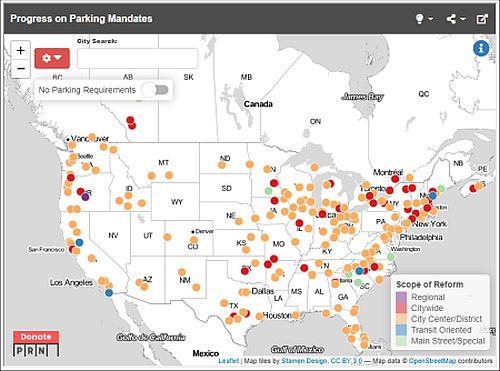
Minimum effort: Many U.S. cities are making progress on parking mandarts, according to the Parking Reform Network.
According to the American Planning Association, those cities should be experiencing lower construction costs: Building fewer parking spaces, the APA says, decreases development costs – the direct costs of building parking lots times the spatial costs of eliminating other profitable uses – and by extension encourages more commercial and residential growth.
Obviously, eliminating parking minimums is not a one-size-fits-all solution. But notable plans are in process for parking reform across the country, including a likely change in New York City.
Property location and use should always dictate the appropriate rules – an idea that’s undeniably gaining steam. Long Island should be a leader in these creative solutions. The best course to a greener, more sustainable future may be straight through our seas of asphalt.
Michael H. Sahn, Esq., is the managing member of Uniondale law firm Sahn Ward Braff Koblenz PLLC, where he concentrates on zoning and land-use planning, real estate law and transactions, and corporate, municipal and environmental law. He also represents the firm’s clients in civil litigation and appeals.