By GREGORY ZELLER //
Stony Brook University scientists are sounding alarms over an evolving fisheries crisis – a global concern already decimating economically critical industries in Long Island waters.
 A new study led by SBU School of Marine and Atmospheric Sciences graduate Stephen Tomasetti, now a visiting assistant professor of environmental studies at upstate Hamilton College, and SBU Endowed Chair of Coastal Ecology and Conservation Christopher Gobler demonstrates that multiplying summer heatwaves and warming ocean waters have virtually eliminated production of bay scallops in the Peconic Estuary – and placed other Northeast estuaries at similar risk.
With Peconic Bay scallop production down 99 percent (including a 2019 die-off and further 2020 complications), the U.S. Department of Commerce declared a federal fishery disaster in 2021. The declaration qualified the regional fisheries for disaster assistance from the National Oceanic and Atmospheric Administration and other federal agencies.
In a study published recently in the peer-reviewed scientific journal Global Change Biology, Tomasetti and Gobler and several collaborators trace the Peconic Bay die-off to extreme summer temperatures – increasingly frequent as climate change deepens – and warn that the collapse of the New York fishery is only the beginning.
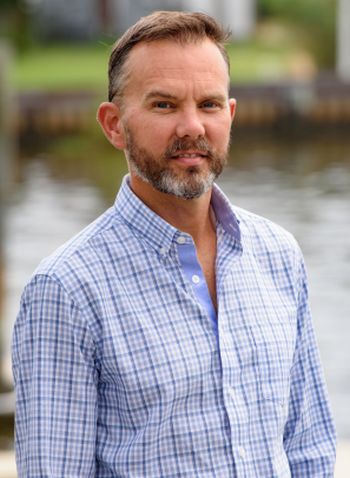
Christopher Gobler: Warming up fast.
“Global warming is happening at an uneven pace in space and time,” noted Gobler, the paper’s senior author. “It just so happens that summer water temperatures in the Northeast are increasing at a rate more than three times the global average.”
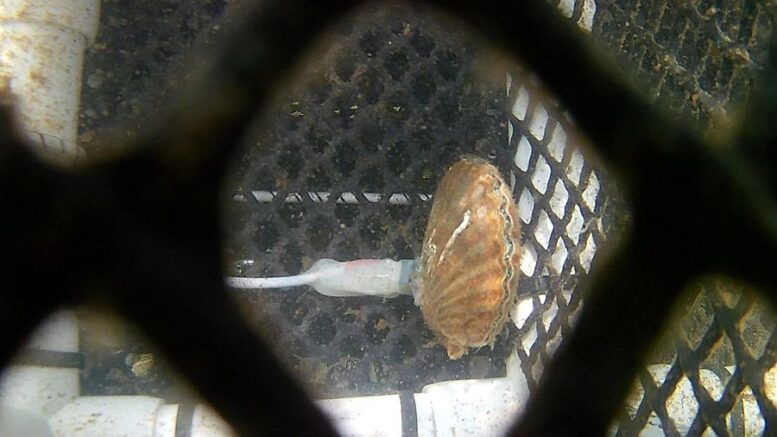
Researchers studied satellite-based temperature readings and long-term environmental records and conducted field and laboratory experiments – including measurements of scallop heartbeats, which vary according to water temperature – to determine that an eight-day summer heatwave and “repeated episodes of low oxygen” in the water caused a 2020 die-off at a specific Peconic Bay site.
Further investigations – in both natural and laboratory settings – confirmed that high-temperature, low-oxygen combinations reduce feeding and energy reserves in scallop populations, spiking mortality rates.
While coastal Massachusetts waters are still within safe temperature ranges, the team also demonstrated how warmer coastal waters are spreading north – and will soon bring the same fatal combination of high temperatures and impaired water quality to fisheries from New York to Massachusetts, threatening the nation’s entire northern bay scallop industry.
It’s happened before, according to Tomasetti, who references the collapse of the Long Island Sound lobster industry, the obliteration of blue mussel populations in Delaware’s coastal bays and other mass-mortality events in East Coast waters.
The destruction of the Peconic Bay scallop industry, he noted, should be a loud wakeup call to environmentalists, lawmakers and anyone who enjoys a dish of scallops oreganata.
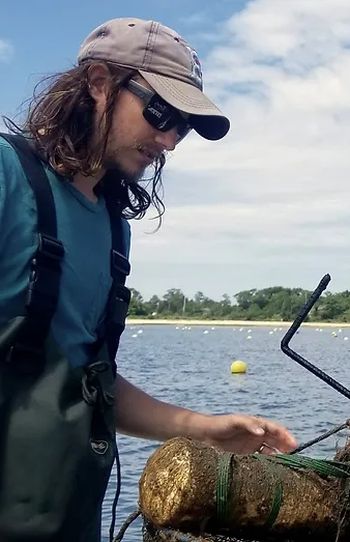
Stephen Tomasetti: Think global, act local.
“Commercial shellfisheries are a vital part of our blue economy, and shellfish habitats are changing rapidly,” Tomasetti said. “Mitigating further warming by transitioning to clean energy is critical.
“But while these global efforts are underway, committing to practices that will improve our local water quality – like reducing nutrient pollution – is also important.”
That message is resonating among lawmakers. Several Suffolk County legislators issued statements supporting the Peconic Bay research, including Leg. Al Krupski, whose district covers much of the Peconic Bay region and is “gratified that the marine science community … has pulled together to try to reestablish a sustainable scallop population.”
Legislator Bridget Fleming, meanwhile, called the research “crucial to not only helping our community restore a vital part of our economy … but [to] help develop a critically important understanding of how we can address climate change impacts to our environment and marine life.”
State Assemblyman Fred Thiele (D-Sag Harbor), who noted “our environment is our economy” on Eastern Long Island, lamented “yet another example of climate change’s extreme and adverse impacts across our region.”
“The repeated threat of scallop die-off in recent years … has become crippling to the commercial fishing community and all related East End industries and businesses,” Thiele said in a statement. “The scallop crop industry can only thrive with resources like clean water and efforts to combat climate change.”