On an island where grandiose project proposals (commercial/residential megalopolises, indoor ski mountains, etc.) come and go, Midway Crossing gives pause. Not for its projected price, which is considerable ($2.8 billion), nor its size, which is impressive (2.7 million square feet of tourism, entertainment and life-sciences development, which seems an unlikely combo, but stay tuned). Midway Crossing – a “Project of Regional Significance,” according to the HIA-LI, fully endorsed by the Long Island Association and the subject of the Long Island Business Development Council’s annual Town of Islip Dinner, held Wednesday in Bay Shore – transcends for three reasons, says Derek Trulson, a vice chairman of Chicago-based commercial real estate titan Jones Lang LaSalle: a brilliant development mix, a unique location on Town of Islip-owned land between a rejuvenated railroad and an expandable airport, and the unprecedented availability of public infrastructure-development funds. According to Trulson, who was well-received at Wednesday’s dinner, “Everyone believes now is the time to make this unique infrastructure investment.”

Derek Trulson: It all adds up at Midway Crossing.
Stars align: Midway Crossing is the opportunity of a lifetime for the entire Long Island community. It’s an opportunity to achieve the thing Long Island needs most, when we want to see more jobs and more housing and more economic growth to offset taxes.
Intermodal inspiration: The project is truly transformative, when you consider the intermodal opportunities of connecting a train and a plane. That’s one of the most important transit-oriented opportunities in the development world today. We’ve seen investments in this throughout the country and in our own state, with the JFK AirTrain and the Newark Airport AirTrain and a planned AirTrain for LaGuardia. These are all intermodal investments.
Leave the driving to us: We’re also moving cars off roads, which is the exact reason the [Metropolitan Transportation Authority] made its investments in the Long Island Rail Road, with the third track and East Side access. If you increase the capacity of the trains, you assume you’re taking cars off the road – this fully realizes that equation.
Commuter central: If we bring, say, 10,000 jobs to a site that’s a transportation hub, we believe the majority of those workers will come by train. There’s easy access to New York City, with improved frequency and the new East Side Access, and it’s easier for employees and travelers to get to and from the airport and to and from the city.
Runway hit: We believe the notion of including Long Island’s first convention center, including a hotel, is critical for several reasons, especially with a new (Long Island MacArthur Airport) North Terminal that we believe can become international. A new hotel and convention center creates leverage for new business travelers and more flights, and we think Suffolk County has done a good job right-sizing [the proposed convention center] for the market it will serve.
Life blood: We’ve also been fortunate to have local institutions become our partners early on, including Northwell Health and Applied DNA Sciences, which have both signed letters of intent. Applied DNA is the poster child of what life sciences can be and Northwell, obviously, is the biggest healthcare provider on Long Island, with substantial partnerships with med-tech companies and other health networks. Their involvement will also help bring forth other academic partners.
Great place to visit: Now start thinking about life-science tourism. Think about places like the Mayo Clinic – it’s right on top of an airport. If we can build out a life-sciences network that goes national and international, we think a hotel and convention center will play a big role in generating new business travel associated with these tenants.
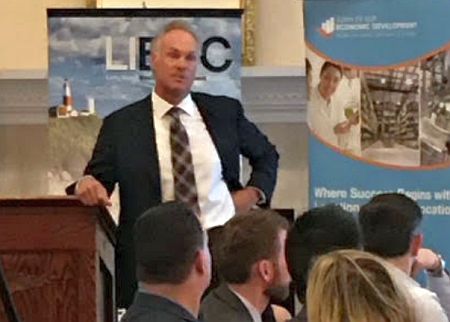
Supportive: Trulson (and Midway Crossing) were a big hit at Wednesday’s Town of Islip Dinner.
All aboard: We’re fortunate that the community of business leaders that care about the future of Long Island is 100 percent behind the project. And for good reason: It makes sense, it’s a good use of public dollars and, for the amount of money the public has to invest, compared to many other projects, it’s very manageable and appropriate. We believe this is a relatively affordable return on investment, in the form of economic-development returns and benefits for the environment.
Islip hospitality: I would say it was a fairly “pro” crowd (at the Town of Islip Dinner). When [Town Supervisor Angie Carpenter] originally invited me and I realized last year they had (JetBlue Airways Founder) David Neelemen, really an entrepreneurial pioneer, I said, “Angie, I can’t hold a candle to that guy!” But I do know that we have the most important project for Islip and Long Island, worthy of this audience’s attention.
Building toward something: We’re entering what I call the “building phase” – building consensus around a plan, building a legal structure that will allow the project to go forward. We need to determine how we will use private and public proceeds, and then we’ll submit an application to the Town of Islip. That will start the formal entitlement process, which will allow us to set a date for a shovel in the ground and set our entitlement rights – what can be built and when.
Big numbers: We’ve done a lot of math, and we project about 13,000 jobs and a $4 billion annual economic impact. And that doesn’t even include a new North Terminal, which we think could bring another $1.8 billion (in annual economic activity).
Slow, but steady: Development could last 10 to 15 years. It will be a phased approach that will take many years to realize its completion. But let’s say we get 50 percent done in five years … that’s $2 billion to $3 billion a year in economic impact, and that’s an excellent return on a modest public investment.
Already in progress: We have a unique situation where we have this town-owned land next to an airport that could be international, right on top of a railroad. We don’t have to move these things or create that infrastructure. They exist. And from a logistics perspective, the trains and the planes can keep going (during construction) … nothing has to stop.
If not now…: It’s logical to take advantage of infrastructure that’s already in place. There are a lot of public resources available right now that can support the project, including the infrastructure bill passed last year and New York’s environmental bond act. And we have a real project, with real partners, that’s built on Long Island’s life-sciences agenda – taking what’s already being done and realizing what this Long Island life-sciences corridor really can be. Now is the time for this community to take advantage of the available infrastructure investments and go get those resources.
Interview by Gregory Zeller