By GREGORY ZELLER //
Autism spectrum disorder affects different people in different ways – and for those with an “insistence on sameness,” the disorder’s effects on the sense of smell can be key.

New research from the New York Institute of Technology could help explain some of those effects, how they’re caused and how they can detract from quality of life – important findings for children with autism and other populations likely to steer clear of unfamiliar elements, such as new foods.
Published this week in the open-access, peer-reviewed science journal Nature Communications, a recent study led by Gonzalo Otazu, assistant professor of biomedical sciences in New York Tech’s Old Westbury-based College of Osteopathic Medicine, analyzes mouse models – one neurotypical cohort, one with a gene mutation linked to autism – to detect differences in the neurological processes responsible for smell.
In a nutshell, Otazu and his team trained the two groups to recognize familiar scents by rewarding them with sips of water, then upped the ante by having them identify the target scents with unfamiliar odors introduced in the background.
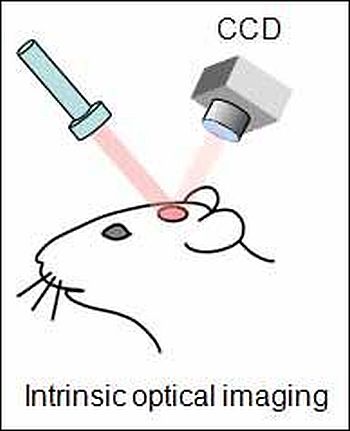
Inside edition: Give a mouse an intrinsic optical imaging scan…
Otazu – who earned a doctoral degree in electrical engineering from Japan’s Tohoku University before completing a postdoctoral fellowship at Cold Spring Harbor Laboratory – likened the process to Internet “captchas,” which require human users to visually identify symbols obscured by busy backgrounds.
While the neurotypical mice were able to “filter out” the unfamiliar odors and zero in on the target scent, the gene-mutation group struggled.
Using cutting-edge intrinsic optical imaging, researchers also digitally visualized neural activity in each animal’s olfactory bulb – a part of the brain that processes smell – and quickly determined the disconnect was occurring sometime after the sensory input reached the bulb.
These findings suggest that olfactory bulbs in the mouse models with the gene mutation “might be more easily overwhelmed by processing new background odors,” Otazu noted.
And that revelation, according to the researcher, creates a host of new questions – and new possibilities – for a scientific community largely focused on autism’s behavioral aspects.
“These findings illustrate why more studies related to the sensory aspect of autism are so important,” Otazu said. “By documenting the neural processes in the mouse model of autism, our findings may help to explain the brain circuitry of humans with autism and one day lead to advancements that improve these individuals’ quality of life.”