By TERRY LYNAM //
Debates rage across all economic sectors over the risks and rewards of artificial intelligence, and its growing influence on our lives.
 When it comes to AI and healthcare, there’s rampant skepticism among American consumers. A Pew Research Center survey released in February found that six out of 10 U.S. adults would feel uncomfortable if their healthcare provider relied on AI to help diagnose disease and recommend treatments, compared to 39 percent who’d be OK with it.
Despite ethical, privacy and security concerns about the use of AI in healthcare – and real worries about government’s ability to regulate it – there’s no debate that AI is already challenging the industry’s status quo, and forever changing the way providers view and use patient data.
For pancreatic cancer specialists Daniel King, a gastrointestinal medical oncologist based at the R.J. Zuckerberg Cancer Center Hospital, and Sandeep Nadella, a Northwell Health gastroenterologist and clinical fellow at Cold Spring Harbor Laboratory, the “aha moment” about the power of AI came while they struggled to recruit patients for a research study investigating the role of genetics in the increased incidence of colon, endometrial and pancreas cancers among Black populations.
King and Nadella ultimately realized they simply weren’t identifying eligible patients in the beginning stages of their diagnosis and treatment – and they needed to “think about how could we better capture these patients,” according to King, also director of research and development for the Northwell Health Cancer Institute’s Center for Genomic Medicine.

Terry Lynam: Defining AI’s role.
“We needed to capture them very early,” King notes. “That’s really hard.”
Specifically, for their clinical trial, they needed to identify potential candidates right after they underwent a pre-diagnostic biopsy. So, King began exploring electronic medical records, searching pre-biopsy records for consistent clinical features – “recurrent” features, King says, “which we could use to better identify patients.”
“Sure enough, I realized that before a biopsy, all patients get a scan, and that scan has a report,” the doctor adds. “And I was reading the reports, and they were saying, ‘mass,’ ‘lesion,’ ‘mass,’ ‘lesion.’”
The next challenge was creating a computational model to extract this data from hundreds of radiology reports. This is harder than it sounds – initial efforts did not work.
And then King remembered: “This is the birth of AI!” Could the specialists use artificial intelligence to search the records and identify the right terms?
Not only could they do it, King notes, but “it was easy.”
“‘Mass’ and ‘lesion’ are terms that a computer can easily extract,” he says. “You just need a computer to read hundreds of scans.
“Radiology reports can identify a mass with high accuracy, and masses in the pancreas are pancreatic cancers until proven otherwise.”
While their initial goal was to make it easier to recruit clinical-trial patients, King and Nadella soon realized their AI-enabled solution – which they dubbed iNAV – had much broader potential, including earlier detection and treatment of not only pancreatic cancer but colon, breast and other common cancers.
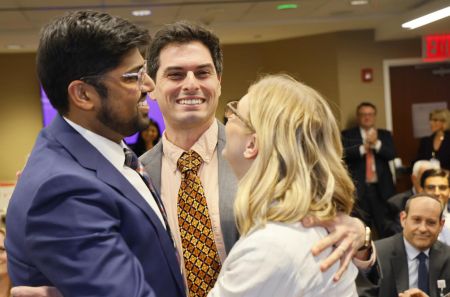
Natural intelligence: Nadella (left), King and Zavadesky (right) celebrate their Innovation Challenge win.
To help expand and commercialize iNAV, the doctors and Nurse Practitioner Tiffany Zavadsky – who heads Cancer Care Direct, Northwell’s new patient-navigation program – received a $500,000 award through the health system’s Sixth Annual Innovation Challenge.
In addition to improving outcomes by identifying cancer cases earlier and navigating pre-diagnosed and newly diagnosed patients into earlier care, iNAV – one of 84 teams applying for funding through the latest Innovation Challenge – has the potential to help health systems and hospitals retain patients who might otherwise seek care with another provider, referred to within the industry as “leakage.”
“Our go-to market plan is straightforward,” Nadella notes. “Revenue from successfully navigated patients will enable iNAV to grow beyond pancreatic cancer and Northwell, enabling eventually other healthcare systems access to our de-identified data streams.”
And all clarity that thanks to AI – even though AI’s place in healthcare, officially, is still quite unclear.
Terry Lynam is a communications consultant and former senior vice president/chief public relations officer for Northwell Health.