By GREGORY ZELLER //
After centuries of best guesses, science is closing in on an exact age for the known universe – and a research team featuring two Stony Brook University professors may have just nailed a precise birthdate.
 Give or take a thousand millennia. “Precise” is a big word in the science of universal expansion – essentially, the science of universal aging – with such vast distances and lengthy epochs in play.
But extrapolating data from a far-off supernova explosion detected in 2014 (including subsequent data gathered months later), researchers led by University of Minnesota Scientist Patrick Kelly – including SBU associate professors Simon Birrer and Anja von der Linden – may have precisely calculated the universal expansion rate.

Simon Birrer: Close enough.
Run that rate backwards, and you have a clock counting down to the Big Bang – and a fairly accurate estimate of the universe’s actual age.
This highly simplified explanation belies the difficulty of these calculations, the numerous scientific disciplines involved and the vast amounts of guesswork still shaping the numbers.
Prevailing schools of scientific thought estimate the age of our universe – that is, the time between the theoretical Big Bang and now – between 12.6 billion and 13.6 billion Earth years. In scientific terms, that 10 percent variance is horrifying; even just ballparking it, a billion years is a big gap.
Until now, one theoretical cosmologist’s guess was pretty much as good as the next. But leveraging several Hubble Space Telescope images of that distant supernova – and computing the changing position of the luminous, lingering explosion over a course of several months – Kelly et al calculated a universal expansion rate that could once-and-for-all settle longstanding debates on the universe’s precise age.
That 12.6 billion-to-13.6-billion-year range is based on two variations of the Hubble constant, which mandates a proportional constant between the velocities of remote galaxies and their distances.
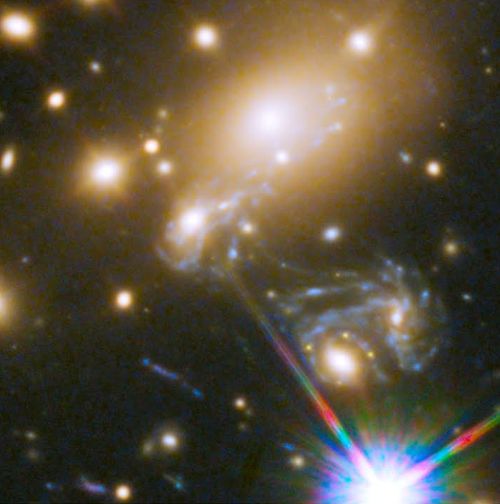
Faster than it looks: Time-lapse imagery shows Supernova Refsdal on the move through galaxy cluster MACS J1149.6+2223.
Named for pioneering American astronomer (and space-telescope namesake) Edwin Hubble, the “constant” comes in two flavors: one in which its “background inferred value” is based on cosmic microwaves (setting the universe’s age around 13.6 billion years) and one basing it on the cepheid-studying Cosmic Distance Ladder, which examines pulsating stars known as cepheids to estimate velocities over relatively shorter distances (and pegs the universe’s age closer to 12.6 billion years).
With von der Linden preparing the Hubble Space Telescope imaging and Birrer clearing small-scale dark matter and otherwise improving the imagery’s robustness, Kelly’s team used five different images from galaxy cluster MACS J1149.6+2223 showing the supernova’s changing position – four from 2014, one from 2015 – and calculated the Hubble constant to be consistent with the cosmic microwave inferred value.
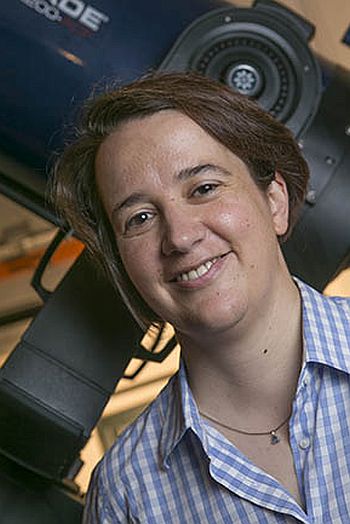
Anja von der Linden: Constant improvement.
The full study was published this month in the peer-reviewed journal Science. But while the work strongly suggests background cosmic microwaves set the universal speed limit – and our universe is on the older side of that backtracked Big Bang count-up – don’t synchronize your watches just yet, according to Birrer.
“The measurement of the expansion rate of the universe is a rollercoaster,” noted the assistant professor in SBU’s Department of Physics and Astronomy. “Our research corroborates a trend yet does not provide the last word on the expansion rate.”
Named for Sjur Refsdal – a Norwegian astrophysicist who first proposed using time-delayed supernova images to measure universal expansion back in 1964 – Supernova Refsdal is the first detected multiply lensed supernova.
Von der Linden, also an SBU Department of Physics and Astronomy associate professor who was part of the team that originally discovered the supernova almost a decade ago, called the University of Minnesota-led study “a great success of our cosmological model based on General Relativity and the mysterious dark matter.”
“These data have allowed multiple teams to further refine their models of how dark matter is distributed in galaxy clusters, yielding a precise measurement of the Hubble constant from a lensed supernova,” she added.