By ZELORY GREGLER //
There’s this unwritten journalism rule about not accepting gifts from the people you write about. In fact, I think it might be written.
 Either way, journalists regularly ignore it. Yes, politicians and corporations greasing reporters and networks is slimy, but I fondly remember the civic association president bringing home-baked cookies to the community-newspaper office, and that sun-splashed afternoon when the manufacturer sent a sample box of frozen-wine dessert thingies.
It happens. And when Dominic Coluccio sent me a thank-you package from his family’s Brooklyn-based Italian foods importer – well, momma didn’t raise no dummy.
Dominic was a guest on our podcast, discussing his role in the ongoing development of Samanea New York, Westbury’s former Mall at the Source. After the show, a box of goodies (and a handwritten thank-you note) arrived at my home, straight from D. Coluccio & Sons, a Bensonhurst cornerstone that’s been importing and distributing cheeses, pastas and other Italian staples for six decades.
Among the spoils was an impressive wedge of parmigiano Reggiano from Montanari & Gruzza, a dairy manufacturer in Reggio Emilia, Italy, and that’s important: Kraft can pump out “parmesan cheese,” but distinctly flavored parmigiano Reggiano comes only from certain Italian regions, including Bologna (west of the river Reno), Mantua (north of the river Po) and the northern city of Reggio Emilia.
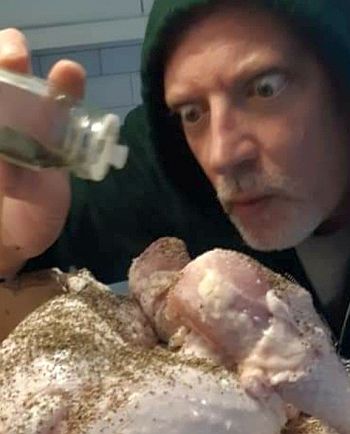
Zelory Gregler: Besto pesto.
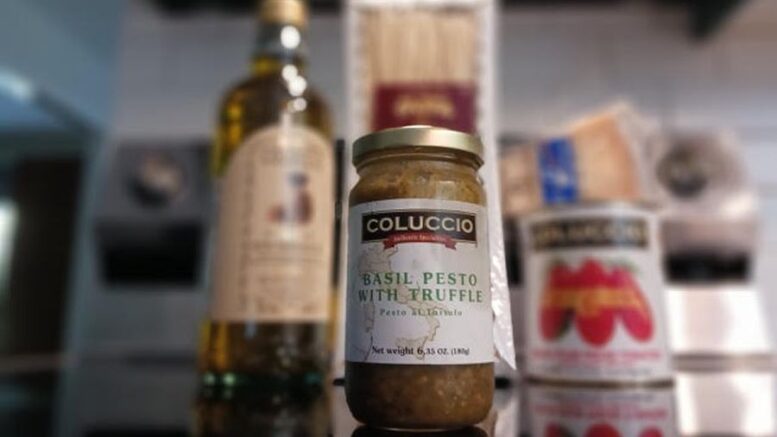
Also dazzling the senses: a pound-plus of uncooked La Bottega della Pasta spaghetti, manufactured in Italy’s Calabria region, and two family-label gems: an enormous can of densely packed Coluccio peeled plum tomatoes, and a quart of Coluccio Premium Select EVOO.
And tucked in the bottom of the box, the smallest and loveliest prize of all: 6.35 ounces of Coluccio Basil Pesto With Truffles.
Private label. Thick glass jar. A green hue suggesting lush vegetation and emeralds. Olive oil, cashews, pine nuts, sea salt and white truffle, traditionally blended in Borgo San Dalmazzo, a small commune in northwesternmost Italy, now here in my kitchen on Long Island.
Not only was this gastronomic treasure trove staying put, it required a special culinary effort.
This was way beyond Wednesday night meatloaf or even Sunday gravy (yeah, I said it). These international ingredients required a pièce de resistance, or however you say it in Italian.
The pesto, though … this was vexing. I’m a big fan, but lacking in cooking-with-pesto experience. The label said the green gold could survive, sealed, for a solid year – but once it was opened, it was seven days or bust.
No room for mistakes. Expert input required.
I start at the top: The Olive Garden website. With 800-plus domestic restaurants (including four on Long Island) and $4.5 billion in annual sales, the just-like-mama-used-to-make Italian chain has gotta know its pesto.
And it does: alfredo pesto sauce, pesto ravioli, linguine a pesto, Chicken Margherita (with pesto)…
Pestoverload! Further refinement required.
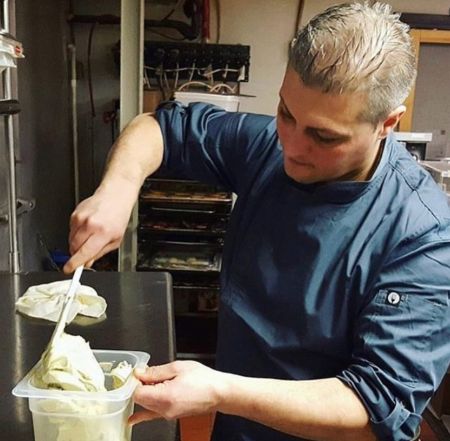
One more thing: Master chef Lino De Vivo saves his pesto for last.
At La Nonna Bella in Garden City, where pesto drizzles the white-wine mussels and the roasted salmon and shrimp swim in a pesto pool, chef and owner Lino De Vivo champions the traditional sauce because “it’s easy to incorporate in other dishes.”
Sometimes he brushes it on a bruschetta special, but his favorite is Trofie Al Pesto, which sauces up thin pasta twists, shrimp, potatoes and cherry tomatoes.
“The flavors…” De Vivo drifts for a second, like he’s tasting the trofie, and liking it. “…they blend so well together.”
Wherever my special sauce was going, the proud Pugliese from Southern Italy prized one pesto pointer above all others.
“To bring out the flavor, it has to be added at the very end, right before the dish goes out,” De Vivo says. “Otherwise, it begins to lose the flavor and the color.
“You don’t want to cook.”
At Orto – a wonderful, rustic gastronomical experience in Miller Place where gemelli pasta is topped with zucchini pesto and stracciatella (mozzarella cheese soaked in sweet cream), and you think maybe you never want to eat again, because why bother, food just peaked right there – chef and owner Eric Lomando likes to keep it real.
“You have people making some bizarre pesto,” he notes. “I really try to keep it more of a classic: olive oil, garlic, one or two herbs at the most, a single nut.
“Some people might take it further,” Lomando adds. “I’m a less-is-more type of person.”
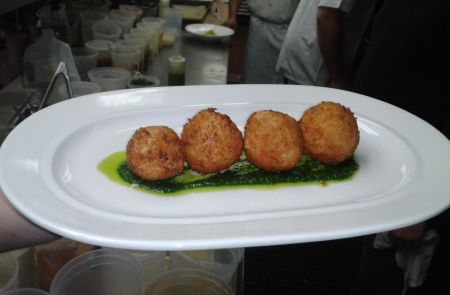
Pesto control: With his risotto balls (and in all other cases), master chef Eric Lomando prefers the real stuff (and real simple).
Lomando – who opened Orto in 2012 after a successful run operating two St. James restaurants – likes to rest his famous risotto balls on a bed of arugula-and-parsley pesto; in the spring, it’s a basil-and-broccoli pesto powering his seasonal vegetable ragu.
Whatever the season, though, the chef’s pesto MO is simple.
“Especially if you have quality ingredients,” Lomando says, “just let the ingredients speak for themselves.”
Definitely closing in now. Time for the big guns – my brother-in-law, Anthony, who grew up in Milan and cut his culinary teeth in the kitchen of his family’s Merrick pizzeria. As old-country as it gets. A pesto master for sure.
“Put it on a sandwich,” he says, through a mouthful of barbecue. “Turkey. Whatever.”
“Like … a condiment?”
“Yeah.”
That seemed anticlimactic, somehow, but it also got me to thinking about something else Anthony has told me, repeatedly, something great chefs like Lomando and De Vivo understand – a great secret of Italian cooking, and therefore all cooking.
Simplicity.
Ultimately, I sauteed those Coluccio tomatoes and some chopped onions in that Coluccio EVOO, boiled that pasta in saltwater and grated some of that fine cheese, ready to top it all off. Just before the tomatoes were done, I stirred in some generous tablespoons of pesto. And that was it.
Easy, delicious and worthy of the ingredients themselves.
As we ate, I glanced at Dominic’s note, magnetized to the fridge. A friendly, neatly handwritten thank-you on a blank card, as simple as it gets.
The pesto was great. But now I knew the real prize in that box.
Zelory “Celery” Gregler has been cooking for most of his life, and eating for all of it.