By TOM MARINER //
Long Island is the last place where you’d expect a question about whether Neil Armstrong really took a “giant leap for mankind” on the Moon, because so much of our aerospace history started here and remains here.
 But at a family dinner recently, a younger relative called the Moon landing a “hoax.”
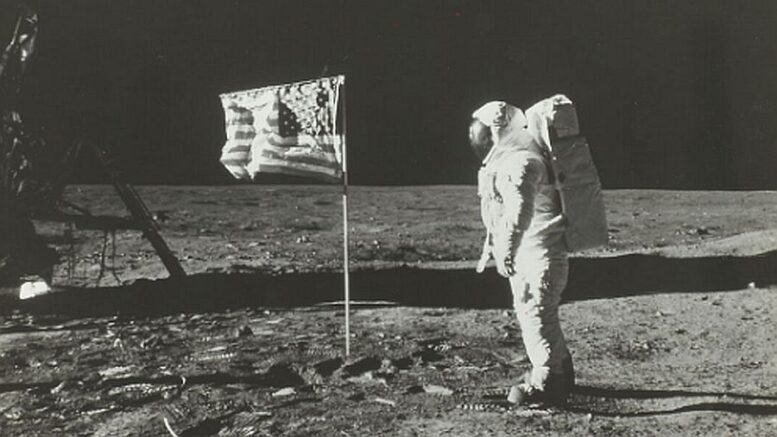
Partly born of our current obsession with conspiracy theories, tiny anomalies in the Apollo 11 mission have been repeated and repeated, until “we never went to the Moon” is now believed by 5 percent of the public. Evidence includes: the flag blowing straight in a nonexistent “Moon wind,” questions about who filmed Armstrong’s famous descent down the ladder, etc.

Tom Mariner: Man on the moon.
The Apollo journeys were energized on May 25, 1961, when President John F. Kennedy challenged the nation to put a man on the moon and return him safely to Earth before the end of the decade. The space race with Russia was on – but the leaders of domestic aerospace industry could only shake their heads. Eight years? That’s it?
Nevertheless, the world was glued to its televisions on July 16, 1969, when the Saturn V rocket carrying the Lunar Module blasted off on the Apollo 11 mission, and four days later, when the Eagle landed.
The Grumman Corp. of Long Island, of course, had won the contract to design, build and test that Lunar Module, which after a 240,000-mile journey would carry the astronauts from the orbiting Command Module to the Moon’s surface.
With its direct line through regional aerospace history, the Cradle of Aviation Museum and Education Center in Garden City seemed like a good place to validate the Apollo experience. At last week’s Manufacturing Day event, masterfully hosted by Cradle of Aviation President Andrew Parton, I started digging.
 Parton has been heading the museum for 18 years and his passion for STEM has bled into the Cradle’s mission and persona. He led me through a winding route of museum exhibits – carefully staged artifacts reflecting decades of Long Island-based aerospace engineering – to a room holding some real blasts from the past.
First up was Grumman’s first full-sized Lunar Excursion Module prototype, the LTA-1, round exit hatch and spindly legs and all. And then the star of the show: the last fully assembled Lunar Module, the LM13, intended for Apollo 19 but never flown.
The full-sized astronaut mannequin assigned to the LM13 had a square backpack, suggesting an actual engineering-design progression from the round-doored LTA-1 (hardly the mark of a made-for-Hollywood stage job). The open hatch to the left of the ladder, meanwhile, held a camera perfectly situated to record small steps for man.
The unfurled Moon flag? “Wires to hold the banner horizontal,” according to the Cradle.
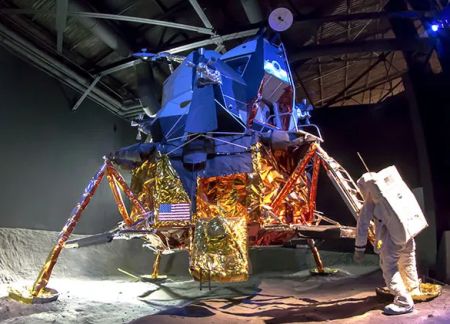
Almost there: The LM13 Lunar Module, denied a brilliant destiny.
Parton, whose museum reign began three years after the Lunar Module exhibit was dedicated, has expanded many exhibits and even added a planetarium. But his favorite Cradle moment, he says, was the celebration in the museum’s atrium on July 20, 2019, when 3,000 people came together to celebrate the 50th anniversary of the Apollo 11 Moon landing.
“We have more Apollo artifacts than even the Smithsonian,” Parton says, with a hint of a challenge in his voice. “Anyone who believes the landing was a hoax, pay us a visit and see for yourself.”
Tom Mariner is the executive director of Bayport-based Long Island Bio.