By JEFFREY L. REYNOLDS //
Tax season might seem like an inopportune time for government to ask for charitable contributions, but hundreds of thousands of New York State taxpayers have answered the call since 1984, checking a box on their personal tax returns and giving up part of their tax refund to support a favorite cause.
 Among the most popular charitable choices for state fiscal year 2022-2023 were breast cancer research and education, food banks, Alzheimer’s disease support services, organ donation outreach, veteran’s services and the Return a Gift to Wildlife Fund – the original tax form checkoff that debuted on New York’s tax forms exactly 40 years ago.
Tax form checkoffs are supposed to make giving to favored causes easier. But a January 2024 audit of New York’s program by New York State Comptroller Thomas DiNapoli suggests that a steady decline in tax-filer contributions – and almost $13.7 million in unspent funds left lying around in Albany – may be cause for concern.
In 1983-84, there were more than 344,000 contributors. But by 2022-23, the number of eligible checkoff options had ballooned to 34 – more than any other state in the nation – while the number of contributors dropped 63.4 percent, to only 218,400, according to DiNapoli’s report.

Jeffrey Reynolds: Checkoffs and balances.
Turns out that more choices might be diluting donations. And as DiNapoli points out, taxpayers are now required to file a separate “voluntary contributions” form with their returns in order to participate, whereas previously, a few checkoffs accounted for just one line on a taxpayer’s annual return.
Bills currently pending in the State Legislature seek to add even more checkoff options, including a new state vaccination awareness campaign fund, a rescued animals spay-and-neuter fund and a statewide horse retirement and rescue fund.
Meanwhile, the NYS Campaign Finance Fund checkoff, which went into effect in tax year 2021, bagged nearly a quarter of the $3.2 million in statewide 2022-2023 contributions – and none of those funds have been distributed, since there haven’t been any statewide elections since 2022. (That makes sense.)
But DiNapoli’s recent audit also found that over the last five fiscal years, less than half of the collected checkoff donations have been spent – and nearly $13.7 million donated by taxpayers has yet to be disbursed to causes that could use the help.
In the case of the Veterans Home Assistance Fund, where funds are supposed to be disbursed in equal amounts annually to five statewide veterans’ homes (including the Long Island Veterans Home at Stony Brook University), no disbursements have ever been made. According to DiNapoli’s 2024 audit, $363,714 is sitting in an unused account.
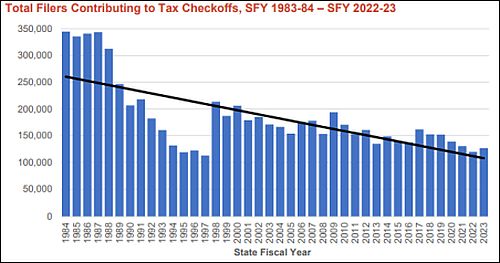
Checkoff drop-off: The number of New Yorkers utilizing the charitable checkoff option has declined significantly since it first appeared on state tax forms in 1984. (Source: New York State Department of Taxation and Finance)
Same goes for the Veteran’s Remembrance and Cemetery Maintenance and Operation Fund, where $1.5 million sits untouched; the Volunteer Firefighting and Emergency Services Recruitment and Retention Fund, where nearly $1.4 million has gone unused; and the Homeless Veterans Assistance Fund, where none of the $1.3 million collected from taxpayers has helped those who need it.
The biggest unused balances are $3.1 million for prostate cancer research, detection and education, and another $2.5 million for breast cancer research.
DiNapoli issued similar audits in 2021, when it was reported that $16.5 million in contributions were unspent, and in 2018, when $15.7 million stagnated with state agencies.
The lag in disbursements was supposed to have been addressed in 2015, when DiNapoli proposed legislation – sponsored by then-State Sen. Carl Marcellino (R-Syosset) and signed into law by then-Gov. Andrew Cuomo – that required tax return checkoff contributions be disbursed in the year they are received, “to the extent practicable.” The law also required state agencies to report back to lawmakers by Feb. 1 of each year.
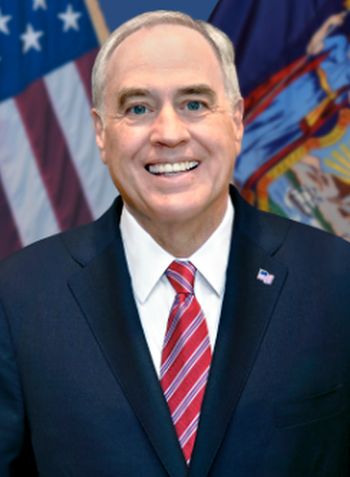
Thomas DiNapoli: Aggravating audits.
Since several departments still haven’t gotten around to getting donors’ money out the door, lawmakers should amend the law to remove the glaring “practicable” loophole and direct the state departments of Health and Education and Division of Homeland Security and Emergency Services, and all other state agencies to actually disburse all collected funds annually.
Then they should report publicly where the money went, how it was allocated and how the recipients spent the funds.
Lawmakers could also streamline the process by reducing the number of charitable choices. A three-year moratorium on new causes seems like a good idea, as does phasing out those that don’t bring in at least $200,000 per year. Adding a new cause or two annually would be a good way to gauge public support.
If those steps don’t turn things around, it might be time for state government to get out of the charitable-donation business. Instead, the state could fund a campaign that encourages donors to contribute directly to nonprofits in their own communities – maybe the best way to put generous donations to good use with urgency and transparency.
Jeffrey Reynolds is the president and CEO of the Garden City-based Family & Children’s Association.