
By GREGORY ZELLER //
Cultural barriers and mental-health stigmas among college students collide in a new study by a Long Island professor.
 Research led by Nayoung Kim, an assistant professor of psychology and counseling at the Old Westbury-based New York Institute of Technology, sheds new light on college-level cultural experiences – and attempts to break through obstacles students may face when seeking mental-health treatments, an exceedingly common higher-education occurrence.
The study, supported by a North Atlantic Region Association for Counselor Education research grant and published March 30 in the peer-reviewed Journal of College Student Mental Health, explores the different ways collegians of different racial backgrounds perceive and pursue mental-health treatments.
Kim and co-author Szu-Yu Chen – an associate professor at California’s Palo Alto University, where the focus is primarily on psychology and counseling – dive deep into data showing that mental-health challenges are a growing concern among all college students, with students of color “remaining an underserved and understudied group.”

Nayoung Kim: Deeper understandings.
These problems were exacerbated by the COVID-19 pandemic, which left students of color “particularly vulnerable,” according to New York Tech.
Kim and Chen analyzed survey responses from 747 U.S. college students – some collected before the pandemic, some after. In both evaluations, students were asked to identify their race (Caucasian/White, African American/Black, Hispanic/Latinx, Asian/Asian American, American Indian/Native American or Multiracial) and to assess how strongly they agreed or disagreed (one a 1 to 5 scale) with perceptions on various mental health-related topics.
Those topics included “self-stigma” (with respondents reacting to prompts such as “It would make me feel inferior to ask a therapist for help”), “public stigma” (with one prompt considering whether mental-health treatment would make people “think bad things of you”) and “perceived discrimination” (“People act like you are not as smart”).
The researchers employed Multivariate Analysis of Variance procedures, in which “dependent variables” are weighted against various interrelationships (for instance, how different kinds of automobile tires affect fuel efficiency in changing road conditions).
Among their key findings: Asian/Asian American students showed higher levels of self-stigma and public stigma compared to other racial groups, suggesting they may take longer to seek help for mental-health issues.
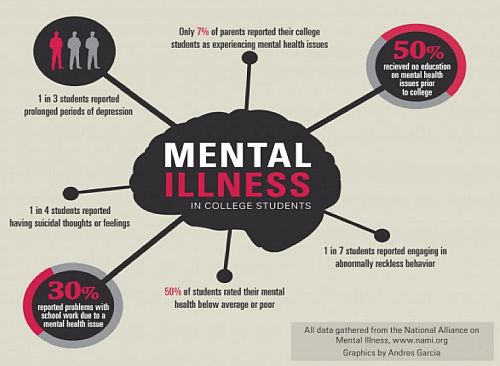
No idea: College students experience mental-health issues at a far greater rate than is generally known — including by their own families. (Source: The Center for Connection)
Other racial groups reported varying levels of stigmata and perceived discrimination.
There were some silver linings – for instance, college students across all races showed lower levels of self-stigma during the pandemic. But far from an improving environment, this suggests that increased mental-health awareness among all populations during the global health crisis reduced the shame associated with seeking mental-health treatment.
According to Kim, the study provides a worthy blueprint for higher-education administrators keen on educating campus communities about psychological distress and related stigmas – and could ultimately empower students who need mental-health assistance to seek it.
“Our findings are particularly helpful for college counseling centers,” noted the New York Tech professor, and those centers “could benefit by tailoring counseling services to provide support for racial and ethnic minority students.”
“With a deeper understanding of students’ cultural experiences, college counselors can also facilitate group counseling sessions that delve into the complexities of mental-health stigma,” Kim added. “[They can] create a safe and inclusive space where students can express their perspectives, acquire effective coping strategies and gain insights into the impact of that stigma.”